
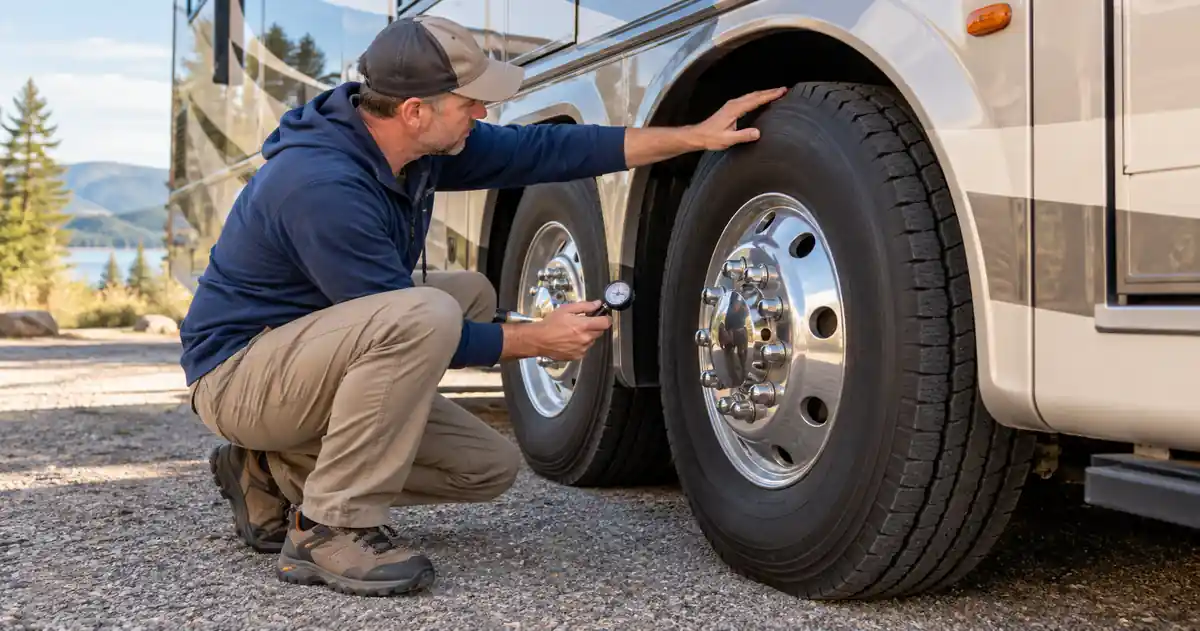
RV Camper Tires: How to Choose, Inspect and Replace Them
Choosing RV camper tires should start with the RV manufacturer’s tire specification, not a brand name or a tire that simply appears to be the same size. Match the correct application and required load capacity, understand the proper inflation method, inspect condition and age, and have a qualified tire professional review any proposed change in size, type, or load range.
That process applies whether you drive a motorhome or tow a travel trailer, but the details are not identical. Motorhome tires, Special Trailer tires, tow-vehicle tires, and commercial tires can follow different load and inflation guidance.
Table of Contents
RV Camper Tires: Start With the RV Type and Placard
Before shopping for RV camper tires, find the vehicle’s tire and loading information.
Depending on the RV, that information may appear on a certification label, tire placard, driver’s door area, interior wall, or near the trailer hitch. The owner’s manual or chassis manual may provide additional requirements.
Look for:
- Original tire size.
- Recommended cold inflation pressure.
- Gross Vehicle Weight Rating.
- Gross Axle Weight Ratings.
- Wheel or rim information.
- Cargo/load limits.
Do not rely only on the tire currently installed. A previous owner may have changed the specification.
Motorhome Tires
A motorhome is a powered vehicle, so tire selection must match the chassis and axle application. Large motorhomes may use commercial-style tires with single and dual load tables rather than the simpler tire specifications common on passenger vehicles.
For certain motorhome tire systems, manufacturers such as Michelin recommend weighing each axle end and using the heavier end of an axle to determine the appropriate pressure for all tires on that axle. The exact process depends on the tire and chassis guidance.
Travel Trailer and Fifth-Wheel Tires
Many travel trailers and fifth wheels are equipped with ST, or Special Trailer, tires. Goodyear states that ST tires are designed for non-driven trailer axle applications.
Trailer owners should start with the certification placard and the RV manufacturer’s tire requirements. Do not automatically apply a motorhome pressure calculation to a trailer or substitute a tow-vehicle tire recommendation for the trailer specification.
Tow-Vehicle Tires
The tires on the pickup or SUV are a separate system.
Trailer tongue weight or fifth-wheel pin weight becomes part of the load carried by the tow vehicle, so the truck’s tire, axle, payload, and inflation requirements still matter. Do not assume that upgrading the trailer tires solves an overloaded tow vehicle.
RV Camper Tires: How to Read Size, Load Range and DOT Code
The markings on RV camper tires help identify what is installed, but they need to be interpreted with the vehicle specification.
A tire size might include information such as:
- Application or tire type.
- Section width.
- Aspect ratio.
- Radial construction.
- Wheel diameter.
- Load index.
- Speed rating.
- Load range.
Do not use an example size from another RV as a shopping recommendation for yours.
Load Range vs. Load Index
Load range identifies a tire’s load and inflation category within its design. Load index is a numerical code corresponding to a defined load-carrying capacity.
Neither should be interpreted in isolation. A replacement tire needs enough capacity for the application while also fitting the approved wheel, size, pressure, clearance, and single or dual configuration.
Maximum Load and Maximum Pressure
The maximum load and pressure molded onto a tire sidewall describe tire limits. They are not automatically the pressure your RV should use.
NHTSA specifically directs vehicle owners to use the vehicle manufacturer’s recommended inflation pressure rather than simply inflating to the maximum number on the tire.
RV Tire DOT Date
The Tire Identification Number, commonly called the DOT or TIN code, identifies the tire and includes its manufacturing date.
For tires manufactured since 2000, the last four digits provide the week and year.
For example:
2325 = the 23rd week of 2025.
Check both sidewalls because the complete TIN/date code may be present on only one side.
Record the date for every tire, including the spare.
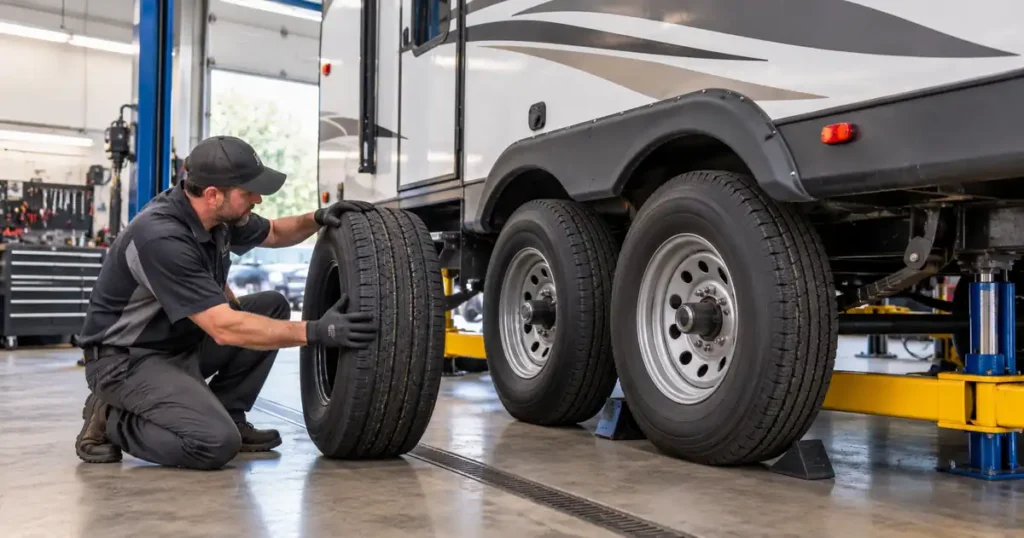
RV Camper Tires Pressure: Why Weight and Application Matter
There is no universal RV camper tires pressure that works for every motorhome or trailer.
Correct inflation depends on the vehicle, tire application, loading, and manufacturer guidance.
Motorhome Tire Pressure
For motorhomes using a load-table approach, loaded weight is important.
A useful process is:
- Load the RV as it normally travels.
- Include passengers, water, fuel, food, and equipment.
- Weigh the RV.
- Obtain individual axle-end weights when the tire/chassis manufacturer calls for them.
- Match the tire size and load to the manufacturer’s current load-and-inflation table.
- Use the heavier axle-end requirement for tires across that axle when instructed.
- Never exceed the wheel’s maximum pressure rating.
Michelin currently uses this axle-end method for its RV tire load-and-inflation tables.
Do not copy another motorhome owner’s PSI merely because the two RVs appear similar.
Travel Trailer Tire Pressure
For travel trailer tires, follow the trailer certification placard, owner’s manual, and tire manufacturer’s specific instructions.
Goodyear’s current ST guidance tells owners to check the trailer certification placard for its load limits and recommended cold inflation pressure, and to check pressure before trips.
Changing tire size or type may change the required pressure and should be reviewed professionally.
What Does Cold Tire Pressure Mean?
Tire pressure should be checked before heat generated by normal driving significantly raises the reading.
NHTSA describes a cold tire as one that has generally not been driven for at least three hours. Use an accurate gauge and follow the applicable manufacturer procedure.
Do not bleed air from a properly inflated hot tire simply because its pressure has risen during driving. Recheck it cold.
RV Tire Load Rating: Do Not Guess From Tire Size
Two RV camper tires with similar dimensions do not necessarily carry the same load.
Check:
- Tire size.
- Load range.
- Load index where used.
- Single or dual load rating.
- Required pressure.
- Wheel capacity.
- Axle rating.
The tire does not increase the RV’s GVWR or GAWR. Installing a higher-capacity tire cannot make an overloaded axle or vehicle legal or safe to operate.
Why Weighing the RV Matters
Your loaded RV can be very different from its empty configuration.
Load can include:
- Passengers.
- Fresh water.
- Fuel.
- Propane.
- Food.
- Camping equipment.
- Batteries.
- Accessories.
- Cargo.
- Trailer tongue or fifth-wheel pin weight where applicable.
USTMA’s RV guidance emphasizes staying within vehicle and tire load limits and notes that underinflation and overloading can generate excessive heat and internal tire damage.
Motorhomes can also be heavier on one side of an axle than the other, which is why individual wheel-position or axle-end weights can be useful when the tire manufacturer uses a weight-based inflation method.
RV Camper Tires Inspection Checklist
Inspect RV camper tires before trips and periodically during the travel season.
Check:
- Cold inflation pressure.
- Tread condition.
- Treadwear indicators.
- Sidewalls.
- Cracks.
- Cuts or scrapes.
- Bulges.
- Foreign objects.
- Penetrations.
- Uneven wear.
- Repeated pressure loss.
- Valve stems and caps.
- Visible damage after impacts.
- Clearance between dual tires.
- Spare-tire condition and pressure.
- DOT manufacturing date.
USTMA specifically recommends periodic professional inspection of RV tires, including the spare, and inspection before each travel season.
Stop and Get Professional Tire Service If You Find
Arrange professional evaluation rather than continuing normal travel when you find conditions such as:
- A sidewall bulge.
- Exposed cords.
- Significant cuts.
- Severe cracking.
- Unexplained repeated air loss.
- Suspected impact damage.
- Separation or deformation.
- New or unexplained vibration.
Goodyear’s ST guidance specifically calls for expert inspection after impact, penetrations, cracks, bulges, or air loss.
Avoid DIY mounting, dismounting, or structural repair of RV tires.
RV Camper Tires and Tread Depth
Tread wear matters, but tread is only one part of the replacement decision.
Check treadwear indicators and look for:
- Uneven shoulder wear.
- Center wear.
- Cupping or irregular patterns.
- Damage between grooves.
- Foreign objects.
Uneven wear can point to inflation, alignment, suspension, balance, or loading issues that should be addressed rather than simply covered up with a new tire.
Do not keep an RV tire in service solely because the tread still looks deep. Aging or structural damage can make replacement necessary long before the tread is fully worn.
When to Replace RV Camper Tires
There is no single universal replacement age for every RV camper tires application.
Replacement decisions should consider damage, tread, age, service conditions, and manufacturer guidance.
Damage or Condition
A tire may need immediate professional evaluation or replacement regardless of age when there is:
- A bulge.
- Structural damage.
- Exposed cord.
- Severe cracking.
- Unrepairable sidewall damage.
- Repeated unexplained pressure loss.
- Separation.
- Significant impact damage.
Tread Wear
Replace tires when they reach the applicable wear limits for the tire and vehicle.
Wear indicators provide a visible reference, but heavier commercial motorhomes can be subject to different axle-specific requirements than a small towable RV. Follow the applicable tire, vehicle, and legal requirements rather than applying one number to every RV.
Tire Age
NHTSA says tire aging is particularly relevant to low-mileage vehicles such as RVs. It notes that some vehicle and tire manufacturers recommend replacing tires between six and ten years old even when tread remains. NHTSA directs owners to the specific vehicle and tire manufacturer for the applicable recommendation.
USTMA similarly states that tire service life cannot be predicted from calendar age alone and recommends following specific manufacturer guidance.
Manufacturer-Specific Example
Michelin currently recommends that tires be professionally inspected at least annually after five years of service and replaced at ten years from the manufacturing date as a precaution, regardless of remaining tread.
That is a Michelin recommendation, not permission to apply the same schedule automatically to every other RV tire brand.
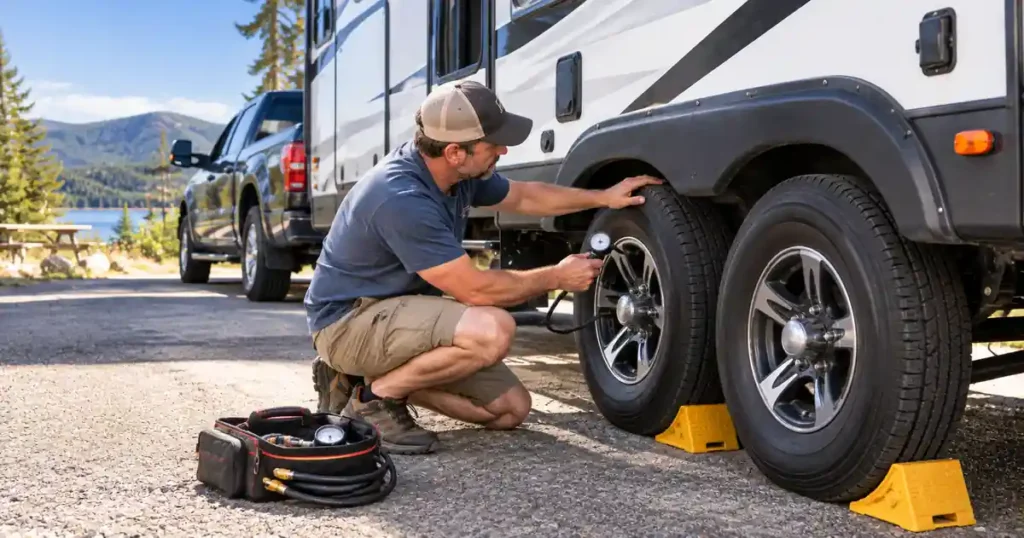
Does Sun and Storage Damage RV Tires?
Long storage periods can matter because RV camper tires may age while accumulating relatively few miles.
Tire aging is affected by a combination of:
- Heat.
- Sunlight and UV exposure.
- Ozone.
- Inflation.
- Loading.
- Storage conditions.
- Impacts.
- Road hazards.
- Time in service.
NHTSA specifically identifies low annual mileage, sunlight, warmer climates, poor storage, and poor maintenance as factors that can make tire aging more relevant.
Follow the tire manufacturer’s storage recommendations. Tire covers may reduce direct exposure when appropriate, but do not assume they guarantee a specific extension in service life.
How to Choose Replacement RV Camper Tires
Use a specification-first process when replacing RV camper tires:
- Photograph the RV tire placard or certification label.
- Record the current tire size and complete sidewall markings.
- Check the owner’s or chassis manual.
- Confirm the tire’s actual application.
- Confirm required load capacity.
- Check the wheel’s size and pressure rating.
- Confirm single or dual application where applicable.
- Verify physical clearance.
- Check the manufacturer’s current inflation guidance.
- Review tire age and service-life policy.
- Have fitment confirmed by a qualified tire professional before changing specifications.
USTMA advises replacement tires to meet the size, load index, and speed-rating requirements specified by the vehicle or tire manufacturer and says a replacement should not have less load-carrying capacity than the original specification.
Goodyear similarly warns that changing tire size or type can affect vehicle handling and recommends professional fitment when moving away from the original equipment specification.
Can You Upgrade the RV Tire Load Range?
Sometimes a different approved tire specification can be suitable, but a higher load range by itself is not automatically an upgrade.
A change can affect:
- Required inflation pressure.
- Wheel pressure capacity.
- Approved rim width.
- Overall tire diameter.
- Section width.
- Wheel-well clearance.
- Dual-tire spacing.
- Ride and handling.
- Load-table values.
The higher load capacity printed on a replacement tire does not increase the axle rating or GVWR.
If you want to change tire size, type, or load range, have the RV/chassis specification and wheel limits reviewed by a knowledgeable tire professional.
Travel Trailer Tires vs. Motorhome Tires
| Issue | Travel trailer | Motorhome |
|---|---|---|
| Vehicle type | Towed, non-driven axles | Powered vehicle |
| Common tire type | ST where specified by manufacturer | LT or commercial/chassis-specific designs |
| Inflation starting point | Trailer placard and tire guidance | Chassis guidance and applicable tire load data |
| Loaded weight | Must remain within trailer, axle, wheel, and tire ratings | Axle-end weights can be especially useful for load-table systems |
| Replacement | Match trailer requirements | Match chassis/RV requirements |
The table is a planning summary, not a substitute for your specific placard and tire documentation.
Do You Need an RV Tire Pressure Monitoring System?
A TPMS can be valuable because it may alert the driver to pressure loss—and, depending on the system, temperature changes—while traveling.
It does not replace:
- Manual cold-pressure checks.
- Sidewall inspection.
- Tread inspection.
- Tire-age checks.
- Load calculations.
- Professional evaluation.
NHTSA also notes that TPMS warnings do not replace routine manual pressure checks.
For towable RVs, industry standards are also changing: the RV Industry Association approved a requirement in March 2026 for TPMS on towable RVs under 26,000 lb GVWR beginning with each manufacturer’s model-year 2028 production. Implementation begins during calendar year 2027 as manufacturers transition to model-year 2028 units.
Common RV Tire Buying and Maintenance Mistakes
Avoid these RV camper tires mistakes:
- Buying by size alone.
- Assuming a higher load range is always better.
- Treating sidewall maximum pressure as the correct operating PSI.
- Copying tire pressure from another RV owner.
- Ignoring loaded RV weight.
- Exceeding axle or vehicle ratings.
- Ignoring wheel pressure capacity.
- Forgetting the spare.
- Judging tire life only from tread depth.
- Ignoring an old DOT date because mileage is low.
- Mixing incompatible tires in dual assemblies.
- Continuing to drive on unexplained pressure loss.
- Assuming TPMS proves an aging tire is structurally sound.
- Changing tire type without professional fitment review.
The safest shopping process starts with the RV, not with a tire-brand list.
Pre-Trip RV Camper Tires Checklist
Before a camping road trip:
- Confirm the placard specification.
- Check all pressures cold.
- Inspect sidewalls.
- Inspect tread.
- Check the spare.
- Check valve stems.
- Record DOT dates.
- Confirm the TPMS is functioning if equipped.
- Investigate abnormal pressure loss.
- Make sure the loaded RV remains within applicable limits.
- Arrange professional inspection if anything looks questionable.
You can include tire checks in your road trip preparation along with route, fuel, campground, and roadside planning.
If you are preparing the whole motorhome for summer travel, it may also be useful to check other RV systems before a hot-weather trip.
Frequently Asked Questions
How do I know what RV camper tires I need?
Start with the RV certification label, tire placard, and owner’s or chassis manual. Match the required application, tire size, load capacity, inflation requirements, and wheel compatibility. If you want to change size, tire type, or load range, have the proposed replacement checked by a qualified tire professional.
What tire pressure should I use on my RV?
There is no universal RV pressure. Travel trailers commonly follow the cold pressure specified on their certification placard and tire guidance. Some motorhome tire systems use actual loaded axle-end weights and manufacturer load-and-inflation tables. Do not automatically use the maximum pressure molded into the tire sidewall.
How do I read an RV tire DOT date?
Find the complete DOT Tire Identification Number and look at its final four digits. The first two give the manufacturing week and the last two the year. For example, 2325 means the tire was manufactured during the 23rd week of 2025. Check both sidewalls if you cannot see the complete code.
When should RV tires be replaced?
Replace RV tires when wear, structural damage, cracking, pressure loss, or other condition requires it, and follow the specific tire and vehicle manufacturer’s age guidance. NHTSA notes that some manufacturers recommend replacement between six and ten years, but there is no single universal replacement age for every RV tire.
Can I replace my RV tires with a higher load range?
Possibly, but higher load range alone does not make a tire a safe upgrade. The replacement must still fit the wheel, pressure limit, approved rim width, physical clearance, axle application, and RV manufacturer’s requirements. Changing specifications should be reviewed professionally.
Conclusion
RV camper tires should be selected from the RV’s actual requirements rather than from a generic brand recommendation. Start with the placard and manual, confirm the loaded application, understand the sidewall and DOT code, check pressure correctly, and inspect every tire—including the spare.
When replacement is needed, preserve the required load capacity and fitment rather than assuming a higher load range or maximum sidewall pressure is better. Record your current specifications before shopping and take them to a qualified tire professional if anything about the replacement differs from the original setup.
References:
- NHTSA — Tire Safety Ratings and Awareness / TireWise. Used to verify recommended-pressure guidance, cold-pressure checks, DOT manufacturing-date interpretation, spare-tire aging, tire-aging context, and TPMS limitations. NHTSA TireWise NHTSA
- Michelin Commercial Tires — RV Tire Load and Inflation Tables. Used to verify axle-end weighing, use of the heavier axle-end load, single/dual terminology, and the instruction not to exceed the wheel’s pressure limit. Michelin RV Load and Inflation Tables Michelin Commercial Tires
- Goodyear — Special Trailer Tire Guidance. Used to verify ST tire application, trailer placard guidance, cold-pressure checks, inspection triggers, replacement load-capacity requirements, and professional review when changing size or type. Goodyear
- U.S. Tire Manufacturers Association — Care and Service of Passenger and Light Truck Tires, Recreational Vehicle Applications. Used to verify RV placard information, load and inflation considerations, RV inspection guidance, spare-tire inspection, service-life principles, and loaded RV considerations. USTMA
- U.S. Tire Manufacturers Association — Replacing Tires. Used to verify replacement size/load guidance and the instruction not to install tires with less load-carrying capacity than specified. USTMA Replacing Tires USTMA
- Michelin USA — When to Replace Tires. Used as one manufacturer-specific example of annual professional inspection after five years and the precautionary ten-year replacement recommendation. Michelin When to Replace Tires Michelin
- RV Industry Association — RV Industry Association Board of Directors Approves Program Requirement Addressing Tire Pressure Monitoring Systems. Used to verify the March 10, 2026 decision and model-year 2028 TPMS requirement for qualifying towable RV production. RVIA TPMS Requirement Announcement