
RV Camper AC Repair: Troubleshooting Before You Call a Technician
RV camper AC repair should begin with a few safe checks, not with opening electrical compartments or assuming the refrigerant is low. Before calling for service, confirm the thermostat setting, shore or generator power, the accessible breaker, return-air filter, open vents, visible frost, and whether extreme outdoor heat is overwhelming an otherwise operating unit.
This guide covers coach and rooftop RV air conditioning rather than automotive dashboard AC. The goal is to help you decide what you can reasonably inspect yourself, when RV camper AC repair needs professional diagnosis, and whether repair or replacement deserves discussion.
Table of Contents
RV Camper AC Repair: Start With the Safe Checks
A useful RV camper AC repair process starts by identifying the exact unit. Rooftop systems do not all use the same thermostat, control board, fuse arrangement, refrigerant, or reset procedure.
Identify the AC Model First
Find the:
- Manufacturer.
- Model number.
- Serial number.
- Ducted or non-ducted configuration, if known.
- Thermostat or ceiling-control model.
Use the manual for that model rather than assuming that instructions for another Dometic, Coleman-Mach, Furrion, GE, or other rooftop unit also apply to yours.
Having the model and serial number ready also makes a later service call more useful.
Confirm the Thermostat Is Calling for Cooling
Check the controls you normally use:
- Set the operating mode to Cool.
- Set the target temperature below the current interior temperature.
- Check the selected fan setting.
- Confirm the thermostat display has power.
- Replace thermostat batteries only if your specific model uses them.
Avoid generic thermostat reset combinations found online unless they are documented for your exact controller.
Confirm Shore Power or Generator Power
If the entire AC appears dead, make sure the RV is connected to the intended power source.
Dometic’s current troubleshooting guidance begins with basics such as checking the shore-power connection and confirming that relevant breakers or fuses have not tripped.
If the problem occurs only on generator power or only on shore power, record that. It is useful diagnostic information because the AC itself may not be the only possible source of the problem.
Do not remove electrical junction-box covers or perform live 120-volt measurements as a beginner troubleshooting step.
Check the Accessible Breaker and Fuse Information
If your RV or AC manual identifies a user-accessible breaker, check its normal position.
A one-time reset may restore operation after an isolated trip. If the breaker trips again, stop resetting it.
Repeated trips can point to a problem involving the power supply, wiring, fan motor, compressor, or another electrical component. Installing a larger breaker or bypassing the protection is not a valid RV camper AC repair method.
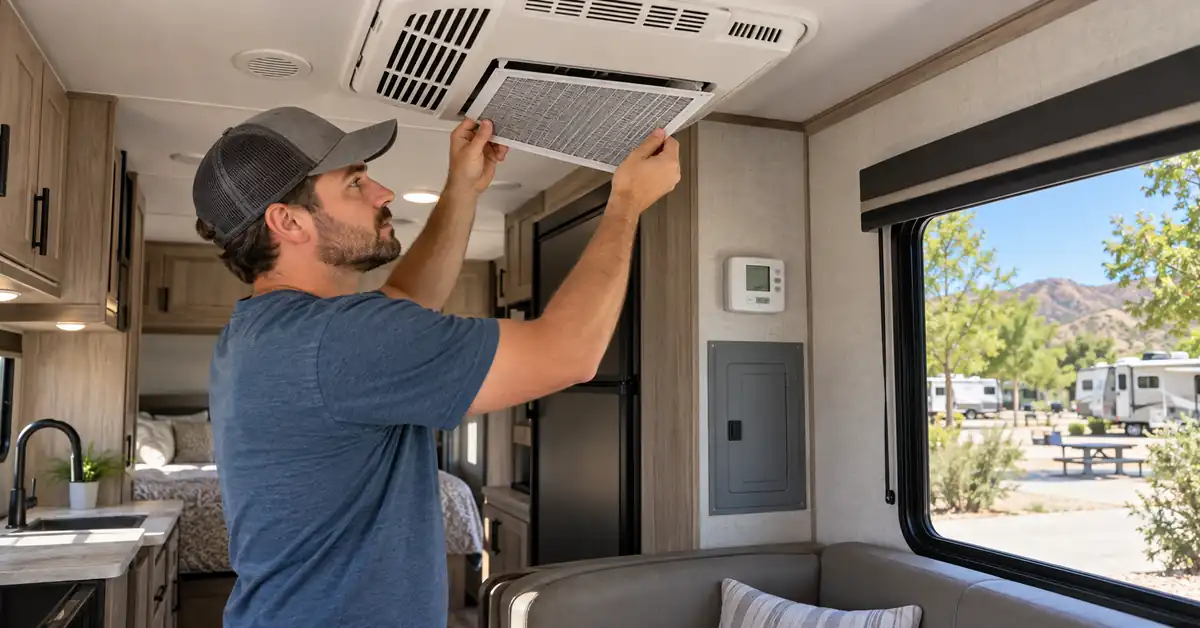
Inspect the Return-Air Filter
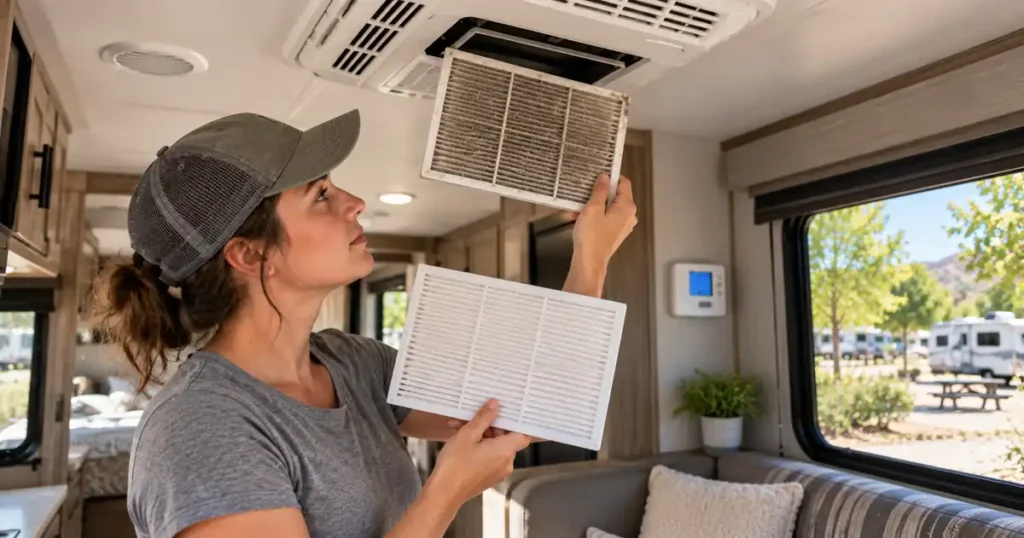
A dirty filter is one of the simplest problems to correct during RV camper AC repair.
Restricted return airflow can reduce cooling performance and contribute to evaporator-coil icing. Dometic documentation for some current rooftop models calls for periodic filter cleaning, with certain models specifying at least every two weeks of operation. The correct interval still depends on the model.
Coleman-Mach similarly advises cleaning or replacing filters as needed.
For a washable filter:
- Remove it according to the manual.
- Clean it using the approved method.
- Allow it to dry completely.
- Reinstall it before running the unit.
Do not run an AC without its required return-air filter simply to increase airflow.
Check Vents and Airflow
Make sure supply vents are open and that bedding, storage bins, clothing, or other objects are not blocking the return-air grille.
Pay attention to what you feel:
- Strong airflow that is not cool.
- Weak airflow from every vent.
- Good airflow from some vents but not others.
- Airflow that decreases as ice develops.
Those are more useful observations for a technician than simply reporting that “the AC doesn’t work.”
Look for Visible Frost
Dometic says that frost can form on an evaporator under some operating conditions. Its Brisk guidance recommends checking the filter and ensuring vents are open. If frosting occurs, Fan Only can be used to clear the ice before normal cooling is resumed; persistent frosting should be referred for service.
Limit this check to what you can safely observe through the normal interior return-air opening. Do not dismantle the rooftop assembly to look for ice.
RV Camper AC Repair for Common Symptoms
The same RV camper AC repair checklist should not be applied blindly to every fault. Start with what the unit is actually doing.
| Symptom | Safe Checks First | When Service Becomes Likely |
|---|---|---|
| AC will not start | Thermostat, power source, accessible breaker/fuse | Internal wiring, controls, compressor |
| Fan runs but air stays warm | Filter, vents, frost, heat load | Compressor or refrigeration fault |
| Weak airflow | Filter, return grille, supply vents | Blower motor or internal duct problem |
| Repeated freezing | Airflow, filter, vents | Sensor, motor, control or refrigeration diagnosis |
| Breaker trips again | Stop after normal user check | Electrical or compressor diagnosis |
| Water inside RV | Operating conditions, visible condensation | Drainage, roof seal or installation problem |
| Burning smell or severe noise | Shut the AC off | Professional diagnosis |
The AC Will Not Turn On
Start with the thermostat, normal power connection, accessible breaker, and any owner-serviceable fuse specifically identified in the manual.
Dometic troubleshooting for a no-operation condition includes checking that power is connected and that breakers or fuses have not tripped. Its deeper diagnostic process then moves into voltage measurements and internal electrical components—exactly where beginner troubleshooting should stop.
If all normal owner checks are correct and the unit remains dead, professional diagnosis may be needed.
The RV AC Runs but Does Not Cool
This is one of the most common reasons owners look for camper AC repair, but warm air does not automatically prove the compressor has failed.
Check:
- Filter condition.
- Return airflow.
- Open supply vents.
- Visible frost.
- Closed windows and doors.
- Direct sun exposure.
- Outdoor temperature and humidity.
- Heat-producing appliances inside the RV.
Dometic notes that the ability of an RV air conditioner to maintain the desired temperature depends partly on heat gain. Its recommendations include parking in shade, using window coverings, keeping doors and windows closed, reducing heat-producing appliances, and starting the AC before the interior becomes severely heat-soaked.
If airflow is normal but the unit still produces little useful cooling under reasonable conditions, a technician may need to diagnose the compressor, controls, or refrigeration circuit.
The RV AC Fan Is Not Working
Confirm that the thermostat or ceiling control is in a mode that should operate the fan and that normal power is available.
If the fan still does not run, avoid guessing that the fan motor itself has failed. Depending on the system, the fault can involve the motor, controls, wiring, capacitor, power supply, or another component.
That makes persistent fan failure a reasonable point to move from basic RV camper AC repair checks to professional diagnosis.
The Coil Keeps Freezing
Correct simple airflow problems first:
- Clean the filter.
- Open vents.
- Remove return-air obstructions.
- Allow existing ice to clear according to the manufacturer’s instructions.
If icing returns after basic airflow problems are corrected, the cause may require inspection of the blower, controls, sensor system, or refrigeration circuit.
Persistent icing is not a reason to start adding refrigerant yourself.
Water Is Dripping Inside the RV
Interior water can have several causes.
Possible sources include:
- Condensation.
- Drainage problems.
- Roof sealing.
- Installation issues.
- Rain intrusion.
- An internal AC problem.
Do not assume every drip is simply a clogged AC drain.
If water persists or appears during rain, have the roof opening and AC installation evaluated before moisture creates additional damage.
The Breaker Keeps Tripping
A repeated breaker trip is a stop condition.
A normal one-time reset may be reasonable when allowed by the manual. Repeatedly resetting a breaker is not a repair and repeatedly energizes a circuit that may have a real fault.
Do not install a larger breaker as a workaround.
There Is a Burning Smell or Severe Mechanical Noise
Turn the unit off.
A burning or electrical odor, melted material, sparking, or severe grinding or impact noise is not something to monitor while the AC continues running.
At that point, RV camper AC repair should move directly to professional diagnosis.
Why RV Camper AC Repair Sometimes Starts With Heat Gain
Not every uncomfortable RV has a broken air conditioner.
RVs can gain substantial heat through windows, walls, the roof, direct sunlight, frequent door opening, and appliances operating inside.
Dometic specifically recommends shade, blinds or curtains, closed doors and windows, reducing heat-producing appliances, and starting the AC earlier in the day to reduce the load on the cooling system.
This distinction matters during RV camper AC repair diagnosis.
An AC that produces cool air but struggles during an extremely hot afternoon in direct sun is different from a unit that fails to provide meaningful cooling under moderate conditions.
Avoid using one generic temperature-drop number from the internet as proof that every rooftop AC is good or bad unless your manufacturer’s service information specifies that test for your model.
What Not to Do During RV Camper AC Repair
Safe troubleshooting includes knowing where to stop.
Do not:
- Open energized electrical compartments.
- Probe live 120-volt circuits without proper qualifications.
- Test or discharge capacitors using a generic video.
- Bypass breakers or fuses.
- Bypass thermostats or freeze sensors.
- Add refrigerant because the air feels warm.
- Attach gauges or open refrigerant lines without the required training and certification.
- Pressure-wash condenser coils.
- Climb onto a wet, damaged, steep, or unstable RV roof.
- Keep resetting a breaker that repeatedly trips.
- Continue operating an AC that smells burned or shows overheated wiring.
Coleman-Mach states that its RV air conditioners use a closed and sealed refrigeration system that ideally should not require routine refrigerant recharging. If low refrigerant is suspected, the company recommends having the unit evaluated by a qualified service technician.
Coleman-Mach also says condenser-coil maintenance should be performed with all vehicle and AC power disconnected and specifically warns against using a pressure washer.
In the United States, EPA Section 608 requires technician certification for covered service that can reasonably be expected to release refrigerant. EPA specifically includes attaching or removing gauges, adding or removing refrigerant, and other work that compromises the refrigerant circuit.
RV Camper AC Repair: When to Stop Troubleshooting and Call a Technician
RV camper AC repair should move to professional service when the remaining work involves internal electrical diagnosis, the refrigeration system, hazardous stored electrical energy, rotating components, or unsafe roof access.
Call a qualified technician when you have:
- Repeated breaker trips.
- A burning or electrical odor.
- Melted or overheated wiring.
- Persistent fan failure.
- Persistent icing after airflow corrections.
- Suspected compressor failure.
- Suspected refrigerant leak.
- An internal control fault.
- Significant water intrusion.
- Roof damage around the AC.
- An AC you cannot safely access.
- Warranty work requiring an authorized provider.
Refrigerant Is Not the Next Beginner Step
An RV AC that does not cool is not automatically “low on Freon.”
For Coleman-Mach systems, the manufacturer describes the refrigerant circuit as closed and sealed and says it should not normally need refrigerant added. Suspected low charge should be professionally evaluated.
In the U.S., EPA certification requirements apply to technicians performing covered service that opens or otherwise compromises the refrigerant circuit.
The useful next question is therefore not “How do I recharge it?” but “What diagnosis shows that the sealed system is actually the problem?”
Capacitors and Internal High-Voltage Parts Are Outside This Guide
Capacitors can retain hazardous electrical energy even when normal power has been disconnected.
This guide intentionally stops before capacitor testing, control-box diagnosis, compressor measurements, and live-voltage testing.
The safe owner-level goal is to identify whether the problem remains outside or has moved inside the equipment.
Mobile RV AC Repair or a Service Center?
Once RV camper AC repair needs professional help, you have to choose how the RV will be serviced.
Mobile RV AC Repair
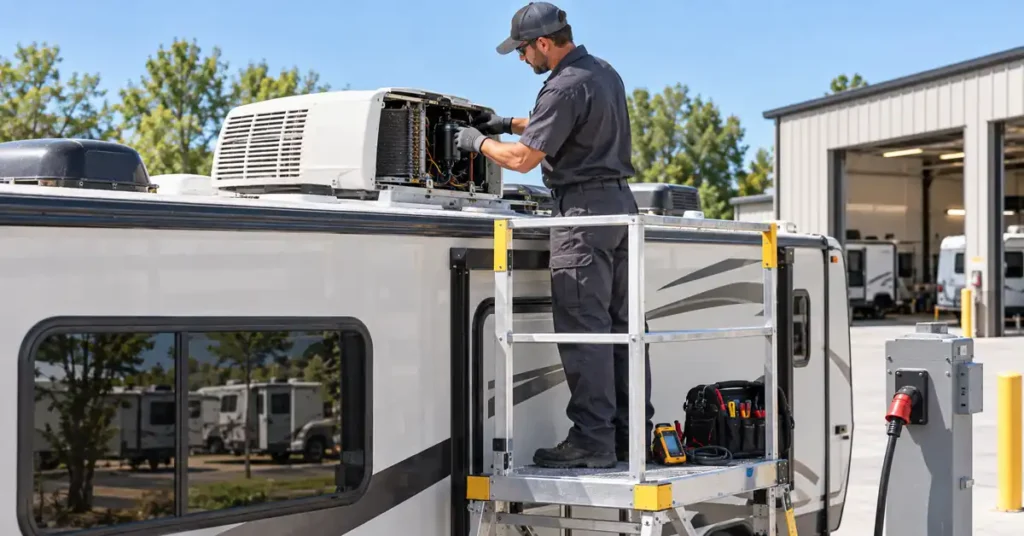
A mobile technician can be useful when:
- The RV is already set up at a campground.
- Moving a large rig is difficult.
- The campground allows outside service providers.
- The likely diagnosis can be performed onsite.
Before booking, ask about:
- Service-call or travel fee.
- Diagnostic fee.
- Service radius.
- AC brands supported.
- Whether roof work can be performed at your location.
- How parts ordering is handled.
A mobile technician may still need to order a component or refer major work to a shop.
RV Service Center
A service center can make more sense when:
- Warranty authorization matters.
- The rooftop unit needs to be removed or replaced.
- Significant roof work is required.
- More extensive diagnostic equipment is needed.
- The repair requires parts that a mobile technician does not carry.
Coleman-Mach maintains an official service-center and dealer locator. Dometic currently provides dedicated U.S. support for RV and van products, including air conditioners.
How to Choose an RV AC Technician
Do not choose a service provider only because they can arrive first.
Ask:
- Do you regularly diagnose rooftop RV air conditioners?
- Do you service this manufacturer and model?
- Are you manufacturer-authorized if my warranty requires it?
- What is the diagnostic fee?
- Is there an additional mobile travel charge?
- Will I receive a written estimate before major work?
- What warranty applies to the repair?
- If refrigerant-circuit work is required, is the person doing it appropriately EPA Section 608 certified?
- Can you quote repair and replacement separately?
The RV Technical Institute currently provides a searchable directory of businesses with RVTI-certified technicians. RVTI certification is not a legal requirement for every RV repair, but it is one useful qualification when comparing service providers.
RV Camper AC Repair or Replacement?
RV camper AC repair is not automatically the cheapest or smartest choice, and replacement should not be based on age alone.
Repair May Make More Sense When
Repair can be reasonable when:
- The problem is isolated.
- The needed parts remain available.
- Warranty coverage applies.
- The written repair estimate is modest relative to replacement.
- There is no history of repeated major failures.
- The roof opening and installation remain in good condition.
Replacement Deserves Discussion When
Ask for a replacement quote when:
- A compressor or sealed-system failure would be expensive to address.
- Several major components are failing.
- Important parts are discontinued.
- The unit has repeated breakdowns.
- Physical or water damage affects the rooftop assembly.
- A compatible current replacement has better ongoing parts or service support.
Do not use a universal “replace after X years” rule. Diagnosis, condition, parts availability, warranty, compatibility, and actual local estimates matter more.
If temporary or supplemental cooling might make more sense while you decide what to do with the rooftop unit, our portable AC for camping guide explains which portable systems are realistic for tents, vans, and smaller RV spaces.
RV Camper AC Repair and Preventive Maintenance
Basic maintenance cannot prevent every component failure, but it can reduce airflow-related problems and make RV camper AC repair less likely to begin with a severely neglected filter or condenser.
Keep the Filter Clean
Dometic manuals for some rooftop units specify cleaning the return-air filter periodically or at least every two weeks during operation. Other systems have different schedules, so use the manual for the actual model.
Keep Exterior Airflow Clear
Coleman-Mach recommends cleaning the outside condenser coil at least annually, gently removing debris, and correcting bent fins as appropriate. It says to disconnect all power before maintenance and not to pressure-wash the coil.
If you cannot safely access the RV roof, make exterior maintenance a technician task.
Test Before a Hot-Weather Trip
Before leaving for a long trip:
- Run the AC on its normal power source.
- Confirm the thermostat responds normally.
- Check the filter.
- Open and inspect the normal vents.
- Look for old moisture stains around the ceiling assembly.
- Listen for new noises.
- Note any abnormal breaker behavior.
Finding a problem at home is easier than beginning RV camper AC repair after arriving at a campground during peak summer heat.
Before You Call: Information the Technician Will Need
Collecting the right details can shorten the first service conversation.
Record:
- RV year, make, and model.
- AC manufacturer.
- AC model number.
- AC serial number.
- Ducted or non-ducted configuration if known.
- Thermostat model if relevant.
- Exact symptom.
- Whether the fan operates.
- Whether the compressor appears to start.
- Whether the breaker trips.
- Whether the problem occurs on shore power, generator power, or both.
- When the problem started.
- Any error code.
- Photos of model and data labels.
- Warranty status.
- Previous AC repairs.
That information also helps a mobile technician decide whether the job is suitable for an onsite visit and whether likely parts should be brought or ordered first.
Frequently Asked Questions
What should I check before calling for RV camper AC repair?
Before calling for RV camper AC repair, check the thermostat mode and setpoint, normal shore or generator power, the user-accessible breaker or fuse identified in the manual, the return-air filter, open vents, airflow, and visible frost. Also consider extreme heat and direct sun. Stop if the breaker repeatedly trips, there is a burning smell, or internal electrical work would be required.
Why Is My RV AC Running but Not Cooling?
Start with airflow and operating conditions. A dirty filter, blocked vents, evaporator frost, high outdoor heat, direct sun, and frequently opened doors can reduce performance. If airflow appears normal and the unit still provides little useful cooling under moderate conditions, a technician may need to diagnose controls, the compressor, or the sealed refrigeration system.
Why Does My RV Air Conditioner Keep Tripping the Breaker?
A repeated breaker trip can result from an overload or a problem involving the supply, wiring, motor, compressor, or another electrical component. After the normal user-level checks, do not repeatedly reset a breaker that trips again and never install a larger breaker as a workaround.
Can I Recharge the Refrigerant in My RV Rooftop AC Myself?
Do not assume an RV rooftop AC needs routine recharging. Coleman-Mach describes its refrigeration system as closed and sealed and recommends professional evaluation when low refrigerant is suspected. In the United States, EPA Section 608 certification applies to technicians performing covered work such as attaching gauges or adding and removing refrigerant.
Is It Better to Repair or Replace an RV Air Conditioner?
It depends on the diagnosis. RV camper AC repair can make sense when the fault is isolated, parts are available, warranty coverage remains, and the repair estimate is reasonable. Replacement deserves consideration when a major sealed-system component fails, parts are discontinued, expensive faults keep returning, or the rooftop assembly has significant physical or water damage.
Conclusion
RV camper AC repair is most useful when it starts with the simple checks: thermostat settings, normal power availability, the accessible breaker, filter condition, airflow, visible frost, and RV heat gain.
Once the problem involves repeated electrical faults, internal components, refrigerant work, severe water intrusion, or unsafe roof access, stop troubleshooting. Record the model and serial number, describe the symptom clearly, and ask a qualified RV technician for a written diagnosis and repair-versus-replacement estimate.
References:
- Dometic — Brisk Air Conditioners: Air Conditioner Fails to Operate or Operates Improperly
Dometic troubleshooting guidance - Dometic — Brisk Air Conditioners: Frost Formation on Cooling Coil
Dometic frost and airflow troubleshooting - Dometic — Brisk Air Conditioners: General Information About Heat Gain
Dometic RV heat-gain guidance - Dometic — Roof Air Conditioner Installation and Operating Manual
Dometic current filter and maintenance guidance - Coleman-Mach — Frequently Asked Questions: Maintenance and Refrigerant
Coleman-Mach maintenance guidance - Coleman-Mach — Service Center and Dealer Locator
Coleman-Mach service locator - U.S. Environmental Protection Agency — Section 608 Technician Certification Requirements
EPA Section 608 certification requirements - RV Technical Institute — Find a Certified Technician
RVTI technician directory