
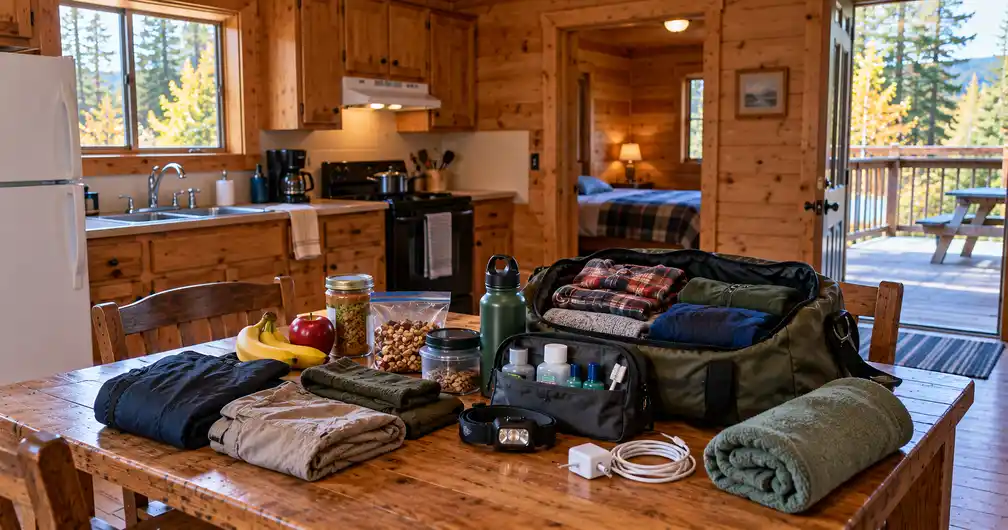
Cabin Camping Checklist: What to Pack for Rustic and Equipped Cabins
A cabin camping checklist should start with the cabin itself, not with a generic pile of camping gear. Before packing, confirm whether your cabin includes bedding, towels, potable water, electricity, a bathroom, cooking equipment, refrigeration, and basic dishes. Then pack only the gaps.
That approach matters because “cabin camping” can mean very different things. One cabin may provide little more than bunks, a table, and basic shelter, while another may have electricity, bathrooms, kitchen appliances, and other developed facilities. This guide helps you build the right list for either type without hauling unnecessary gear.
Table of Contents
Cabin Camping Checklist: Check These Cabin Amenities First
Before packing clothing or food, open the reservation listing, confirmation email, or official cabin page and verify what is actually provided.
Check for:
- Beds or bunks.
- Mattresses.
- Sheets, blankets, and pillows.
- Towels.
- Toilet and shower.
- Toilet paper.
- Potable drinking water.
- Electricity and indoor lighting.
- Heating or air conditioning.
- Refrigerator or freezer.
- Stove or cooktop.
- Microwave.
- Coffee maker.
- Pots, pans, and cooking utensils.
- Plates, bowls, cups, and cutlery.
- Grill, fire ring, fireplace, or wood stove.
- Firewood rules.
- Dish soap and cleaning supplies.
- Trash disposal.
- Parking and access instructions.
- Cell service or Wi-Fi if those matter to your trip.
Do not assume that a mattress includes bedding, that a faucet provides potable water, or that a kitchen contains everything needed to cook. Cabin operators use different definitions of “rustic,” “deluxe,” and “equipped.”
Cabin Camping Checklist at a Glance
| Category | Most trips | Rustic cabin additions | Leave home if confirmed provided |
|---|---|---|---|
| Reservation and access | Booking details, directions | Offline map and access notes | N/A |
| Clothing | Weather-appropriate layers | Extra insulation | N/A |
| Bedding | Verify first | Sleeping bag, pillow, sheets | Yes |
| Towels | Verify first | Bath and hand towel | Yes |
| Food | Yes | More shelf-stable options | N/A |
| Drinking water | Verify first | Bring full supply | If potable water is confirmed |
| Cookware | Verify first | Pot, pan, utensils | If fully supplied |
| Cold storage | Depends | Cooler and ice | If reliable refrigerator is available |
| Lighting | Headlamp or flashlight | Extra batteries or power | N/A |
| Toiletries | Yes | Sanitation extras if needed | Only confirmed cabin supplies |
| Charging | Phone charger | Power bank | If unnecessary |
| Cleanup | Verify first | Trash bags, soap, towels | If supplied |
Use this cabin camping checklist as a filter rather than a command to pack everything in the table. The most efficient cabin trip is usually the one where you confirm amenities early and avoid duplicates.
Cabin Camping Checklist: Core Items for Almost Every Stay
Some items remain useful whether the cabin is primitive or well equipped.
Reservation and Access Information
Save your booking confirmation, cabin number or name, check-in instructions, door or gate code, parking information, and the operator’s contact details.
For remote cabins, save directions offline. Do not depend on having a cell signal when you reach a forest road, mountain valley, or rural property.
Clothing and Footwear
Pack for the forecast and the activities you actually plan to do. A basic list may include:
- Everyday clothing.
- Sleepwear.
- Warm layer.
- Rain shell.
- Extra socks.
- Closed-toe shoes.
- Camp shoes or sandals when useful.
- Hat and sun protection.
Cabins can feel colder at night than expected, especially when heating is limited or temperatures drop sharply after sunset.
Toiletries and Personal Items
Bring:
- Toothbrush and toothpaste.
- Personal toiletries.
- Prescription medications.
- Glasses or contact-lens supplies.
- Sunscreen.
- Insect repellent.
- Hand sanitizer.
- Any personal medical supplies you normally need.
A small first-aid kit is also sensible for minor cuts, blisters, and everyday outdoor mishaps.
Lighting and Charging
Pack at least one headlamp or flashlight even when the cabin has electricity. You may need it for walking outside after dark, finding the cabin during a late arrival, or dealing with a power outage.
Bring the correct phone and device chargers. For cabins with uncertain electricity, a charged power bank adds useful backup capacity.
Rustic Cabin Camping Checklist
A rustic cabin camping checklist usually requires more self-sufficiency, but “rustic” is not a standardized amenity category. Check the exact cabin before assuming what is missing.
Sleeping Gear
If linens are not provided, you may need:
- Sleeping bag or sheets and blankets.
- Pillow.
- Sleeping liner if useful.
- Extra warm layer for nighttime.
- Mattress pad only if the existing sleeping surface and cabin rules make one necessary.
Some rustic public-use cabins provide bunks or mattresses but no bedding. Others provide very basic sleeping platforms. Verify the exact setup before deciding what to carry.
Drinking Water
If the operator does not explicitly confirm potable water, bring enough safe drinking water for the stay.
Plan for:
- Drinking.
- Cooking.
- Coffee or tea.
- Brushing teeth.
- Any other personal use that requires potable water.
Do not assume nearby streams, pumps, or cabin taps are safe to drink.
Kitchen and Food Gear
Depending on the cabin, you may need:
- Cooler and cold source.
- Pot or pan.
- Cooking utensils.
- Knife and cutting board.
- Plates or bowls.
- Cups.
- Cutlery.
- Can opener.
- Reusable food containers.
- Dish soap and sponge.
- Trash bags.
Portable camping stoves should be used outdoors according to the stove manufacturer’s instructions and the cabin operator’s rules. Do not move an outdoor stove indoors simply because the weather changes.
If your cabin has only a basic cooking area, build your cabin kitchen around the meals you actually plan to cook instead of packing your entire home kitchen.
Sanitation and Cleanup
Rustic cabins may require more cleanup supplies. Depending on the site, that can include toilet paper, handwashing supplies, a quick-dry towel, dish-cleaning items, and trash bags.
Follow the cabin’s waste rules. Some remote cabins require visitors to pack out all garbage.
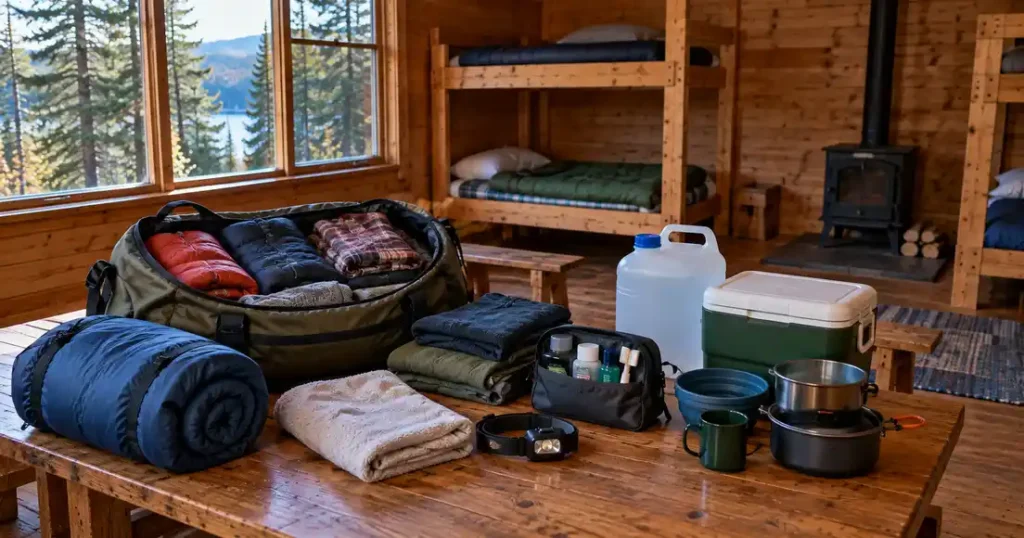
Equipped Cabin Camping Checklist
An equipped cabin camping checklist should usually be shorter.
If the cabin provides bedding, towels, a bathroom, refrigerator, cooktop, microwave, cookware, dishes, and cleaning supplies, you can leave large categories of camping gear at home.
You may still need:
- Clothing.
- Toiletries.
- Medications.
- Food and drinks.
- Preferred coffee or tea.
- Phone and chargers.
- Headlamp.
- Outdoor activity gear.
- Personal comfort items.
Read the listing carefully before removing items from your bag. “Kitchenette” might mean a microwave and mini-fridge, while “full kitchen” may include much more. The exact equipment matters more than the label.
Cabin Kitchen Supplies: What Do You Actually Need?
Kitchen packing should begin with the menu.
Ask:
- How many breakfasts, lunches, and dinners will you prepare?
- Which meals require cooking?
- Which appliances are actually in the cabin?
- Does the cabin have reliable refrigeration?
- Are cookware, dishes, and utensils supplied?
Once you know the meals, pack only the missing tools.
If you have not planned the food yet, use a simple three-day camping meal plan as a starting point and adapt it to the cabin kitchen.
For a short equipped-cabin stay, you may need nothing more than food, a few preferred seasonings, and personal drink items. For a rustic cabin, the same menu might require a cooler, cookware, an appropriate outdoor cooking setup, plates, and cleanup supplies.
Food and Cooler Safety for a Cabin Trip
Keep perishable food at 40°F (4.4°C) or below during transport and storage. Food held between 40°F and 140°F is in the temperature range where bacteria can multiply rapidly.
As a practical rule, perishable food should not remain above safe cold-storage temperature for more than two hours, or more than one hour when the temperature is above 90°F (32.2°C).
For cabin trips:
- Chill food before loading the cooler.
- Use enough ice or frozen cold packs.
- Keep raw meat separated from ready-to-eat food.
- Put perishables into the cabin refrigerator promptly.
- Do not rely on smell to determine whether improperly stored food is safe.
- Carry a shelf-stable backup meal for remote stays.
If you want less preparation after arrival, prepare part of your cabin menu before leaving home and keep those meals safely chilled during transport.
Cabin Camping Gear for Outdoor Time
The cabin may replace your tent, but it does not replace equipment for the outdoor activities around it.
Pack only what matches the trip:
- Daypack.
- Water bottle.
- Hiking shoes.
- Rain shell.
- Trekking poles if appropriate.
- Swimwear if there is a legal swimming area.
- Camp chairs if outdoor seating is not supplied.
- Binoculars.
- Camera.
- Paper map or downloaded offline map.
Fishing, paddling, climbing, cycling, and other specialized activities need their own equipment and safety planning. They do not belong automatically on every cabin camping checklist.
Family Cabin Camping Checklist
Family trips benefit from assigning shared items before packing.
For children, consider:
- Weather-appropriate spare clothing.
- Sleep comfort item.
- Child-specific medication.
- Snacks.
- Reusable water bottle.
- Books or simple games.
- Outdoor activity gear.
- Any age-appropriate safety equipment required for planned activities.
For shared items, assign one person to bring coffee supplies, another to bring group food, another to handle games, and another to check kitchen equipment when appropriate.
That prevents three people from bringing frying pans while nobody brings the can opener.
Cabin Camping Checklist for Cold Weather
For cool or cold conditions, add:
- Insulating base layers.
- Warm midlayer.
- Weather-resistant outer layer.
- Warm hat and gloves.
- Extra socks.
- Appropriate footwear.
- Sleep system matched to expected indoor conditions if bedding is not supplied.
Do not treat a cabin heater as a substitute for weather-appropriate clothing. Heating systems can be limited, cabins can cool quickly, and winter conditions can affect road access.
If snow or ice is possible, check current road conditions and vehicle requirements before departure instead of adding generic winter equipment without knowing what the destination requires.
Cabin Camping Checklist for Warm Weather
Warm-weather additions may include:
- Lightweight clothing.
- Sun hat.
- Sunscreen.
- Insect repellent.
- Rain shell.
- Extra drinking-water capacity if water is not provided.
- Cooler or refrigerator plan.
- Swimwear when relevant.
Warm weather also makes safe cold storage more important. Keep food out of a hot vehicle longer than necessary and move perishables into dependable cold storage when you arrive.
What Not to Bring Cabin Camping
A useful cabin camping checklist also removes unnecessary gear.
You can often leave home:
- A tent when you have a confirmed cabin reservation and no backup camping plan requires one.
- Full camp-kitchen bins when cookware and dishes are confirmed.
- Multiple coolers when the cabin has a reliable refrigerator with enough room.
- Bedding when linens are explicitly provided.
- Large lantern collections when cabin lighting and personal headlamps are enough.
- Firewood, axes, or fire tools when they are prohibited or unnecessary.
- Large electronics that add little to the trip.
- Duplicate group supplies.
Do not remove something just because you assume the cabin provides it. Remove it only after checking.
Common Cabin Camping Packing Mistakes
The most common mistakes are simple:
- Not reading the complete amenity list.
- Assuming a mattress includes sheets and blankets.
- Assuming running water is potable.
- Assuming electricity is available.
- Assuming cookware and dishes are included.
- Forgetting the can opener for canned meals.
- Depending on cell service for directions or access codes.
- Carrying perishable food without dependable cold storage.
- Forgetting a headlamp or flashlight.
- Bringing duplicate group items.
- Assuming firewood can be collected locally.
- Carrying an outdoor camp stove without checking legal and safe use.
- Forgetting trash or cleanup requirements.
The best packing system prevents both extremes: arriving without essential gear and bringing half your camping closet for a cabin that already supplies it.
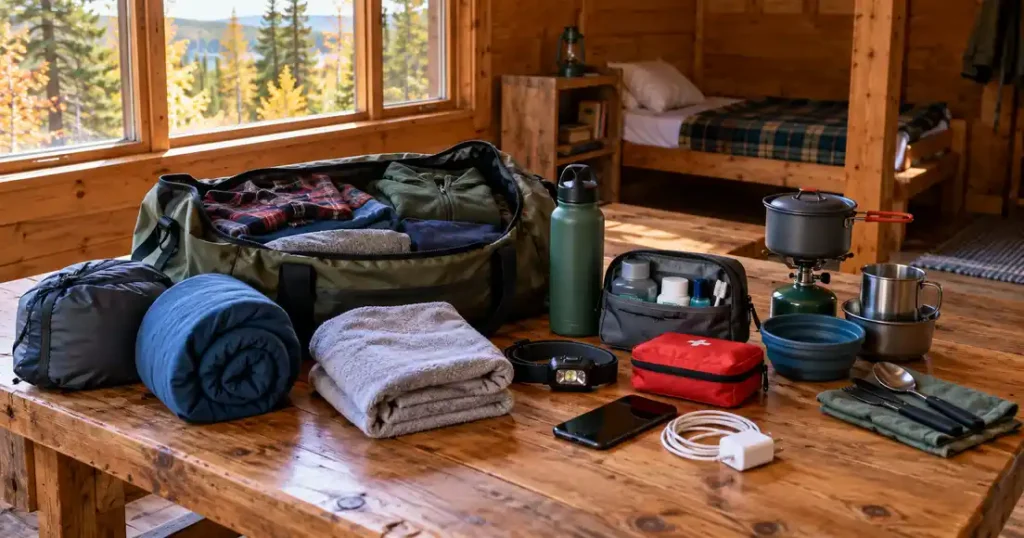
Cabin Camping Checklist: Final Pre-Departure Check
Before leaving, run through this cabin camping checklist one final time:
- Reservation confirmed.
- Access instructions saved.
- Weather checked.
- Cabin amenities confirmed.
- Bedding confirmed or packed.
- Towels confirmed or packed.
- Potable water confirmed or packed.
- Food plan complete.
- Perishable food safely chilled.
- Kitchen gaps packed.
- Clothing matches the forecast.
- Toiletries and medications packed.
- Headlamp or flashlight packed.
- Chargers and power bank packed if needed.
- Outdoor gear matches planned activities.
- Fire, stove, and heating rules reviewed where relevant.
- Trash and cleanup requirements confirmed.
The final check should take only a few minutes because the important decisions were made when you reviewed the cabin amenities.
Frequently Asked Questions
What should be on a cabin camping checklist?
A cabin camping checklist should cover reservation and access information, weather-appropriate clothing, toiletries, medications, lighting, charging, food, drinking water, bedding, towels, kitchen gear, and cleanup supplies. The key is to verify what the cabin already provides before packing each category.
What should I bring to a rustic cabin?
Bring whatever the cabin does not provide. Common needs include bedding, a pillow, potable water, a cooler, cookware, dishes, headlamps, toiletries, trash bags, food, and weather-appropriate clothing. Some rustic cabins provide several of these items, so always check the exact listing.
Do I need bedding for cabin camping?
It depends entirely on the cabin. Some rentals include sheets, blankets, and pillows; others provide only a mattress, bunk, or sleeping platform. Confirm linens with the operator rather than assuming a bed means bedding is supplied.
What food should I bring for a cabin trip?
Choose food after checking the kitchen. An equipped cabin can support normal stovetop or refrigerator meals, while a rustic cabin may favor make-ahead meals, shelf-stable foods, or simple dishes that use minimal cookware. Keep all perishable food safely chilled.
What can I leave at home when staying in an equipped cabin?
Leave confirmed duplicates at home. If the cabin definitely supplies linens, towels, cookware, dishes, a refrigerator, and cooking appliances, you usually do not need to bring those items. Keep personal essentials, food, clothing, lighting, chargers, medications, and activity-specific gear.
Conclusion
A cabin camping checklist works best when it begins with one question: what does this cabin already provide?
For an equipped cabin, your packing list may shrink to clothing, toiletries, food, personal items, and outdoor gear. For a rustic cabin, you may need bedding, potable water, cooking equipment, cold storage, lighting, and cleanup supplies.
Check the listing, pack the gaps, and run through the cabin camping checklist once more before departure. That is the simplest way to avoid both forgotten essentials and unnecessary gear.
References:
- USDA Food Safety and Inspection Service — Food Safety While Hiking, Camping & Boating — Used to verify cold-storage guidance, cooler practices, separation of raw foods, and outdoor food-safety planning. Food Safety and Inspection Service
- USDA Food Safety and Inspection Service — Danger Zone (40°F–140°F) — Used to verify the 40°F–140°F danger zone, two-hour rule, one-hour rule above 90°F, and 40°F-or-below cold-storage guidance. Food Safety and Inspection Service
- National Park Service — Public Use Cabins, Wrangell–St. Elias National Park & Preserve — Used to verify that some public-use cabins are extremely rustic and may provide only basic furnishings such as bunks, tables, chairs, and heating equipment. National Park Service
- National Park Service — Group Cabin Camping, Prince William Forest Park — Used to verify that cabin facilities can also include bathrooms, lighting, dining halls, refrigerators, cooking appliances, and other developed amenities, demonstrating why packing needs vary by cabin. National Park Service
- National Park Service — Cabin Camp 5, Prince William Forest Park — Used to verify an example where beds, electricity, bathrooms, showers, and kitchen equipment are available while guests must still bring bedding, towels, toiletries, cookware, and other supplies. National Park Service