
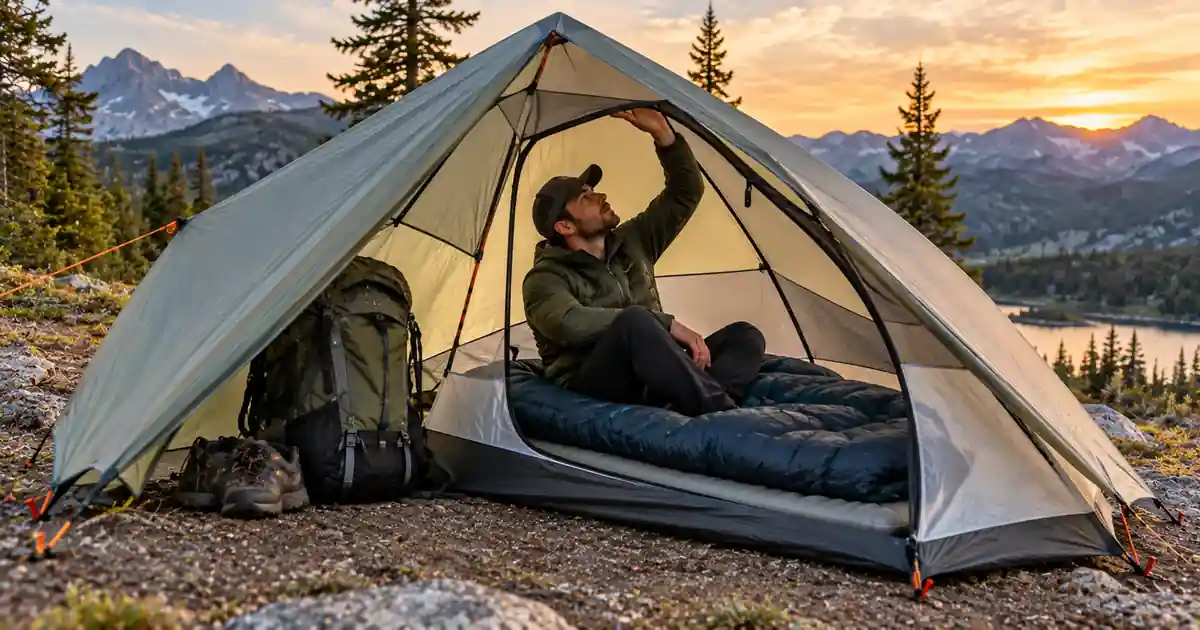
1 Person Backpacking Tent: How to Choose for Solo Trips
A 1 person backpacking tent can reduce shelter weight and packed bulk, but the lightest model is not automatically the right solo shelter. The best choice depends on expected weather, campsite terrain, usable interior space, pitch style, and the weight of the complete system you will actually carry. Start with fit and conditions, then compare weight and price.
This guide focuses on three-season solo shelters and shows how to compare freestanding, semi-freestanding, and trekking-pole designs without confusing headline specifications.
Table of Contents
1 Person Backpacking Tent: Start With Your Trip Conditions
Before comparing models, define where and how you backpack. A 1 person backpacking tent for sheltered forest campsites can prioritize different features from one used above treeline, in humid conditions, or on rocky ground where staking is difficult.
Ask four questions first:
- What seasons and weather do you expect?
- How reliable is the ground for stakes?
- How much interior room do you need?
- Do you already carry trekking poles?
For most spring, summer, and early-fall backpacking, a three-season backpacking tent is the normal category. These shelters balance weather protection, ventilation, bug protection, and low weight. They are not substitutes for mountaineering tents in sustained severe wind or heavy snow.
Campsite terrain also matters. A non-freestanding shelter can be efficient when good stake placement is available, while a freestanding design is easier to reposition on compact or awkward sites. Even a freestanding tent should still be properly staked and guyed when conditions require it.
If you want to use a lightweight shelter for a bike camping trip too, this first-overnight bike camping guide explains how carrying constraints change on a bicycle.
Is a 1-Person Tent Actually the Right Size?
A “1P” label tells you intended occupancy, not how roomy the tent will feel. There is no universal industry standard for the floor space a one-person shelter must provide, so compare actual dimensions.
Before buying, measure your real sleep system:
- Sleeping pad width and length.
- Sleeping bag loft around your feet.
- Your height while lying down.
- How much room you need to sit up.
- Whether your backpack can stay under the vestibule.
A narrow solo tent may work well with a regular 20-inch pad and gear outside. It can feel much tighter with a 25-inch pad, thick mattress, bulky bag, broad shoulders, or interior gear.
When a 2-Person Tent Makes More Sense for One Backpacker
Sizing up can be reasonable if you camp with a dog, strongly dislike tight interiors, are unusually tall or broad, or want substantial gear space inside. It can also make sense when a particular 2P model adds only modest weight.
The trade-offs are more weight, packed volume, campsite footprint, and usually cost. Compare specific models rather than assuming every 2P tent is only slightly heavier.
1 Person Backpacking Tent Weight: Compare the Right Number
Tent weight is easy to misread because manufacturers and retailers may publish different configurations.
Minimum or Trail Weight
Minimum trail weight usually means the tent body, rainfly, and poles for a conventional double-wall tent. Stakes, sacks, repair items, and a footprint may be excluded.
Packaged Weight
Packaged weight includes the components sold with the tent. That can include stakes, storage sacks, instructions, and accessories you may not carry on every trip.
Your real trail weight often falls between minimum and packaged weight.
Trekking-Pole Tent System Weight
A trekking-pole shelter needs a different calculation. Add the tent, stakes, necessary guylines, and either your existing trekking poles or dedicated shelter poles.
If you already hike with trekking poles, they are multipurpose gear. If you do not, dedicated poles belong in the shelter-system calculation.
The useful rule: compare the configuration you will actually carry, not the smallest number on each product page.
How Light Should a Solo Backpacking Tent Be?
There is no universal weight that makes a shelter “ultralight.” Lower weight can come from smaller interiors, lighter fabrics, fewer poles, greater stake dependence, or more expensive materials.
A lighter 1 person backpacking tent can save pack weight and volume, but it may also mean less room, thinner fabrics, more careful campsite selection, or a higher price.
If you are deciding where extra comfort weight is worth carrying, our ultralight backpacking chair comparison uses the same weight-versus-comfort logic for camp seating.
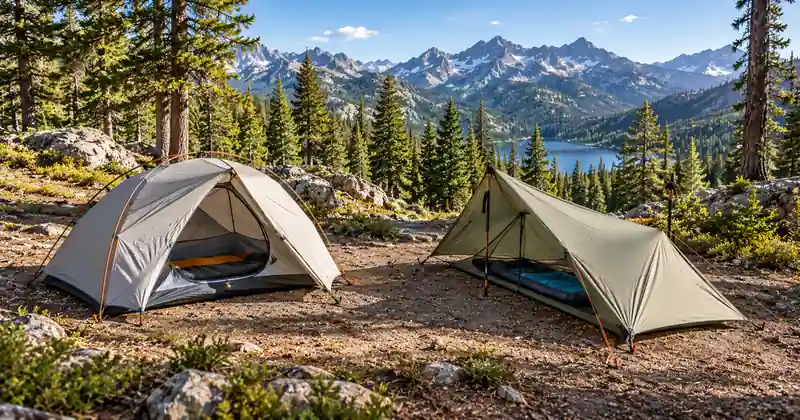
1 Person Backpacking Tent: Freestanding vs. Trekking Pole
| Design | Main advantage | Main trade-off | Often suits |
|---|---|---|---|
| Freestanding | Simple structure and easy repositioning | Dedicated poles add weight | Beginners and varied terrain |
| Semi-freestanding | Some structural support with lower pole weight | Certain corners require staking | Weight-conscious hikers |
| Trekking pole | Uses poles you may already carry | More stake and pitch dependence | Experienced trekking-pole users |
Freestanding 1 Person Tent
A freestanding tent uses its own pole structure and can generally stand before every corner is staked. That makes it easier to move if you discover a root, rock, or drainage problem under the floor.
The current Big Agnes Copper Spur UL1 is a three-season freestanding double-wall example. It has a 2 lb (907 g) minimum trail weight, 2 lb 6 oz (1.08 kg) packaged weight, an 88-inch floor, 38-inch peak height, and current price of $499.95. Its footprint is sold separately.
Consider it if you value conventional setup and easy repositioning. Skip it if minimizing cost or shelter weight matters more.
Trekking Pole Tent
A trekking pole tent replaces dedicated structural poles with trekking poles or optional support poles.
The current Durston X-Mid 1 is a double-wall example. The manufacturer lists the complete tent at 26.2 oz (745 g) and a typical setup with sack and six stakes at 29.4 oz (835 g), before the two trekking poles. Its floor is 93 by 33 inches (236 by 84 cm), with a 47-inch peak and two vestibules. The current price is $269.
Consider it if you already use trekking poles and want a light double-wall shelter. Skip it if you dislike stake-dependent pitches or often camp where secure staking is difficult.
Semi-Freestanding
A semi-freestanding tent uses poles for most of its shape but still needs certain corners staked to create its intended floor area. Check how many stakes are required and what interior space is lost if they cannot be placed well.
Single-Wall vs. Double-Wall Solo Tents
A double-wall shelter separates the inner tent from the outer fly. Mesh and vents can help manage moisture, and the inner reduces direct contact with a wet fly. The trade-off is more components.
A single-wall shelter can save components and weight, but interior condensation is more noticeable. Humidity, temperature, ventilation, campsite location, and wet gear all affect condensation.
The Six Moon Designs Lunar Solo illustrates the single-wall approach. It weighs 26 oz (740 g) before stakes or a support pole, has a 90-inch floor, uses one 49-inch support pole, and currently costs $260. The seams are not sealed by default; the manufacturer says seam sealing is required for full waterproofing.
Include stakes, a trekking or dedicated pole, and seam sealing when comparing its real system cost and weight.
1 Person Backpacking Tent for Tall People: Check Usable Length
Floor length alone does not determine fit. Sloping end walls can bring fabric into contact with your sleeping bag even when the floor looks long enough on paper.
For a tall backpacker, check:
- Floor length.
- End-wall angle.
- Sleeping-pad thickness.
- Sleeping-bag loft.
- Peak location.
- Head and foot clearance while lying down.
The current Durston X-Mid 1 has a 93-inch floor and steep end walls. Durston says it typically works for hikers up to 6 ft 4 in (193 cm), while noting that pad thickness, bag size, sleeping style, and personal expectations still matter.
Do not apply that fit claim to other tents with the same nominal floor length.
Floor Width and Sleeping-Pad Compatibility
A regular backpacking pad is often around 20 inches wide, while many wide pads are about 25 inches. That five-inch difference can consume nearly all spare floor space in a narrow 1 person backpacking tent.
When comparing a 1 person backpacking tent, check width at both ends because many floors taper. A pad that technically fits may leave no useful floor beside it.
The current Gossamer Gear The One, for example, tapers from 33 inches at the head to 21 inches at the foot.
Peak Height, Wall Shape and Livability
Peak height is measured at one point. Wall shape determines how much of that height remains useful around your head and shoulders.
Ask:
- Can you sit upright comfortably?
- Can you change clothes?
- Is the door easy to use?
- Are pockets reachable?
- Would the interior remain tolerable during several hours of rain?
A slightly heavier tent can be a better choice if its shape gives you substantially more usable room.
Vestibule Space and Gear Storage
A vestibule keeps shoes, a pack, and wet rain gear outside the sleeping area while protected from direct precipitation. Door shape and pole placement matter as much as square footage.
Food may need to be stored elsewhere. In areas with wildlife food-storage rules, follow the land manager’s requirements rather than treating the tent vestibule as food storage.
Three-Season Backpacking Tent: What the Rating Means
A three-season backpacking tent is generally intended for spring, summer, and early fall, with protection from rain, insects, and ordinary seasonal wind when properly pitched.
It is not a promise that the shelter can handle every storm. If your trips involve sustained snow loading, severe exposed winds, or technical winter travel, evaluate a shelter designed for those conditions instead of the 1 person backpacking tent category covered here.
Tent Materials and Durability
Backpacking tents commonly use nylon and polyester, while some premium ultralight shelters use composites such as Dyneema.
Do not use denier as a universal durability score across different fabric types. Construction, coatings, weave, and fiber type also matter.
To protect light fabrics:
- Clear sharp debris before pitching.
- Do not drag the tent across the ground.
- Dry it before long-term storage.
- Repair small damage early.
- Follow manufacturer care instructions.
Do You Need a Tent Footprint?
Not always.
A footprint can protect the floor from abrasion and simplify cleanup, but it adds weight and cost. Big Agnes currently sells the Copper Spur UL1 footprint separately for $80 and recommends it for extra floor protection and Fast Fly compatibility.
Durston says the X-Mid 1 groundsheet is optional if its 15D floor is used carefully and harsh surfaces such as gravel are avoided.
If you use a footprint, keep it fully beneath the tent floor so it does not collect rainwater.
Setup Difficulty and Campsite Flexibility
Before buying a 1 person backpacking tent, check:
- Minimum required stakes.
- Optional guylines.
- Number and type of poles.
- Required trekking-pole height.
- Total fly footprint.
- Whether the shelter is easy to reposition.
A trekking-pole design may become fast with practice but still depends on good geometry and stake placement. A freestanding shelter is easier to move, but it still needs secure staking in wind.
Practice pitching any new tent before depending on it in the backcountry.
Current 1 Person Backpacking Tent Examples by Design
These are current design examples, not Camping Trip Atlas field-test rankings. Prices and availability were rechecked on September 30, 2026.
| Tent | Architecture | Wall type | Comparable weight | Current price/status |
|---|---|---|---|---|
| Big Agnes Copper Spur UL1 | Freestanding | Double-wall | 2 lb minimum; 2 lb 6 oz packaged | $499.95; available |
| Durston X-Mid 1 | Trekking pole | Double-wall | 26.2 oz tent; 29.4 oz typical setup before poles | $269; available |
| Six Moon Designs Lunar Solo | Single-pole trekking shelter | Single-wall | 26 oz before stakes/pole | $260; in stock |
| Gossamer Gear The One | Two-pole trekking shelter | Single-wall | 19.68 oz shelter; 22.24 oz listed total before poles | $315; sold out |
Big Agnes Copper Spur UL1
Choose it if you prioritize freestanding setup, double-wall construction, and conventional pole-supported pitching. Its current floor is 88 x 38/28 inches, with 20 sq. ft. of floor area and a 9 sq. ft. vestibule.
Skip it if the price or roughly two-pound minimum trail weight exceeds your priorities.
Durston X-Mid 1
Choose it if you already carry trekking poles and want a double-wall shelter with a long floor and two vestibules.
Skip it if you routinely camp where a four-stake base pitch is difficult or prefer dedicated tent poles.
Six Moon Designs Lunar Solo
Choose it if you want a single-wall shelter with a large listed floor area for its weight. It has a 90 x 48-inch maximum floor and 26.25 sq. ft. of listed floor area.
Skip it if you want stakes, a support pole, and factory-sealed seams included in the base configuration.
Gossamer Gear The One
The One is the lightest shelter example here at 19.68 oz for the shelter and 22.24 oz for the manufacturer’s listed total before trekking poles. It has an 84-inch floor, 33-inch head width, 21-inch foot width, and 49-inch peak height.
It was $315 but sold out when rechecked September 30, 2026, so treat it as a design reference rather than an immediately available recommendation.
How Much Should You Spend?
The right 1 person backpacking tent should justify its total system cost through fit, architecture, and the features you actually need.
Higher prices can buy lower-weight poles, specialized fabrics, refined hardware, or better weight-to-space efficiency. They do not guarantee easier setup or better fit.
Compare complete system cost:
- Tent.
- Stakes.
- Trekking or dedicated poles.
- Footprint if wanted.
- Seam sealing when required.
A lower base price can rise quickly when required components are sold separately.
When a 1 Person Backpacking Tent Is the Wrong Shelter
A solo backpacking shelter is a poor match when you primarily camp beside your vehicle and do not need to carry it for miles. In that case, standing height, larger doors, heavier fabrics, and more floor space matter more.
If that sounds like your trips, choose a roomier car camping tent instead.
Also look beyond a typical 1P shelter if you need winter mountaineering protection, regularly camp with a large dog, need extensive interior gear space, or strongly dislike confined sleeping quarters.
1 Person Backpacking Tent Buying Checklist
Before ordering a 1 person backpacking tent, confirm:
- Expected season and weather.
- Typical campsite terrain.
- Sleeping-pad dimensions.
- Usable floor length.
- End-wall slope.
- Peak placement.
- Vestibule capacity.
- Actual carried weight.
- Included stakes.
- Required poles.
- Trekking-pole requirements.
- Seam-sealing status.
- Footprint need.
- Packed size.
- Pitch footprint.
- Current price and stock.
- Warranty and repair support.
- Return policy.
Then compare two or three models using the same weight configuration.
Frequently Asked Questions
How much should a 1 person backpacking tent weigh?
There is no universal correct weight for a 1 person backpacking tent. Compare the complete configuration you will actually carry, including required stakes and support poles. A lighter shelter may trade away interior room, freestanding structure, fabric weight, or ease of pitching, so weight should be considered alongside terrain and weather.
Is a 1-person or 2-person tent better for solo backpacking?
A 1-person tent is usually lighter and smaller to pack, while a 2-person tent gives you more room for a pet, gear, broad shoulders, or long periods inside. Compare actual model weights and dimensions rather than capacity labels alone.
Is a trekking pole tent better than a freestanding tent?
Neither is universally better. Trekking-pole shelters can reduce dedicated pole weight for hikers who already carry poles. Freestanding tents are generally easier to reposition and less dependent on stake geometry. Your usual campsite surfaces and setup preference should decide.
What tent size should a tall solo backpacker choose?
Do not choose from floor length alone. Check end-wall angle, pad thickness, sleeping-bag loft, and usable head and foot clearance. Manufacturer fit guidance can help when available, but tents with the same published floor length can fit very differently.
Is a three-season tent enough for backpacking?
For many spring, summer, and early-fall trips, yes. A three-season tent balances ventilation, rain protection, bug protection, and weight. It is not designed for sustained severe winter winds or heavy snow loads, so match the shelter to the actual conditions you expect.
Conclusion
A 1 person backpacking tent should fit your body, sleep system, campsites, and expected weather before it meets a target number on the scale.
Start with conditions, decide whether freestanding or trekking-pole architecture suits your terrain, measure usable sleeping space, and calculate real carried weight with every required component. Then compare current models using equivalent specifications and recheck manufacturer price and availability before buying.
References:
- REI Co-op — How to Choose a Backpacking Tent — Used to verify capacity guidance, three-season versus four-season distinctions, minimum versus packaged weight, freestanding terminology, livability, ventilation, setup, and material-comparison guidance. REI
- Big Agnes — Copper Spur UL1 — Used to verify the current $499.95 price, current availability, three-season freestanding construction, footprint status, materials, taped seams, and manufacturer warranty/support information. Big Agnes
- REI Co-op — Big Agnes Copper Spur UL1 Technical Specifications — Used to verify the current model’s 2 lb minimum trail weight, 2 lb 6 oz packaged weight, 88 x 38/28-inch floor, 20 sq. ft. floor area, 9 sq. ft. vestibule, and 38-inch peak height. REI
- Durston — X-Mid 1 — Used to verify the $269 price, 2026 model update, 26.2 oz complete-tent weight, 29.4 oz typical setup, 93 x 33-inch floor, 47-inch peak height, dual vestibules, four-stake basic pitch, and manufacturer tall-user guidance. Durston
- Six Moon Designs — Lunar Solo Backpacking Tent — Used to verify the $260 price, 26 oz weight excluding stakes/pole, 90-inch floor length, 48-inch maximum width, 26.25 sq. ft. floor area, one-pole construction, current stock, and required seam sealing. Six Moon Designs
- Gossamer Gear — The One — Used to verify the $315 price, sold-out status, 19.68 oz shelter weight, 22.24 oz listed total, 84-inch floor, tapered 33/21-inch width, 49-inch peak height, included stakes, and two-pole requirement. Gossamer Gear