
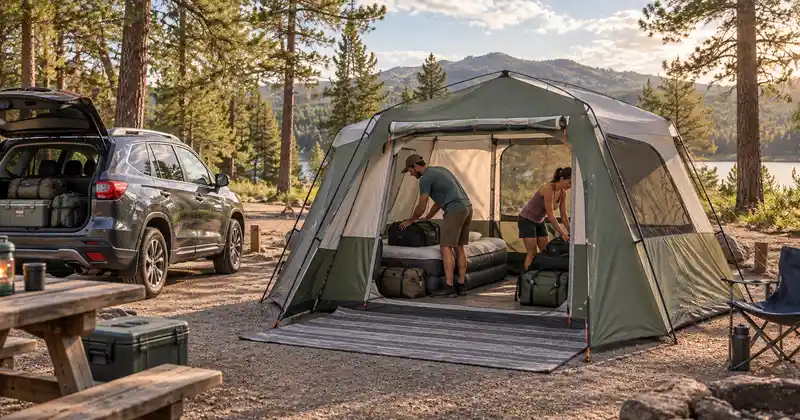
Car Camping Tent: A Practical Guide to Size and Features
A car camping tent lets you prioritize comfort, standing room, easier setup, and generous storage because you are transporting the shelter by vehicle instead of carrying it for miles. That freedom is useful, but it can also make it easy to buy a tent that is unnecessarily large, bulky, or awkward for your campsite.
For most campers, the right size is based on the actual people, mattresses or cots, pets, gear, and movement space you need—not only the manufacturer’s person rating. Measure your sleep setup first, then compare floor dimensions, height, vestibules, weather construction, setup style, and packed size.
Table of Contents
Car Camping Tent at a Glance
| Factor | What to check | Why it matters |
|---|---|---|
| Capacity | People, pets, and gear | Maximum sleeping capacity can feel crowded |
| Floor dimensions | Actual length and width | Determines whether mattresses and cots fit |
| Height | Peak height and wall shape | Affects changing clothes and moving around |
| Vestibules | Covered storage area | Keeps wet or bulky gear outside the sleeping area |
| Doors | One or two entrances | Changes nighttime access for couples and families |
| Setup | Traditional, instant, or inflatable | Affects speed, bulk, and complexity |
| Weather construction | Fly, seams, floor, poles, guylines | More useful than a vague “weatherproof” label |
| Packed size | Bag length and overall bulk | Must fit your vehicle and home storage |
| Weight | Total packed weight | Still matters when lifting and carrying from parking |
Car Camping vs Backpacking Tents: What Changes?
The biggest difference is what the tent is designed to prioritize.
A backpacking tent needs to be carried on your back, so designers normally reduce:
- Weight
- Packed volume
- Pole size
- Floor area
- Standing height
- Fabric weight
A tent for car camping can make different trade-offs. Since the vehicle does most of the carrying, it can offer:
- Taller walls
- Larger doors
- More floor space
- Bigger vestibules
- Heavier fabrics
- Larger poles
- More storage pockets
- Faster instant-frame systems
That does not mean a heavy tent is automatically better.
A lightweight 3-person shelter can still work for a couple who wants a simple campground setup. Likewise, a large family tent is not automatically more comfortable if its footprint barely fits your campsite or one person struggles to pitch it.
If you backpack regularly and also want a roomy campground shelter, two purpose-built tents often solve those jobs better than one compromise design.
How to Choose the Right Car Camping Tent Size
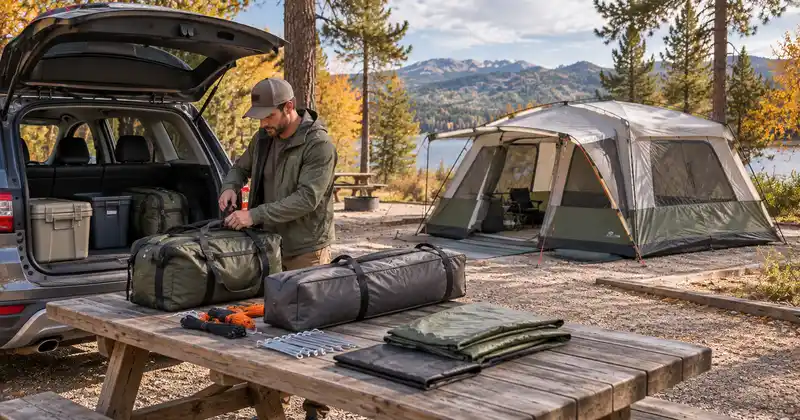
Ignore the number printed on the tent bag for a moment.
Start with what actually needs to fit inside.
Step 1: Count People, Pets and Gear
Your space calculation may include:
- Adults
- Children
- Dogs
- Sleeping pads
- Air mattresses
- Cots
- Clothing bags
- Personal gear
Do not automatically plan to keep food or scented items inside the sleeping tent. Food-storage requirements vary by destination, especially in wildlife areas.
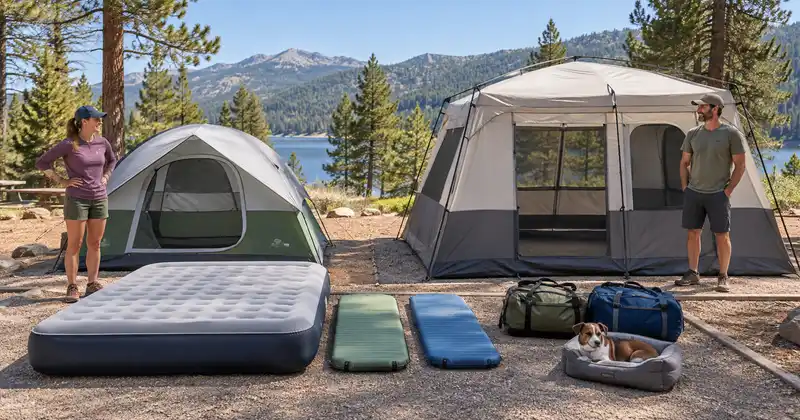
Step 2: Measure Your Sleep System
This is one of the easiest ways to avoid buying the wrong tent.
Measure the actual width and length of:
- Queen air mattress
- Double sleeping pad
- Individual sleeping pads
- Camping cots
- Children’s mattresses
Then compare those measurements with the tent’s published floor dimensions.
Two tents advertised for four people can feel completely different when one has a wide rectangular floor and the other narrows toward the ends.
Step 3: Add Movement Space
A sleep system that technically covers the floor does not necessarily create a comfortable campsite.
Ask:
- Can everyone reach the door?
- Can you change clothes without stepping on bedding?
- Is there somewhere to place a duffel?
- Can you move around when rain keeps everyone inside?
- Can a dog sleep without blocking an entrance?
If every square inch is occupied by mattresses, you are using the tent close to maximum sleeping capacity rather than comfortable capacity.
Step 4: Decide Where Gear Will Go
Not all equipment needs to remain inside.
You may store gear:
- In a vestibule
- In the vehicle
- Under another approved campsite shelter
- Inside the sleeping tent
A useful vestibule can make a moderately sized tent feel more practical because muddy shoes, wet rain jackets, and some appropriate gear can stay covered without occupying sleeping space.
Tent Size for Couples: When a 4-Person Tent Makes Sense
A couple does not necessarily need a 2-person tent simply because two people are sleeping inside.
A 2-person design may work well when you use individual sleeping pads and prioritize compactness.
A 3-person model can add some elbow room and space for gear.
A 4-person model often becomes attractive when a couple uses:
- A queen air mattress
- Bulky bedding
- A dog bed
- Larger duffels
- More interior living space during bad weather
This does not mean every couple should buy a 4-person shelter.
A larger tent takes more campsite space, uses more vehicle cargo room, may cost more, and can expose more fabric to wind.
A 6-person tent can feel spacious for two people, but that extra room may provide little benefit if you mainly sleep in the tent and spend the day outside.
Family Car Camping Tent Size
Family sizing requires even more caution because “six people” can mean very different things.
Two adults and two young children do not use a tent the same way as four adults.
Before choosing a family car camping tent, think about:
- Number and size of mattresses
- Children’s sleeping arrangements
- Pets
- Clothing
- Rainy-day interior time
- Standing room
- Door access
- Campsite footprint
A 6-person label may describe maximum sleeping capacity more closely than comfortable family capacity.
For larger families, also compare one large shelter with two smaller tents.
One large tent keeps everyone together, but two tents can provide:
- More privacy
- Easier campsite placement in some locations
- Smaller individual packed pieces
- Flexibility as children get older
The best arrangement depends on the campsites you use and how your family prefers to sleep.
Floor Area Is Only Half the Space Question
Square footage helps compare tents, but it does not tell the whole story.
Two shelters with similar floor areas can feel very different because of:
- Sloping walls
- Vertical walls
- Pole geometry
- Narrow corners
- Door placement
- Interior height
A traditional dome often slopes inward substantially as it rises.
A cabin-style shelter may keep more usable width at shoulder height because its walls are steeper.
That difference matters when you stand, change clothes, sit inside during rain, or use tall cots.
When comparing a spacious camping tent, look at the shape of the usable volume, not only the floor number.
Peak Height and Wall Shape
Peak height tells you the tallest point inside the shelter.
It does not tell you how much of the tent provides that height.
A 6-foot peak located only in a small central area is different from a frame that keeps much of the ceiling high.
NEMO’s Aurora Highrise is a useful example. The manufacturer specifically uses steep sidewalls to create more standing-height interior volume rather than relying on one high center point. Its current design also includes two large doors, two vestibules, and rain-protected windows.
Tall cabin-style walls are comfortable, but there is a trade-off: a larger vertical surface gives wind more area to push against.
Height should therefore be balanced with pole structure, guyline use, campsite exposure, and expected weather.
Doors, Vestibules and Interior Storage
Tent doors become more important as the number of campers increases.
With only one door, someone sleeping near the entrance may have to move whenever another person gets out.
Two doors can make a significant difference for:
- Couples
- Families
- Different sleeping schedules
- Nighttime bathroom trips
Vestibules are equally useful.
The North Face currently lists the Wawona 6 with 86.11 sq. ft. of interior floor area, plus a 44.7 sq. ft. front vestibule and a 21 sq. ft. rear vestibule. That covered storage area illustrates why you should not compare tents using sleeping-floor area alone.
Also check for:
- Interior pockets
- Ceiling pockets
- Gear loops
- Headlamp storage
- Door holdbacks
These are small camping tent features individually, but organization becomes much more useful when several people share the shelter.
Easy-Setup Tent Types
Setup systems affect convenience, packed size, and weight.
Traditional Pole Tents
Traditional designs use separate or partially connected poles.
Advantages can include:
- Familiar construction
- Color-coded components
- Reasonable packed size
- Individual replaceable parts
The downside is usually more assembly than an instant-frame tent.
Instant-Frame Tents
An instant tent keeps much of the frame attached to the shelter.
Coleman’s Skylodge 4 uses pre-attached telescoping poles, and Coleman currently states that the tent can be structurally set up in about one minute. The tent measures 7.5 × 7.5 feet, has a 5.4-foot center height, weighs 21.37 pounds, and is designed to fit one queen-size air bed.
That fast structural setup comes with a trade-off: instant-frame tents are often heavier and pack into longer bags.
Also remember that a manufacturer’s setup time does not include:
- Choosing the tent site
- Clearing loose debris
- Orienting the door
- Installing the rainfly
- Staking the shelter
- Tensioning guylines
- Arranging bedding
An easy setup camping tent can save time, but compare the whole pitching process, not just the headline number.
Inflatable Tents
Inflatable designs replace major structural poles with pressurized air beams.
They can simplify pitching for some larger campground tents, but they also introduce:
- A pump
- Inflation pressure requirements
- Valves and air chambers
- Model-specific repair considerations
If that setup interests you, Camping Trip Atlas has a separate guide where you can compare inflatable tent pros and cons without duplicating all of those air-frame details here.
What Makes a Weather-Ready Car Camping Tent?
“Weatherproof” should not be treated as an absolute guarantee.
Instead, inspect the actual shelter construction.
Useful features include:
- Rainfly coverage
- Taped or protected seams
- Floor construction
- Protected doors
- Ventilation
- Strong pole geometry
- Guyline attachment points
- Appropriate stakes
Coleman’s current Skylodge description, for example, specifies welded corners, inverted seams, taped seams on the rainfly and tent body, and a frame that Coleman says has been tested in winds up to 35 mph. That is a manufacturer test claim for that model, not a general wind guarantee for camping tents.
The Wawona 6 uses a polyester fly/canopy with a published 1,200 mm PU coating and a 1,500 mm PU-coated floor, plus external guylines.
No specification replaces proper campsite selection.
Even a well-built tent can perform poorly if it is:
- Incorrectly pitched
- Poorly staked
- Left with loose guylines
- Positioned in exposed severe weather
- Set up where water pools beneath it
Ventilation and Condensation
Moisture inside a tent is not always a leak.
People release moisture simply by breathing, and humidity can condense on cooler tent surfaces overnight.
Good ventilation can include:
- Mesh ceilings
- Mesh doors
- Low vents
- High vents
- Rain-protected windows
- Space between inner tent and rainfly
NEMO’s Aurora Highrise uses large rain-protected windows for airflow, while The North Face Wawona 6 uses a large mesh front door as part of its ventilation design.
Keep vents open when conditions allow instead of sealing every opening simply because the night is cool.
Packed Weight and Vehicle Space Still Matter
Car camping removes the need to carry the tent for miles.
It does not make size and weight irrelevant.
Think about:
- Hatchback versus SUV cargo space
- Coolers
- Camp chairs
- Stoves
- Water containers
- Children’s gear
- Distance from parking to campsite
- Home storage
- One-person lifting
Current examples show the range clearly.
The NEMO Aurora Highrise 4 has a listed packed weight of 15 lb 14 oz, while Coleman’s Skylodge 4 weighs 21.37 lb. The Wawona 6 weighs 19 lb 7 oz despite its larger six-person capacity.
Weight alone still does not tell you which packs most conveniently. Long instant-frame poles can create a carry bag that is harder to fit across a small trunk than a shorter traditional-pole tent.
Before buying a large shelter, match your tent and cargo to the campsite so you know how much vehicle and campsite space the complete setup requires.
Current Car Camping Tents as Size and Feature Examples
These examples are based on current manufacturer specifications. They are not personal field-test claims or a universal ranking.
NEMO Aurora Highrise 4 — Spacious Couples and Small Families
NEMO currently categorizes the Aurora Highrise for car camping and backyard use.
Current features include:
- 4-person capacity
- 3-season design
- 15 lb 14 oz packed weight
- Steep standing-height walls
- Two large doors
- Two vestibules
- Rain-protected windows
- 150D polyester floor
- Duffel-style storage bag
- Stakes and guy-out cord included
- Pole repair splint included
The current manufacturer price is $399.95, verified September 9, 2026.
Best fit: couples who want extra living space or small families prioritizing standing room and interior comfort.
Main limitation: much heavier and bulkier than a backpacking-focused shelter.
Coleman Skylodge 4 Instant — Fast Setup Example
Current manufacturer specifications include:
- 4-person capacity
- 7.5 × 7.5-ft floor
- 5.4-ft center height
- 21.37-lb listed weight
- Pre-attached telescoping poles
- About-one-minute manufacturer setup claim
- Space for one queen air bed
- Rainfly
- Mesh storage pockets
- Wide door
- 1-year limited warranty
Coleman listed the model at a temporary $213.99 sale price when rechecked September 9, 2026, versus a $284.99 list price. Sale pricing and stock can change.
Best fit: campers who value fast structural setup more than low weight.
Main limitation: it is heavy for a 4-person shelter and the instant frame creates more packed bulk than many conventional pole designs.
The North Face Wawona 6 — Family and Vestibule Example
The Wawona 6 currently provides:
- 6-person capacity
- 86.11 sq. ft. interior floor
- 44.7 sq. ft. front vestibule
- 21 sq. ft. rear vestibule
- 19 lb 7 oz total weight
- Hybrid double-wall design
- Large mesh front door
- Color-coded setup
- Interior and ceiling storage pockets
- External guylines
- Footprint sold separately
The current U.S. price is $585, verified September 9, 2026.
Best fit: families or small groups who value interior height and extensive covered gear space.
Main limitation: a large footprint and higher purchase price compared with simpler family tents.
Tent Comparison Table
| Model | Capacity | Floor | Weight | Storage / vestibule | Setup style | Best use | Main limitation | Price verified Sept. 9, 2026 |
|---|---|---|---|---|---|---|---|---|
| NEMO Aurora Highrise 4 | 4 | Spacious steep-wall design; exact current floor dimensions should be checked before purchase | 15 lb 14 oz | Two vestibules | Traditional pole frame | Couples / small families wanting interior volume | Bulk compared with backpacking tents | $399.95 |
| Coleman Skylodge 4 Instant | 4 | 7.5 × 7.5 ft | 21.37 lb | Interior pockets / door awning | Pre-attached instant frame | Fast campground setup | Heavy and bulky | $213.99 sale price |
| The North Face Wawona 6 | 6 | 86.11 sq. ft. | 19 lb 7 oz | 44.7 + 21 sq. ft. vestibules | Color-coded pole frame | Family camping and covered gear storage | Large footprint and price | $585 |
Prices and availability can change. The Coleman figure is a temporary sale price rather than an evergreen regular price.
Which Tent Features Are Worth Paying For?
For many campers, the most useful upgrades are not flashy.
Higher-value features often include:
- Strong rainfly coverage
- Good ventilation
- Two doors for multiple sleepers
- Useful vestibule space
- Reliable frame construction
- Enough height for your needs
- Storage that keeps small gear organized
- A carry bag you can realistically repack
Other features are more situational:
- Instant frame
- Multiple rooms
- Screen room
- Inflatable air beams
- Dark-room fabric
- Oversized awning
Pay for those features only when they solve a real problem in the way you camp.
Common Tent Buying Mistakes
Avoid these mistakes:
- Buying only by the advertised person rating.
- Failing to measure your mattress or cots.
- Ignoring campsite footprint limits.
- Choosing extreme height without considering wind exposure.
- Assuming “weatherproof” means stormproof.
- Ignoring vestibule storage.
- Forgetting packed dimensions.
- Buying an instant tent without checking vehicle cargo length.
- Choosing a backpacking shelter solely because it is lighter.
- Buying an oversized family tent that one person cannot comfortably pitch.
- Ignoring stakes and guylines because the frame appears freestanding.
Car Camping Tent Buying Checklist
Before purchasing, verify:
- Number of sleepers
- Pets
- Mattress or cot dimensions
- Floor length and width
- Floor area
- Peak height
- Wall shape
- Number of doors
- Vestibule size
- Interior storage
- Ventilation
- Rainfly coverage
- Seam construction
- Floor construction
- Guyline points
- Included stakes
- Setup style
- Solo-setup practicality
- Packed weight
- Packed dimensions
- Campsite footprint
- Vehicle cargo fit
- Warranty/support
- Current price
- Current availability
The fastest way to narrow the choices is to measure your sleeping system and vehicle cargo area before shopping.
Frequently Asked Questions
What size car camping tent is best for two people?
A 3- or 4-person model is often comfortable for two car campers who want space for a larger sleeping system and gear. A 2-person tent can still work when compactness matters. Measure your mattress or pads first rather than automatically choosing a capacity based only on the number of sleepers.
Is a 4-person tent big enough for a family of four?
It may fit four sleepers, but comfortable family capacity depends on the floor dimensions, children’s ages, mattresses, pets, and gear. A family using several bulky sleep systems may prefer a larger shelter, while a 4-person model can work for a family that stores much of its gear elsewhere.
What is the difference between a car camping tent and a backpacking tent?
A car camping tent can prioritize standing height, floor space, larger doors, heavier materials, and easier campground living because it is transported by vehicle. A backpacking tent prioritizes lower carried weight and smaller packed volume, usually at the cost of some interior space and campground comfort.
Are instant tents good for car camping?
They can be. Instant tents are useful when quick structural setup is a priority and you have enough vehicle storage for the larger packed frame. Their main trade-offs are usually additional weight and bulk compared with conventional pole tents.
What features matter most in a weather-ready car camping tent?
Look beyond the word “weatherproof.” Check rainfly coverage, seam construction, floor material, pole or frame design, ventilation, guyline attachment points, and included stakes. Correct pitching and campsite selection also matter. No tent should be treated as guaranteed protection from every severe weather condition.
Conclusion
The right car camping tent is not necessarily the biggest shelter your vehicle can carry. It is the one that fits your real sleeping setup, people, pets, gear, campsite footprint, expected weather, and available cargo space without adding unnecessary complexity.
Measure the mattress or cots first, decide how much standing and storage room you actually want, then compare doors, vestibules, weather construction, setup style, packed size, and current manufacturer specifications before buying.
References:
- NEMO Equipment — Aurora Highrise Camping Tent
https://www.nemoequipment.com/collections/tents-and-shelters/products/aurora-highrise - Coleman — Skylodge 4-Person Instant Camping Tent
https://www.coleman.com/camp-sports/tents-by-size/skylodge-4-person-instant-camping-tent/SP_270921.html - The North Face — Wawona 6 Tent
https://www.thenorthface.com/en-us/p/bags-and-gear/camp-shop-829877/wawona-6-tent-NF0A8BDV