
Inflatable Camping Tent: Pros, Cons and Buying Guide
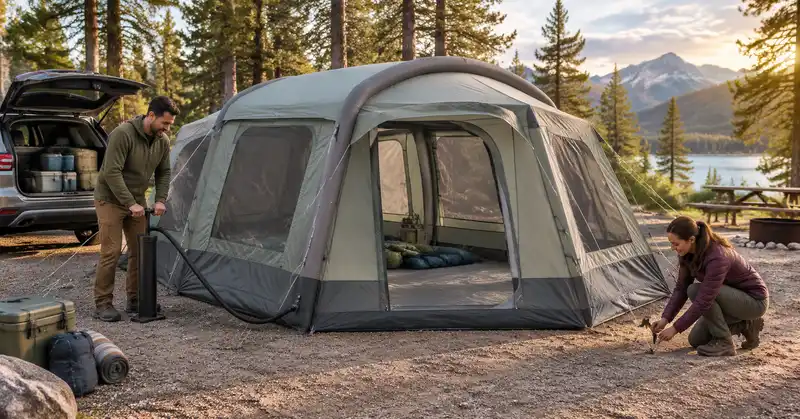
An Inflatable Camping Tent replaces most traditional structural poles with pressurized air beams that you inflate with a compatible pump. The biggest benefit is simpler setup, especially for larger family tents. The main trade-offs are higher prices, pump dependency, possible air-beam repairs, and—in some designs—considerable packed weight.
The real question is not whether inflatable tents are automatically better than pole tents. It is whether the easier setup, air-frame construction, packed size, weather protection, repair support, and price fit the way you actually camp.
Table of Contents
Inflatable Camping Tent at a Glance
| Factor | Inflatable tent | Traditional pole tent |
|---|---|---|
| Main structure | Pressurized air beams | Aluminum, fiberglass, or steel poles |
| Basic setup | Inflate, then stake and guy | Assemble poles, then stake and guy |
| Pump required | Yes | No |
| Possible structural problem | Air leak, bladder, or valve issue | Bent, cracked, or broken pole |
| Typical field repair | Patch or replace air component | Pole splint or replacement section |
| Weight | Varies widely | Varies widely |
| Packed bulk | Can be substantial on family models | Depends on tent design |
| Price | Often higher for premium air tents | Wider low-cost selection |
| Best fit | Convenience-focused car and family camping | Broad range of camping styles |
Inflatable construction alone does not tell you whether a tent will be light, compact, or easy to transport. Current models range from compact 2–3-person shelters weighing around 10 pounds to large canvas family tents weighing well over 100 pounds.
How Does an Inflatable Camping Tent Work?
Instead of sliding rigid poles through sleeves or attaching tent clips to a frame, an inflatable air tent uses pressurized tubes as structural supports.
A typical air beam includes:
- An airtight inner bladder
- A protective fabric sleeve
- One or more inflation valves
- Connections that hold the beam within the tent structure
Some inflatable tents use a single inflation point. Others use several independent beams or chambers.
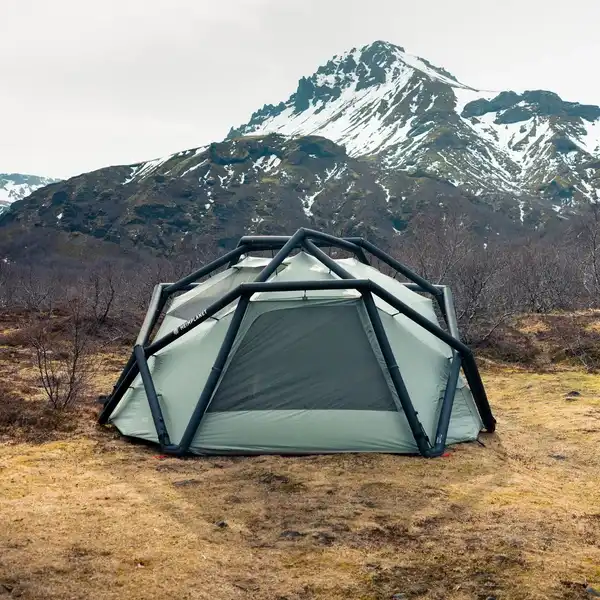
For example, HEIMPLANET’s The Cave uses an interconnected air frame that can later be separated into individual chambers. That means damage to one section does not automatically cause the entire frame to lose pressure.
This kind of chamber-isolation system is useful, but it is not standard on every inflatable tent.
Air beams also do not eliminate the need for stakes and guylines. Inflatable tents still need to be anchored correctly for the conditions.
Inflatable Camping Tent Pros and Cons
Understanding the trade-offs is more useful than simply looking for the fastest-pitching model.
Advantages of an Inflatable Camping Tent
Setup can be easier. You do not need to identify, connect, and thread several long pole sections before raising the tent.
Large tents may be easier for one person to pitch. This is especially useful for parents, couples, or solo campers setting up a family-size shelter.
Air beams can flex under load. Unlike some rigid poles, an air beam can bend and return to shape rather than staying permanently bent.
Some models are designed to be repaired. Quality manufacturers may offer patch kits, replacement inner tubes, valves, or full air-beam components.
Large family designs can offer substantial living space. Air-frame construction is widely used in tall campground tents where convenience matters more than minimum weight.
Disadvantages of an Inflatable Camping Tent
Prices can be high. Many premium air tents cost considerably more than basic pole tents of similar sleeping capacity.
A pump is essential. If the correct pump is forgotten, damaged, or incompatible, pitching the tent may become impossible.
Leaks can happen. The problem could involve an inner bladder, valve, connection, or another part of the air system.
Replacement parts are model-specific. You cannot assume that a generic repair part will work with every inflatable tent.
Large inflatable tents can be heavy. Removing rigid poles does not automatically make a tent lightweight.
Packed size can be substantial. Family air tents often suit SUVs, pickups, trailers, and car camping better than long carry-in campsites.
Inflation is only one part of setup. The tent still needs positioning, staking, guying, organizing, and weather adjustment.
Inflatable Camping Tent vs Traditional Tent: Which Is Better?
An inflatable tent usually makes more sense when quick structural setup is valuable and you normally transport your shelter by vehicle.
Consider an inflatable tent when:
- You regularly use a large family shelter.
- One-person setup matters.
- You dislike assembling long pole systems.
- Your vehicle has enough cargo space.
- The packed weight is manageable.
- Replacement air components are available.
- You camp often enough to benefit from faster setup.
A traditional pole tent may be better when:
- Budget is a priority.
- You backpack or carry gear long distances.
- You do not want to bring a pump.
- Your vehicle has limited cargo space.
- You prefer simple pole repairs.
- You want the widest possible product selection.
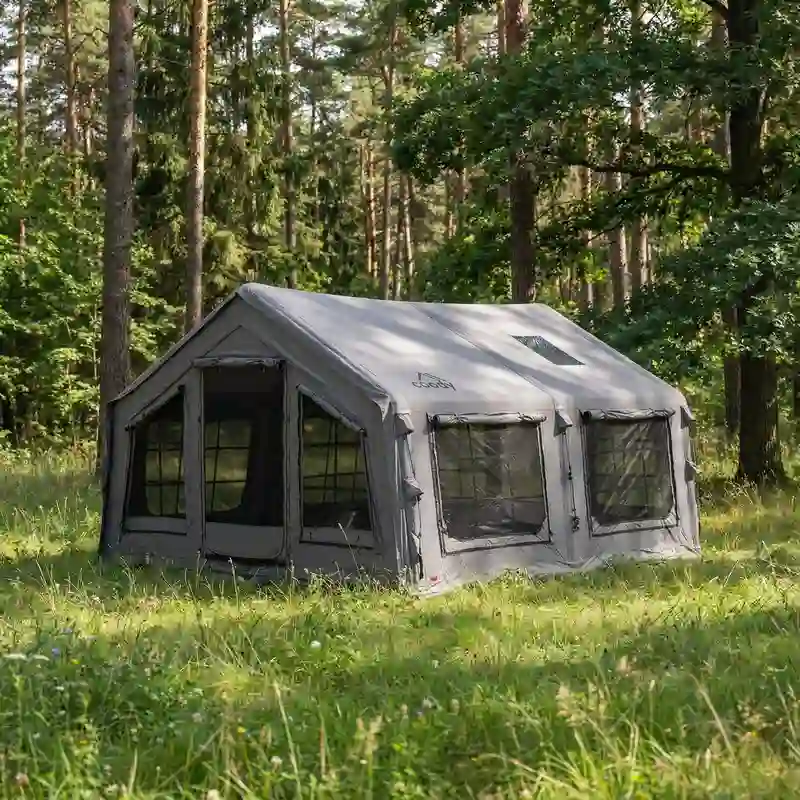
There are exceptions. HEIMPLANET’s The Cave weighs about 10.7 pounds, while the much larger Coody 13.6 weighs about 132 pounds. That difference shows why you should compare the actual specifications rather than assuming all air tents share the same advantages or drawbacks.
How to Choose an Inflatable Camping Tent by Weight and Packed Size
Weight should be one of your first filters.
Consider these current examples:
- HEIMPLANET The Cave: about 10.7 lb
- Zempire Pronto 5 V2: 37 lb
- Coody 13.6: about 132 lb
Before purchasing, ask:
- Can one person lift the packed tent?
- How far is the campsite from the vehicle?
- Will the tent fit with coolers, chairs, bedding, and other equipment?
- Where will you store it at home?
- Will you move camp every day or stay several nights?
A large inflatable family tent can work well for a multi-night basecamp but become frustrating if every trip involves carrying equipment hundreds of yards from the parking area.
If you mainly camp by vehicle, it also helps to match your shelter to the campsite and trip plan before choosing a very large tent.
Choosing the Right Inflatable Camping Tent Capacity
Do not buy solely from the person rating printed in the product name.
Maximum sleeping capacity often assumes people are positioned closely together with minimal room for luggage.
Zempire, for example, distinguishes between the Pronto 5 V2’s:
- Comfort capacity: 4 people
- Maximum capacity: 5 people
- Bedroom area: 82.9 sq. ft.
- Peak height: 76 in.
That distinction is useful for family campers.
When comparing an inflatable family tent, consider:
- Actual floor dimensions
- Mattress sizes
- Number of adults versus children
- Gear storage
- Pets
- Standing height
- Vestibule or living area
- Total campsite footprint
For most campground trips, realistic comfort capacity is more useful than the absolute maximum sleeping number.
Air Beams, Valves and Inflation Pressure
Inflatable tents need the correct pressure to provide structural support.
Too little pressure can make the beams soft and reduce stability. Too much pressure can put unnecessary stress on the bladder, seams, and valves.
There is no universal inflation pressure for every inflatable tent.
HEIMPLANET currently specifies 6–8 PSI for The Cave. Coody also lists 6–8 PSI for its 13.6 model.
Those matching numbers do not mean you should automatically use 6–8 PSI for another brand.
Always follow the exact manual supplied with your tent.
Temperature can also influence air pressure. Avoid adding excessive pressure simply because the beams feel slightly different during cooler conditions.
Inflatable Camping Tent With Pump: What Should Be Included?
The pump is part of the shelter system, not just an optional accessory.
Before buying, check whether the package includes:
- Hand pump
- Pressure gauge
- Correct valve adapter
- Inflation hose
- Deflation function
- Replacement or repairable pump components
Zempire Pronto 5 V2
The Pronto 5 V2 currently includes a high-pressure pump and an emergency repair kit.
Coody 13.6
Coody currently includes a hand pump and specifies a recommended inflation pressure of 6–8 PSI.
HEIMPLANET The Cave
The Cave includes a pump adapter, but the compatible floor pump is sold separately.
That is an easy purchasing detail to miss.
Do not automatically substitute an air-mattress inflator, tire compressor, or other high-pressure device. The pressure range and valve connection need to be compatible with the tent.
If you plan to use an electric pump, carrying a compatible manual pump as a backup can prevent a battery or electrical failure from leaving you unable to pitch the shelter.
Is a Waterproof Inflatable Camping Tent Really Waterproof?
Inflatable beams do not determine whether the tent keeps rain outside.
Water resistance depends mainly on:
- Flysheet material
- Hydrostatic-head rating
- Floor construction
- Seam sealing
- Rainfly coverage
- Door design
- Correct pitching
- Guyline tension
- Fabric condition
- Ventilation
Current examples show how specifications differ.
HEIMPLANET lists The Cave with:
- 3,000 mm flysheet
- 5,000 mm floor
Zempire lists the Pronto 5 V2 with a 3,000 mm waterhead rating.
Those numbers are useful for comparison, but they do not guarantee that a tent can never leak.
Rain can still enter because of damaged seams, worn coatings, poor pitching, open doors, water pooling under the floor, or condensation forming inside.
Coody’s 13.6 uses a PVC floor with raised edges and includes a rainfly, but its current specifications do not provide a directly comparable hydrostatic-head figure.
Wind, Guying and Weather Limits
Flexible air beams can bend under wind loads rather than behaving exactly like rigid poles, but that does not make an inflatable tent storm-proof.
Manufacturers still require proper anchoring.
You should:
- Use the required stakes.
- Deploy guylines.
- Tension the shelter correctly.
- Recheck anchors as conditions change.
- Follow manufacturer weather guidance.
- Check the forecast before leaving home.
- Avoid exposed campsites when severe weather is expected.
HEIMPLANET specifically advises securing all stakes even in calm weather and recommends avoiding setup during thunderstorms, strong winds, and heavy snowfall when possible.
Coody also recommends reinforcing the tent with additional stakes and guylines in stronger winds.
If you want a refresher on securing shelter lines, Camping Trip Atlas covers basic camping knots for securing guylines.
Do not rely only on promotional wind-test videos when deciding whether a tent is suitable for a forecast.
Inflatable Camping Tent Repair: What Happens if an Air Beam Leaks?
An air leak does not always mean the entire tent needs to be replaced.
Possible problems include:
- Loose valve
- Damaged valve
- Punctured inner bladder
- Leaking connection
- Damaged beam sleeve
- Failed individual chamber
The correct repair depends on the manufacturer’s system.
HEIMPLANET includes a repair kit with The Cave, and its chamber design allows parts of the air frame to be isolated.
Zempire publishes instructions for accessing and replacing inner tubes in its AirSystem beams and provides model-specific replacement components.
That means repair support should be part of the buying decision.
Before purchasing, check whether the manufacturer sells:
- Replacement inner bladders
- Replacement beams
- Replacement valves
- Appropriate repair patches
- Pump adapters
- Model-specific repair instructions
Keep the original repair kit with the tent whenever you camp.
For an actual puncture, use the manufacturer’s procedure rather than applying random glue or tape that could damage the bladder material.
Current Inflatable Camping Tents to Consider
These selections are based on current manufacturer specifications and intended use. They are not personal field-test claims.
Zempire Pronto 5 V2 — For Family Car Camping
Current specifications include:
- 4-person comfort capacity
- 5-person maximum capacity
- 37 lb weight
- 76-in. peak height
- 82.9 sq. ft. bedroom
- 3,000 mm waterhead rating
- High-pressure pump included
- Emergency repair kit included
- Two-year Pronto Series guarantee
- Listed price verified September 4, 2026: $500
Zempire’s official page gives slightly inconsistent pitching-time wording. Its marketing copy describes very fast frame inflation and roughly 5–10 minutes for complete setup, while the specification table gives a longer inflation figure.
The more useful conclusion is that the Pronto is designed for simplified campground setup rather than relying on one exact stopwatch number.
Best for: families and small groups who want standing height, simple setup, an included pump, and a moderate price within the air-tent category.
Skip it if: you need a shelter for long carry-in campsites.
HEIMPLANET The Cave — For Compact Premium Camping
Current specifications include:
- 2–3-person design
- About 10.7 lb
- Packed size of about 15.7 × 12.6 × 9.1 in.
- 39.8 sq. ft. inner-tent area
- 49.2-in. total height
- 3,000 mm flysheet
- 5,000 mm floor
- Single inflation point
- Separable air chambers
- Repair kit included
- Pump adapter included
- Compatible floor pump sold separately
- Listed price verified September 4, 2026: $1,199
HEIMPLANET also provides long-term support and sells replacement parts for its tent systems.
Best for: couples or small groups wanting a compact inflatable design with repairable air chambers.
Skip it if: you want standing room, large family living space, or a lower purchase price.
Coody 13.6 — For Large Family and Basecamp Camping
Current U.S. specifications include:
- Up to 8 sleeping-bag occupants
- About 146.39 sq. ft. usable interior
- About 6.9 ft interior height
- 132 lb listed net weight
- 210 gsm TC fabric
- PVC floor
- PVC air tubes
- 6–8 PSI recommended pressure
- Hand pump included
- Rainfly included
- One-year warranty
- Listed price verified September 4, 2026: $1,899
The shelter also includes multiple doors and windows and a removable divider.
At 132 pounds, transport is the dominant consideration.
Best for: vehicle-supported family basecamps, extended campground stays, and campers prioritizing interior space.
Skip it if: you move camp often, have limited cargo space, or need to carry the shelter any meaningful distance.
Inflatable Camping Tent Comparison
| Model | Intended use | Capacity | Weight | Weather specification | Pump | Repair/support | Price verified Sept. 4, 2026 | Main limitation |
|---|---|---|---|---|---|---|---|---|
| Zempire Pronto 5 V2 | Family car camping | 4 comfort / 5 max | 37 lb | 3,000 mm waterhead | Included | Repair kit, 2-year guarantee | $500 | Heavy for carry-in camping |
| HEIMPLANET The Cave | Compact premium camping | 2–3 | 10.7 lb | 3,000 mm fly / 5,000 mm floor | Adapter included; pump separate | Repair kit, isolated chambers, long-term support | $1,199 | High price and low standing height |
| Coody 13.6 | Large basecamp/glamping | Up to 8 sleeping bags | 132 lb | No comparable HH figure published | Included | 1-year warranty | $1,899 | Extremely heavy |
Prices and availability can change. They were verified from manufacturer listings on September 4, 2026.
Is an Inflatable Camping Tent Worth It for Family Camping?
For many vehicle-based families, yes—especially when a large conventional pole tent is frustrating to pitch.
An inflatable family tent can be particularly useful when:
- One adult often handles most campsite setup.
- You arrive at camp late.
- Children need supervision while camp is being built.
- You use a tall multi-person shelter.
- You camp frequently enough for easier setup to matter.
It may offer less value when:
- You only camp occasionally.
- Your existing pole tent already pitches quickly.
- Storage space is limited.
- You must carry gear far from the car.
- Your budget is tight.
The value comes mainly from setup convenience, not from the air-beam label itself.
Inflatable Camping Tent Buying Checklist
Before paying, verify:
- Comfortable sleeping capacity
- Maximum capacity
- Floor area
- Peak height
- Vestibule or living space
- Packed weight
- Packed dimensions
- Campsite footprint
- Fly material
- Floor construction
- Waterproof ratings
- Air-beam design
- Required PSI
- Pump included or separate
- Pressure gauge
- Repair kit
- Replacement bladder availability
- Replacement valve availability
- Warranty
- U.S. parts and support
- Current price
- Current availability
For a large family air tent, measure your vehicle’s cargo area before ordering. Product photos rarely communicate packed bulk accurately.
Inflatable Camping Tent Care and Storage
Air beams need care, but so does the surrounding fabric.
Useful habits include:
- Dry the tent completely before long-term storage.
- Remove dirt and debris before packing.
- Keep valves clean.
- Protect beams from sharp objects.
- Keep the correct pump with the tent.
- Store the repair kit in the tent bag.
- Follow manufacturer inflation-pressure limits.
- Avoid unnecessary long-term UV exposure.
- Inspect valves and beams before major trips.
Zempire specifically recommends drying tents fully before storage to reduce mildew risk. It also recommends adequate ventilation during use to help control condensation.
The best time to discover a damaged valve or missing pump adapter is at home—not after reaching a campground.
Frequently Asked Questions
Are inflatable camping tents reliable?
A well-made Inflatable Camping Tent can be reliable when it is inflated correctly, properly staked and guyed, and maintained according to the manufacturer. Reliability also depends on repairability. Models with available replacement bladders, valves, repair kits, and manufacturer support are easier to keep usable after an air-system problem.
Do inflatable tents puncture easily?
Not necessarily. Quality air beams usually protect the airtight inner bladder with a stronger outer sleeve. Punctures, valve leaks, and wear are still possible, so carrying the correct repair kit and confirming replacement-part availability is sensible.
Are inflatable tents waterproof?
They can provide strong rain protection, but air beams do not determine waterproofness. Look at the flysheet, hydrostatic-head rating, floor, seams, doors, and pitching system. Proper staking, guyline tension, ventilation, and fabric maintenance also affect performance in wet weather.
Do inflatable tents need a special pump?
Usually, yes. The pump must match the tent’s valve and pressure requirements. Some inflatable tents include a hand pump, while others include only an adapter. Do not assume an air-mattress pump or automotive compressor is compatible.
Is an inflatable tent better than a normal tent?
It depends on the trip. Inflatable tents are attractive for car campers and families who value easier structural setup. Traditional pole tents remain better for many budget, backpacking, and lightweight uses. Compare packed weight, capacity, weather construction, repairability, setup effort, and price rather than choosing only by frame type.
Conclusion
An Inflatable Camping Tent makes the most sense when easier pitching is important enough to justify the pump, air-frame maintenance, packed size, and often higher purchase price.
Before buying, compare comfortable capacity, packed weight, weather construction, required pressure, pump setup, replacement parts, and warranty support. Those factors will tell you far more about whether the tent fits your trips than a fast inflation claim alone.
References:
- Zempire — Pronto 5 V2 Air Tent
Direct working URL - Zempire — Warranty Policy
Direct working URL - Zempire — Replacement AirSystem Beams
Direct working PDF - HEIMPLANET — The Cave 3-Season
Direct working URL - HEIMPLANET — Lifetime Support
Direct working URL - Coody USA — Coody Familia AirTent 13.6
Direct working URL