
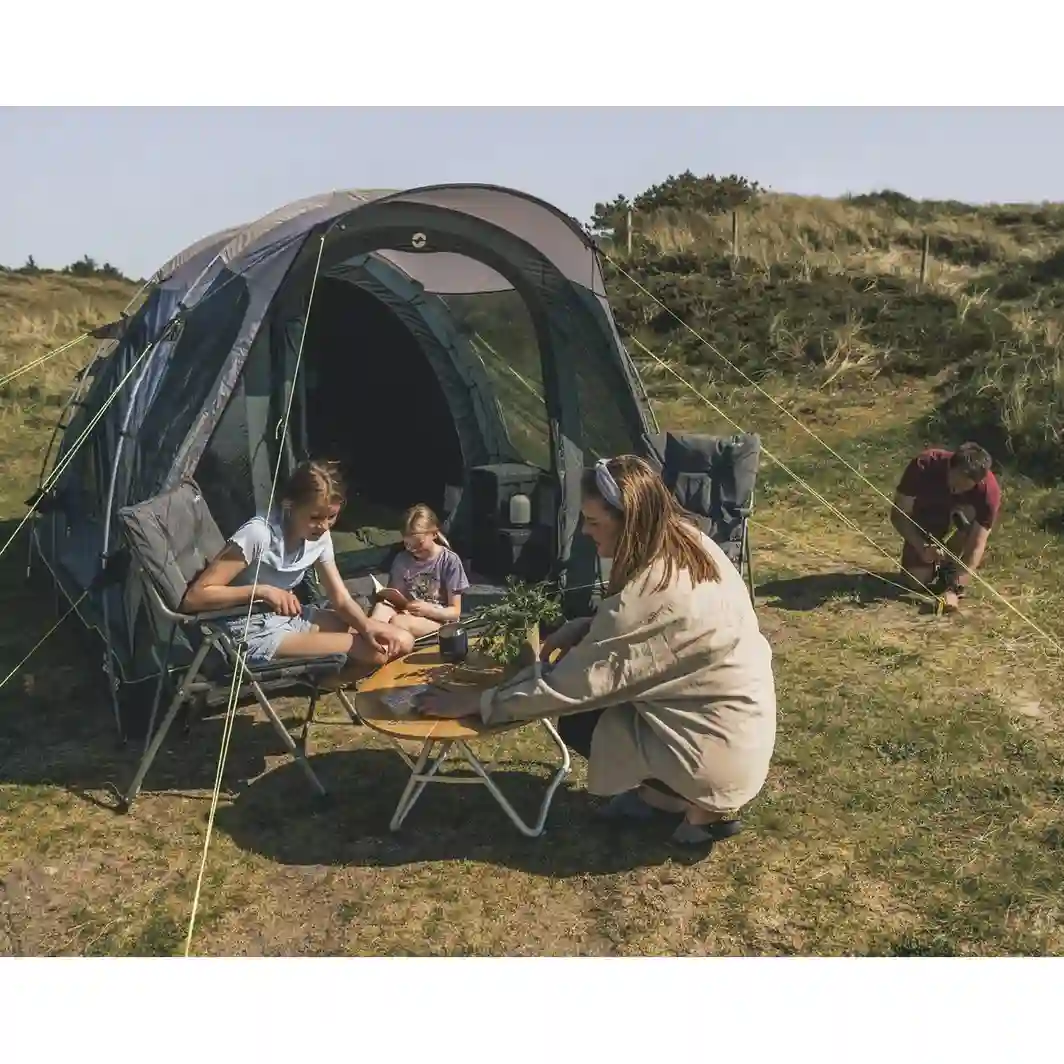
4 Person Camping Tent: Size, Features and Buying Guide
A 4 person camping tent can work for four sleepers, but the capacity label does not tell you how comfortable those four people will be. Two adults with a queen air mattress, a family with children, and four adults using individual sleeping pads all need different amounts of usable floor space.
Start by measuring your sleeping setup. Then compare the tent’s actual floor dimensions, wall shape, vestibules, height, doors, ventilation, setup system, weather protection, packed size, and campsite footprint. Those details tell you much more than the number printed on the tent bag.
Table of Contents
4 Person Camping Tent at a Glance
| Factor | What to check | Why it matters |
|---|---|---|
| Capacity | Maximum sleeping capacity | Does not guarantee roomy occupancy |
| Floor dimensions | Actual length and width | Determines whether mattresses or pads fit |
| Floor area | Total square footage | Helps compare similarly rated tents |
| Peak height | Tallest interior point | Does not show how much standing room you get |
| Wall shape | Dome, steep-wall, cabin | Changes usable interior volume |
| Doors | One or two | Affects nighttime access |
| Vestibules | Covered storage area | Keeps gear off the sleeping floor |
| Setup | Traditional or instant | Changes setup speed, weight, and bulk |
| Weather design | Rainfly, seams, floor, guylines | More useful than a simple “waterproof” claim |
| Packed size | Bag dimensions | Matters for vehicles and home storage |
What Does “4 Person” Actually Mean?
A four-person rating is best treated as a sleeping-capacity starting point, not a promise of spacious comfort.
Tent manufacturers do not all use one identical amount of floor space per camper. Two shelters labeled for four people can therefore have noticeably different floor areas, shapes, heights, and storage options.
At maximum occupancy, four sleepers may use most of the floor.
That leaves less room for:
- Clothing
- Duffel bags
- Shoes
- Dog beds
- Interior movement
- Rainy-day lounging
This is why comparing only person capacity can lead to the wrong tent.
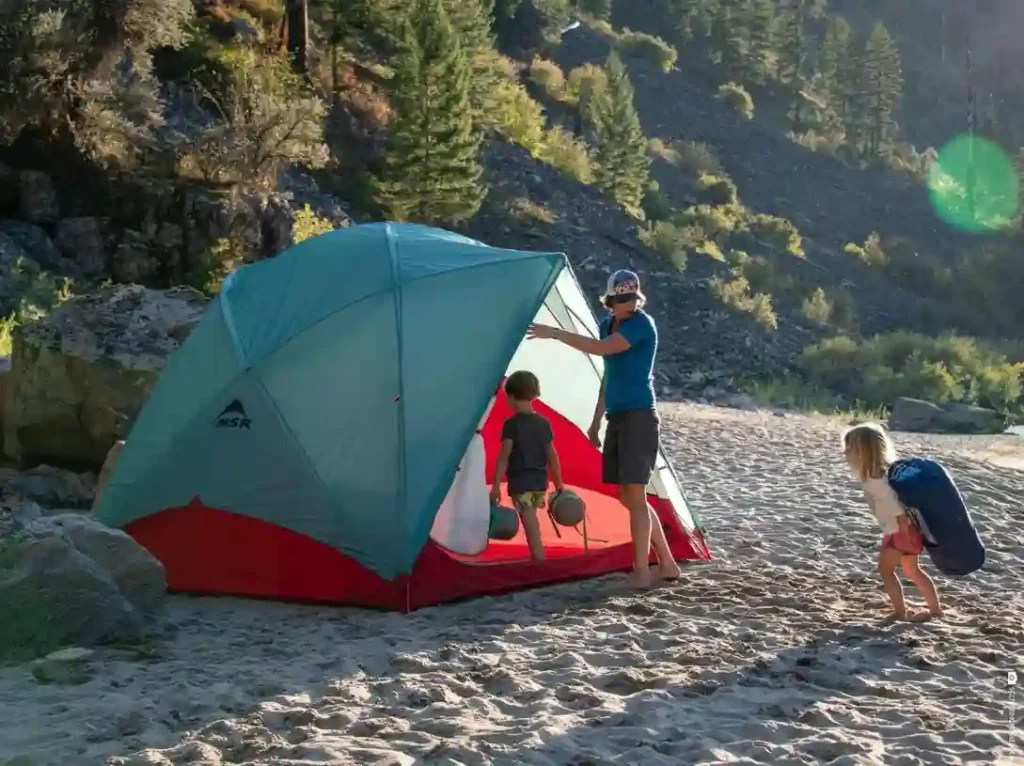
How Much Space Does a Four-Person Tent Really Give You?
The best way to answer this question is to create your sleeping arrangement before you shop.
Measure Your Sleeping Pads
If four people use individual sleeping pads, write down the width and length of each pad.
Then arrange those dimensions on paper or tape out the approximate footprint on the floor at home.
Ask:
- Can all four pads fit?
- Is there a route to the door?
- Where will bags go?
- Does the floor narrow toward one end?
- Will a pet need floor space?
Even a few inches can matter when several sleeping pads sit side by side.
Check Queen Air-Mattress Fit
Many couples choose a 4-person tent because they use a queen-size air mattress.
But “fits a queen air bed” does not necessarily mean you will have lots of empty floor around it.
For example, the current Coleman Skylodge 4 is designed to fit one queen air bed. Its floor measures 7.5 × 7.5 feet.
That arrangement can work well for two people, but you should still think about where you will place clothing, footwear, and other gear.
Add Gear, Pets and Movement Space
The sleeping system is only the first layer.
Also account for:
- Clothing bags
- Children’s equipment
- Small personal items
- Dog beds
- Wet-weather gear
- Space needed to enter and exit
If every inch of the tent floor is covered with bedding, the shelter may technically accommodate the group but still feel inconvenient.
Use Vestibules Before Automatically Sizing Up
A vestibule is covered space outside the sleeping floor but protected by the rainfly.
It can be useful for:
- Boots
- Wet jackets
- Packs
- Some appropriate gear
A tent with useful vestibules may feel more practical than another tent with slightly more interior floor space but nowhere to keep dirty gear.
Is a 4-Person Tent Good for Two Adults?
Yes, a four-person tent can be an excellent car-camping size for two adults when comfort matters more than minimizing weight and packed size.
It gives a couple room for:
- A queen air mattress
- Extra clothing
- A dog
- Easier entry and exit
- Changing clothes
- More comfort during rain
However, two people do not automatically need that much room.
A smaller tent may make more sense when:
- Campsites are small.
- You use compact sleeping pads.
- Most gear stays in the vehicle.
- You move camp frequently.
- Packed size matters.
The right answer depends on how you actually use the shelter.
Can a Family of Four Use a 4-Person Tent?
A family of four can use a four-person tent, but comfort depends on who the four people are and what they sleep on.
Two adults with two young children may use the same floor very differently from four adults.
Things to consider include:
- Children’s mattress sizes
- Sleeping-pad width
- Bedtime routines
- Clothing storage
- Pets
- Amount of time spent inside
- Trip length
For a one- or two-night fair-weather trip, a compact arrangement may be completely acceptable.
For a longer family vacation where everyone may spend time inside during rain, sizing up can provide noticeably more usable space.
4 Person Tent vs 6 Person Tent
Moving up to a six-person tent gives you more room, but it also creates trade-offs.
| Decision factor | 4-person tent | 6-person tent |
|---|---|---|
| Campsite footprint | Usually smaller | Usually larger |
| Vehicle storage | Usually easier | Usually bulkier |
| Setup | Often simpler | May require more work |
| Living space | More compact | More room for people and gear |
| Family of four | Can work | Often provides extra comfort |
| Weight | Usually lower | Often higher |
| Wind exposure | Design-dependent | Larger/taller designs can expose more fabric |
A 4-person shelter makes sense when:
- Two or three campers are typical.
- Campsite space is limited.
- Gear can remain in the vehicle or vestibules.
- Lower weight and bulk matter.
- You move camp regularly.
A 6-person tent may make more sense when:
- Four people want significant interior space.
- You bring a large dog.
- Bulky gear stays inside.
- You expect longer stays.
- Rainy-day living space matters.
- Standing and movement room matter more than packed size.
Do not size up automatically. A larger tent that does not fit the campsite is not an upgrade.
Floor Dimensions Matter More Than the Label
Floor area is useful, but actual length and width are even more useful when planning mattresses.
Look for:
- Rectangular versus tapered floors
- Narrow corners
- Door position
- Pole intrusions
- Mattress orientation
- Cot length
- Space between sleepers
A wide rectangular tent may be easier to organize than another shelter with similar square footage but more aggressive tapering.
If you use cots, measure them carefully. Cots are often less forgiving than flexible sleeping pads because their frames cannot overlap or compress.
Peak Height and Wall Shape
Peak height measures the tallest point inside the tent.
It does not tell you how much of the interior reaches that height.
A dome-shaped shelter may have plenty of height at the center but lower headroom near the walls.
A steeper-wall or cabin-style tent keeps more usable volume around the edges.
That difference matters when:
- Sitting on a cot
- Changing clothes
- Standing
- Moving around during bad weather
- Sharing the shelter with several people
Tall walls can improve livability, but they also create more surface area for wind. Shelter shape should be considered alongside pole structure, stakes, guylines, and campsite exposure.
Doors and Vestibules
Multiple sleepers make door placement more important.
Two doors allow people on different sides of the tent to enter or leave without climbing over everyone else.
Vestibules are equally valuable.
The current Wawona 4 provides about 58.13 square feet of interior floor area, plus a large front vestibule and smaller rear vestibule. That design shows why comparing tents only by interior square footage can be misleading.
Covered exterior storage can make a smaller sleeping area much easier to live with.
Easy Setup: Instant vs Traditional Pole Tents
Different setup systems solve different problems.
Instant-Frame Tents
Instant designs keep much of the tent frame attached.
The Coleman Skylodge 4 uses pre-attached telescoping poles. Coleman currently states that its structural setup takes about one minute.
That can be useful for campers who:
- Arrive late
- Move camps frequently
- Camp with children
- Prefer fewer separate poles
The trade-off is weight and bulk.
The Skylodge 4 currently weighs 21.37 pounds, which is heavy compared with many traditional 4-person designs.
Also remember that “one-minute setup” does not include every campsite task. You still need to select the location, position the tent, install or adjust the rainfly, stake it correctly, tension guylines, and arrange the interior.
Traditional Pole Tents
Traditional tents use separate poles assembled during setup.
The Marmot Limestone 4 is a current example of this approach, with aluminum poles, a color-coded clip-and-pole system, two doors, and two vestibules.
Its listed minimum weight is 10 pounds 12.6 ounces, substantially lower than the Coleman instant model.
A traditional frame usually takes longer to assemble, but it can offer:
- Lower weight
- Shorter packed components
- Simple replaceable parts
- Familiar construction
Inflatable Tents
Some tents replace major structural poles with pressurized air beams.
This can make large shelters easier to raise, but it introduces pumps, inflation pressure, valves, and repair considerations.
If this design interests you, Camping Trip Atlas has a separate guide where you can compare inflatable tent construction and trade-offs.
What Makes a Weather-Ready 4-Person Tent?
Avoid treating the word “waterproof” as an absolute guarantee.
Instead, inspect the complete weather system:
- Rainfly coverage
- Seam treatment
- Floor construction
- Door protection
- Ventilation
- Pole structure
- Guyline attachment points
- Stakes
- Correct pitching
The current Marmot Limestone 4 uses a seam-taped, full-coverage fly and a seam-taped floor.
The Wawona 4 currently uses a 1,200 mm PU-coated rainfly/canopy and a 1,500 mm PU-coated floor, along with external guylines.
The Coleman Skylodge uses welded corners, inverted seams, and taped seams on the rainfly and tent body.
Those are useful construction details, but none guarantees that a shelter will remain completely dry in every combination of wind, rain, campsite drainage, and pitching error.
Ventilation and Condensation
Four people can produce a surprising amount of moisture inside a tent simply through breathing.
Good ventilation helps move that moisture out.
Useful features include:
- Mesh doors
- Mesh roof panels
- High vents
- Low vents
- Rain-protected openings
- Space between the inner tent and rainfly
Condensation on the inside of a rainfly does not always mean rainwater leaked through the fabric.
Warm humid air inside the tent can condense when it meets a cooler surface.
Keep ventilation open when conditions allow rather than sealing every opening at night.
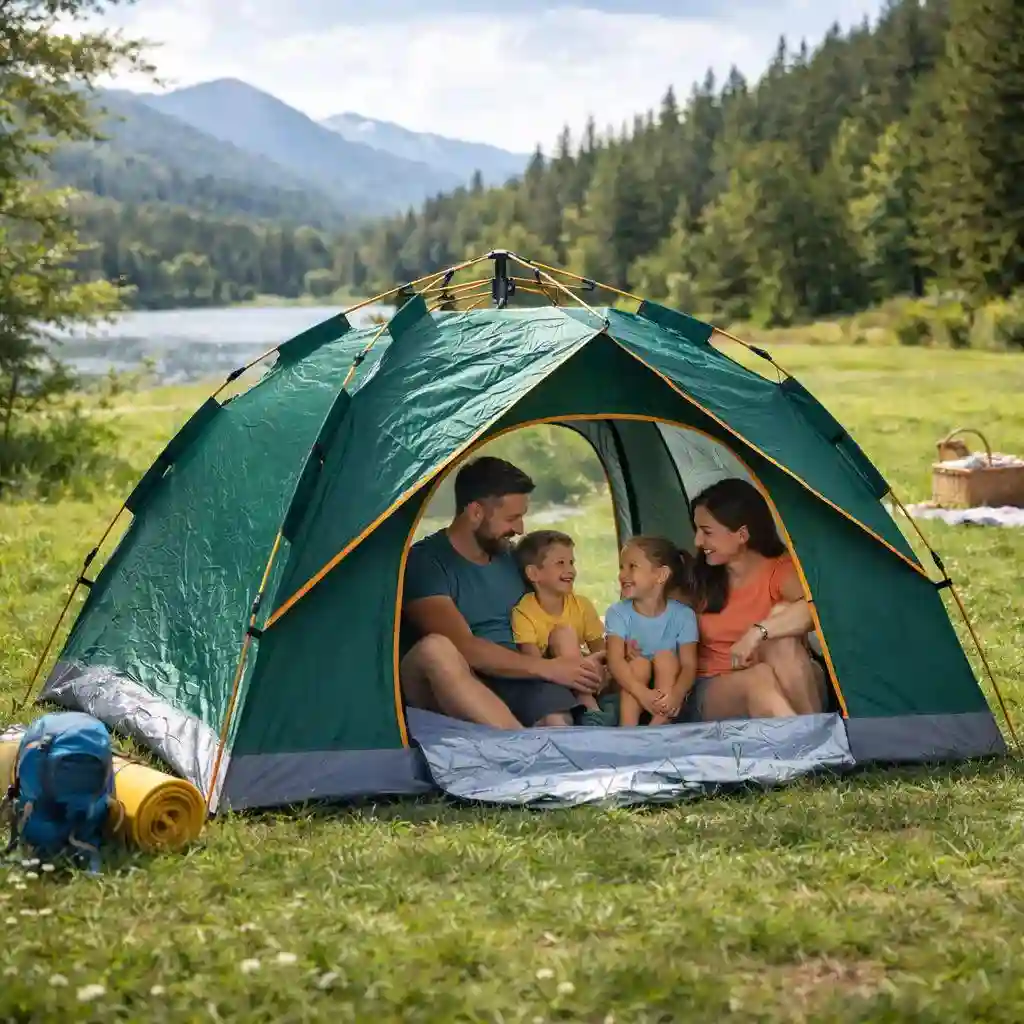
Weight, Packed Size and Campsite Footprint
Even if you are car camping, weight still matters.
You may need to:
- Lift the tent into a vehicle.
- Carry it from a parking area.
- Fit it beside coolers and chairs.
- Store it in an apartment or garage.
Packed dimensions can matter as much as weight.
The Coleman Skylodge 4 uses an instant frame and packs into a longer bag than many conventional pole tents.
The Marmot Limestone 4 currently packs to about 24.4 × 10.4 inches.
Before sizing up, also check whether your shelter fits the campsite. A 6-person upgrade can be inconvenient if the campground provides a small tent pad or limited usable space.
Current 4-Person Camping Tent Examples
These models illustrate different design priorities. They are specifications-based examples, not personal field tests or a universal ranking.
Coleman Skylodge 4 — Easy-Setup Example
Current manufacturer specifications include:
- 4-person capacity
- 7.5 × 7.5-ft floor
- 5.4-ft center height
- 21.37-lb weight
- Pre-attached telescoping poles
- About-one-minute manufacturer setup claim
- Space for one queen-size air bed
- Rainfly
- WeatherTec seam and floor construction
- Wide door
- Mesh storage pockets
- 1-year limited warranty
Coleman currently lists a sale price of $213.99, compared with a $284.99 list price. Price and stock can change.
Best for: car campers who prioritize quick structural setup.
Main limitation: the convenience comes with substantial weight and packed bulk for a four-person shelter.
Marmot Limestone 4 — Traditional Pole Example
Current manufacturer specifications include:
- 59.2 sq. ft. floor area
- 63-in. peak height
- 10 lb 12.6 oz minimum weight
- Two doors
- Two vestibules
- 27.99 sq. ft. total vestibule area
- Aluminum poles
- Seam-taped full-coverage fly
- Seam-taped floor
- 24.4 × 10.4-in. packed size
- Footprint not included
- Limited lifetime warranty
At the time of verification, Marmot’s current product page listed this version as out of stock, so it should be treated as a design example rather than assumed immediately available.
Best for: campers who want traditional construction, two doors, useful vestibule storage, and lower weight than many instant-frame family tents.
Main limitation: less standing height than taller cabin-style designs, plus uncertain current availability.
The North Face Wawona 4 — Vestibule and Living-Space Example
Current manufacturer specifications include:
- 4-person capacity
- 58.13 sq. ft. floor area
- 14 lb 9.5 oz total weight
- 27.6-sq.-ft. front vestibule
- 14.9-sq.-ft. rear vestibule
- Hybrid double-wall construction
- Large mesh front door
- External guylines
- 1,200 mm PU-coated rainfly/canopy
- 1,500 mm PU-coated floor
- Footprint sold separately
- Limited lifetime guarantee
The current U.S. manufacturer price is $485.
Best for: campers who prioritize covered gear storage and interior livability.
Main limitation: the price is significantly higher than basic four-person tents, and the large vestibules increase the total deployed footprint.
4-Person Tent Comparison Table
| Model | Floor | Height | Weight | Doors / vestibules | Setup | Best use | Main limitation | Current price/status |
|---|---|---|---|---|---|---|---|---|
| Coleman Skylodge 4 | 7.5 × 7.5 ft | 5.4 ft | 21.37 lb | Wide door; no dedicated vestibule listed | Instant frame | Fast campground setup | Heavy and bulky | $213.99 sale price |
| Marmot Limestone 4 | 59.2 sq. ft. | 63 in. | 10 lb 12.6 oz minimum | 2 doors; 27.99 sq. ft. vestibule area | Traditional poles | Lower-weight conventional setup | Lower height; currently out of stock | Out of stock at manufacturer |
| The North Face Wawona 4 | 58.13 sq. ft. | Tall stand-up-oriented interior | 14 lb 9.5 oz | Large front + rear vestibules | Color-coded poles | Covered storage and livability | Price and deployed footprint | $485 |
Prices and availability were checked on September 11, 2026 and can change.
Which Features Are Worth Paying For?
For many campers, the highest-value upgrades are practical rather than flashy.
Worth prioritizing:
- Floor dimensions that fit your actual sleep system
- Good rainfly coverage
- Effective ventilation
- Two doors for several sleepers
- Useful vestibule storage
- Reliable frame construction
- Guyline points
- Repair and warranty support
More situational features include:
- Instant frames
- Very tall cabin walls
- Dark-room fabrics
- Screen rooms
- Inflatable frames
- Electrical-access ports
Pay for these when they solve a specific problem in the way you camp.
Common 4-Person Tent Buying Mistakes
Avoid these problems:
- Buying only by the advertised capacity.
- Not measuring mattresses or sleeping pads.
- Assuming four adults will also have plenty of gear space.
- Ignoring sloping walls.
- Ignoring vestibule storage.
- Treating “waterproof” as a guarantee.
- Forgetting packed dimensions.
- Choosing instant setup without checking total weight.
- Automatically buying a 6-person tent without checking campsite size.
- Assuming every footprint is included.
- Comparing only price without checking doors, fly coverage, and usable floor shape.
4 Person Camping Tent Buying Checklist
Before buying, verify:
- Number of sleepers
- Adults versus children
- Pets
- Mattress or pad dimensions
- Floor dimensions
- Floor area
- Peak height
- Wall geometry
- Number of doors
- Vestibule area
- Interior storage
- Ventilation
- Rainfly coverage
- Floor construction
- Seam treatment
- Guyline points
- Included stakes
- Setup system
- Packed weight
- Packed dimensions
- Campsite footprint
- Whether the footprint is included
- Warranty and support
- Current price
- Current availability
Frequently Asked Questions
Is a 4-person tent actually big enough for four people?
Yes, a 4 person camping tent is designed to accommodate four sleepers, but that does not mean four adults will have generous living and gear space. Measure the sleeping pads or mattresses and compare them with the actual floor dimensions. A family with young children may use the same tent very differently from four adults.
What are typical 4 person tent dimensions?
There is no single standard size. Current four-person tents vary meaningfully in floor shape, square footage, and height. For example, some use roughly a 7.5 × 7.5-ft floor, while others list around 58–59 square feet. Always check the individual model rather than relying on capacity alone.
Can a queen air mattress fit in a 4-person tent?
Many four-person car-camping tents can fit a queen air mattress, but compatibility depends on the exact floor dimensions and wall shape. Even when the mattress fits, it may occupy most of the useful floor, leaving less room for bags, pets, and movement.
Should a family of four buy a 4-person or 6-person tent?
A four-person model can work when the family uses compact sleeping pads and does not need much interior gear space. A six-person tent may be more comfortable for longer trips, bulky bedding, older children, pets, or rainy-day living, provided the larger shelter fits the campsite and vehicle.
What should I look for in a waterproof 4 person camping tent?
Look beyond the word “waterproof.” Compare rainfly coverage, seam treatment, floor construction, door protection, ventilation, pole structure, guyline points, and the manufacturer’s published water-resistance specifications when available. Correct setup and campsite drainage also affect real-world rain performance.
Conclusion
The right 4 person camping tent is not simply the shelter with “4-person” printed on the bag. Real comfort depends on the actual floor dimensions, sleeping system, wall shape, vestibules, weather construction, setup style, packed size, and campsite footprint.
Measure your mattress or pads first. Once you know exactly how much sleeping and gear space you need, it becomes much easier to decide whether a four-person model is sufficient or whether a six-person tent is worth the extra size.
References:
- Coleman — Skylodge 4-Person Instant Camping Tent
Coleman product page - Marmot — Limestone 4-Person Tent (Spring 2026)
Marmot product page - The North Face — Wawona 4 Tent
The North Face product page - REI Co-op — Best Tents for Camping of 2026: Tested
REI Expert Advice