
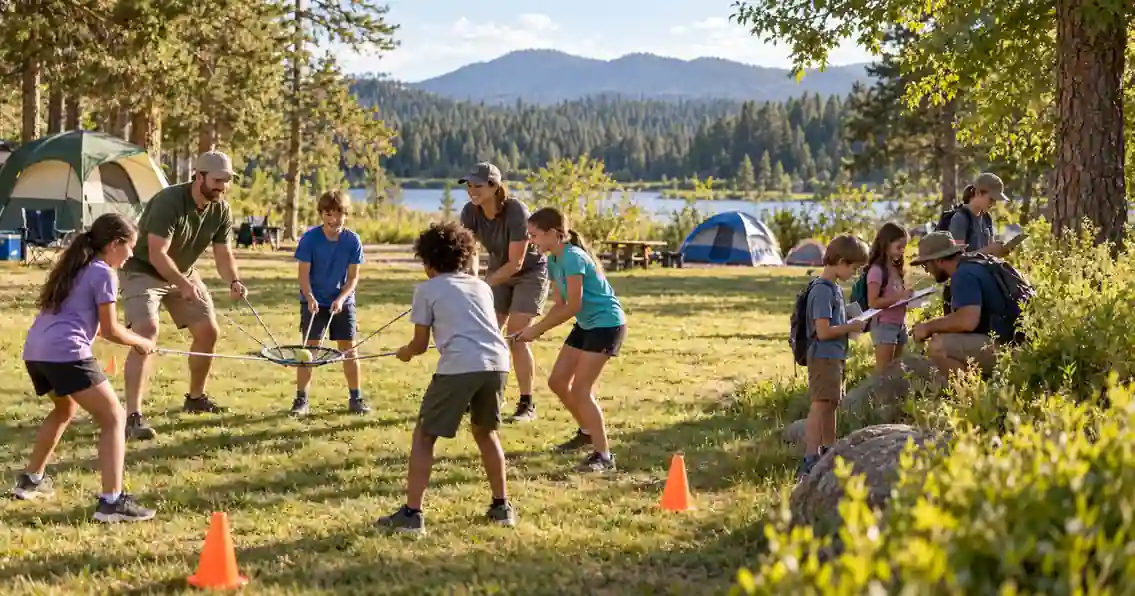
Summer Camp Activities: 25 Outdoor Ideas for All Ages
Good summer camp activities should do more than keep people busy. A balanced camp day gives campers chances to move, explore nature, solve problems together, create something, and slow down between high-energy sessions.
The 25 ideas below are designed to be flexible rather than tied to one age group. Younger campers may need shorter rounds and simpler rules, while teens and adults can add strategy, leadership roles, harder clues, or longer challenges. Always adjust the activity to the group’s abilities, available space, supervision, and weather.
Table of Contents
Summer Camp Activities at a Glance
| Activity type | Energy level | Typical setup | Good time to use it |
|---|---|---|---|
| Nature and exploration | Low–medium | Minimal | Morning or transitions |
| Active outdoor games | High | Low–medium | Cooler parts of the day |
| Team-building challenges | Medium | Low | Group-bonding sessions |
| Creative and camp skills | Low–medium | Low | Midday or recovery periods |
| Quiet and evening activities | Low | Minimal | Late afternoon or evening |
Before You Start: Match Activities to the Group and Weather
A great game can become frustrating if the play area is too large, the instructions are too complicated, or the weather is wrong for the activity.
Before starting, consider:
- Age and individual ability
- Group size
- Mobility differences
- Clear activity boundaries
- Adult or staff supervision
- Shade
- Drinking water
- Footwear and clothing
- Forecast and changing weather
- A backup location or activity
On hot days, move strenuous games toward cooler parts of the morning or later afternoon when possible. Build in water and shade breaks instead of waiting until people already feel overheated.
Thunderstorms require a different response. If thunder is heard or lightning is present, stop outdoor activities and move everyone to a substantial enclosed building or a hard-topped vehicle with the windows closed.
An open picnic shelter, pavilion, dugout, or small rain shelter should not be treated as safe lightning protection. Wait at least 30 minutes after the last thunder before restarting outdoor activities.
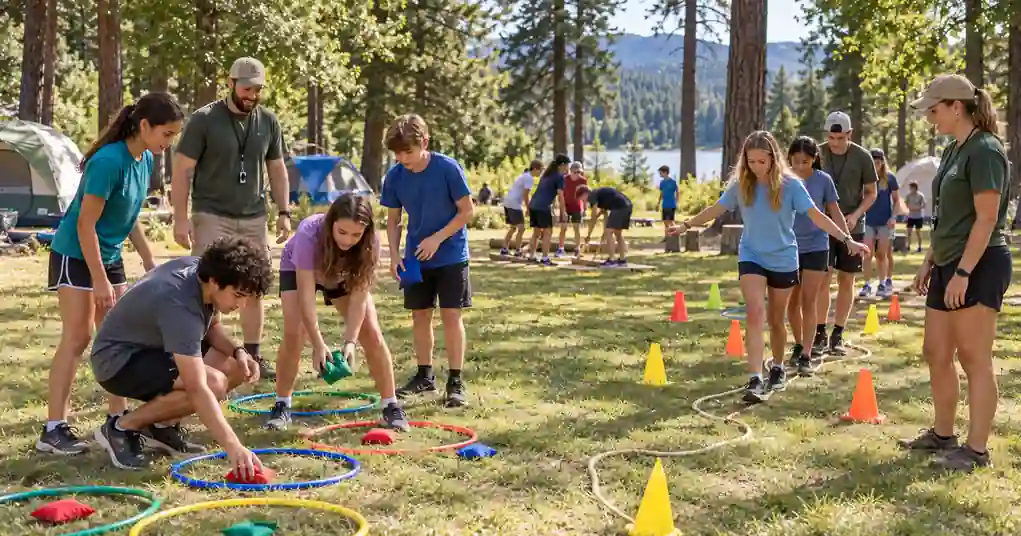
Nature and Exploration Activities
1. Observation-Based Nature Scavenger Hunt
Give each camper a checklist of things to observe rather than collect.
Possible items include:
- Something rough
- Three shades of green
- An animal sound
- A fallen leaf
- A cloud shape
- Evidence that an animal has been nearby
- Something that provides shade
Campers can check items off, sketch them, or write a short description.
For younger campers, use pictures instead of written clues. Teens and adults can work from harder clues or identify patterns in the landscape.
Avoid pulling leaves, picking flowers, collecting rocks, or disturbing wildlife just to complete the game.
2. Nature Bingo
Create simple bingo cards using outdoor observations such as:
- Bird
- Pinecone
- Insect
- Cloud
- Tree bark
- Wildflower
- Spiderweb
- Animal track
- Moving water
- Something yellow
The first person to complete a row can call out, but the activity also works without making it competitive.
For mixed-age groups, pair younger campers with older participants.
3. Five-Senses Nature Walk
Take a short walk through an established campsite area or trail and pause at several locations.
Ask campers what they can:
- See
- Hear
- Smell
- Feel through safe surfaces or the weather
Avoid asking participants to taste wild plants, berries, mushrooms, or other natural materials.
With teens and adults, make the challenge quieter: walk for several minutes without talking, then compare what everyone noticed.
4. Nature Detective Challenge
Ask campers to look for clues that reveal what has happened in an area.
Examples include:
- Tracks
- Fallen seeds
- Chewed plant material
- Feathers already on the ground
- Nesting material seen from a distance
- Holes or burrows
- Animal sounds
The goal is observation, not touching wildlife or investigating nests closely.
Older campers can write down several possible explanations for each clue rather than assuming the first guess is correct.
5. Camp Photo Challenge
Create a list of photo subjects instead of objects to collect.
Ideas include:
- Interesting shadow
- Something symmetrical
- Three colors together
- A teamwork moment
- A texture
- A reflection
- A creative campsite detail
Campers can use phones or cameras only where camp rules allow them.
The challenge works especially well with teens and adults because it combines exploration with creativity without requiring participants to remove anything from the environment.
Active Outdoor Summer Camp Games
6. Capture the Flag
Divide the group into two teams, give each side a clearly marked territory, and place one flag or visible object in each team’s area.
The objective is to retrieve the other team’s flag and return safely.
Keep the boundaries smaller for younger campers and make them larger for older groups only when supervision allows.
Avoid rough tackling. A simple tag should be enough to stop or send a player back according to the rules you establish.
7. Relay Race Mix
Instead of repeating one race, create several short relay tasks.
Examples:
- Fast walk around a cone
- Balance a beanbag
- Carry a lightweight ball
- Walk backward through a short marked section
- Move water with a cup
For a mixed-ability group, give each participant a task that suits them rather than forcing everyone to run.
The goal can also be completing all tasks successfully instead of simply finishing first.
8. Low-Obstacle Camp Course
Build a ground-level obstacle course with simple equipment such as:
- Cones
- Hoops
- Chalk or rope lines
- Beanbags
- Buckets
Campers might weave around cones, step through hoops, balance an object, and throw a beanbag into a target.
Keep the course on level ground and avoid turning it into improvised climbing.
9. Camp Field-Day Challenge
Create four or five short stations instead of one long competition.
Possible events include:
- Beanbag target toss
- Frisbee accuracy
- Standing long toss
- Balance challenge
- Bucket carry
Not every station needs to reward speed or athleticism. Mixing accuracy, memory, balance, and creativity gives more campers a chance to contribute.
10. Sponge-and-Bucket Water Relay
Place a bucket of water at one end of a short course and an empty bucket at the other.
Campers soak a sponge, carry it across the course, squeeze it into the second bucket, and return.
This provides a water-based summer game without requiring a pool or swimming area.
Use a non-slip play surface and keep the course short enough that campers are not running dangerously on wet ground.
Team-Building Camp Activities
11. Silent Line-Up Challenge
Ask the group to arrange themselves without speaking.
They might line up by:
- Birthday month
- Height
- Alphabetical first name
- Shoe size
Choose only harmless, comfortable categories.
The challenge forces campers to communicate through gestures and observation. For younger groups, allow limited talking after a few minutes if they become stuck.
12. Group Shape Challenge
Place a rope safely on the ground.
Ask the team to work together to turn it into:
- Triangle
- Square
- Star
- Letter
- Simple campsite symbol
The rope should remain on the ground and should never be wrapped around people.
Older campers can try completing a shape with limited verbal communication.
13. Map-and-Clue Treasure Challenge
Create a simple map or set of clues within a clearly bounded camp area.
Teams follow the clues to reach several checkpoints.
Keep this activity within a known, supervised area. It is a game, not wilderness navigation instruction.
Younger campers can follow pictures or landmarks. Teens and adults can solve riddles or multi-step clues.
14. Camp Problem-Solving Stations
Build several stations that reward different strengths.
One might involve:
- Memory
- Observation
- Communication
- Balance
- Pattern recognition
- Creative thinking
Small groups rotate through each station.
This works well because the fastest or strongest camper does not automatically become the most important person on every challenge.
15. Cooperative Beanbag Challenge
Give the group a shared target instead of dividing everyone into winners and losers.
For example:
“Can the whole group make 25 completed passes without dropping the beanbag?”
After success, increase the distance or introduce a second beanbag.
This type of activity encourages communication and shared problem-solving while still giving the group a clear goal.
Creative and Practical Outdoor Activities
16. Nature Sketching
Give campers paper and pencils and ask them to choose something they can observe from an appropriate location.
Subjects might include:
- Tree
- Cloud
- Campsite
- Mountain profile
- Leaf pattern
- Distant bird
- Rock formation
The goal is observation rather than artistic perfection.
Adults and teens may enjoy trying to sketch the same subject from different angles.
17. Camp Journal Challenge
Give the group several short prompts.
Examples:
- What did you notice today that you normally miss?
- What was the hardest activity?
- What did someone else do that helped the group?
- What new outdoor skill did you practice?
Younger children can draw instead of writing long answers.
A camp journal also provides a useful quiet transition between active sessions.
18. Friendship-Bracelet Station
Set up cord or thread at a picnic table or other suitable workspace.
This is useful during:
- Hot midday periods
- Recovery time
- Activity transitions
- Mixed-energy group sessions
Keep patterns simple for beginners and allow older campers to try more complex designs.
The point is not producing a perfect bracelet. It is giving the group a social activity that does not require constant movement.
19. Knot-Tying Skill Challenge
Give each camper a short practice cord and teach one or two ordinary campsite knots.
Then create small challenges such as:
- Tie the correct knot from memory.
- Identify which knot is adjustable.
- Choose a knot for a simple guyline task.
For step-by-step instruction, campers can learn a few practical camping knots before the activity.
Keep this strictly to normal camping uses. Recreational knot practice does not qualify someone to use knots for climbing, rappelling, rescue, or other life-safety applications.
20. Outdoor Story-Building Circle
Sit in a circle and have one person begin a story with one or two sentences.
Each participant adds a short piece.
To keep it connected to camp, use a starter such as:
- “When we opened the tent that morning…”
- “The strange sound beside the trail turned out to be…”
- “Nobody expected the map to lead us to…”
For teens and adults, add a rule that every new section must incorporate one detail from the campsite or surrounding landscape.
Quiet and Evening Camp Activities
21. Camp Charades
Write simple camping and nature prompts on slips of paper.
Examples:
- Setting up a tent
- Hiking
- Squirrel
- Fishing
- Paddling
- Owl
- Flashlight
- Camp stove
One camper acts while the group guesses.
For younger groups, use easy actions. Adults and teens can use more specific outdoor situations.
22. Twenty Questions: Camp Edition
One camper silently chooses a camping item, animal, outdoor activity, or natural feature.
The group asks questions that can be answered with yes or no.
This requires no equipment and works well while:
- Waiting for dinner
- Sitting under shelter during light rain
- Resting between activities
- Winding down before evening
23. Sunset Observation Challenge
Choose a safe established viewing area rather than walking onto cliffs, rocks, shorelines, or other hazardous terrain simply to improve the view.
Ask the group to notice:
- Changing colors
- Cloud movement
- Temperature
- Shadows
- New evening sounds
Younger campers can describe colors. Older participants can record changes over 10 or 15 minutes.
24. Stargazing and Constellation Spotting
After dark, choose an open area that is permitted for nighttime use and away from vehicle traffic.
Allow everyone’s eyes time to adjust before using bright lights.
Campers can look for:
- Bright stars
- Moon
- Visible planets when identifiable
- Familiar constellations
- Satellites
Keep this simple unless someone leading the group has appropriate astronomy knowledge.
25. Camp Reflection Circle
End the day with one short question for everyone.
Examples:
- What was your favorite activity?
- What did you learn?
- Who helped you today?
- What would you change tomorrow?
- What did you notice outdoors that surprised you?
Nobody needs to give a long speech.
This works particularly well for teens, adults, and mixed-age groups because it closes the day without turning the final activity into another competition.
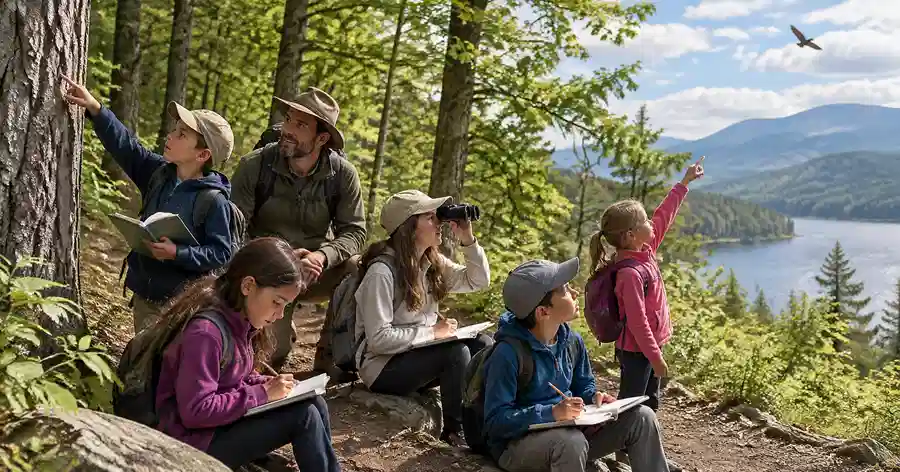
How to Adapt the 25 Activities for Different Ages
Age can help you choose a starting point, but individual ability matters more than the number on a birthday.
| Group | Useful adaptation |
|---|---|
| Younger campers | Short rounds, visual instructions, smaller boundaries |
| Older children | More choices and basic strategy |
| Teens | Harder clues, leadership roles, timed challenges |
| Adults | Strategy, humor, longer problem-solving tasks |
| Mixed ages | Small mixed teams with flexible roles |
| Different mobility levels | Replace speed with accuracy, observation, communication, or problem-solving |
If one participant cannot comfortably perform a task, change the task rather than automatically excluding that person.
A Balanced Half-Day Camp Schedule
The best summer camp activities work better when you rotate energy levels instead of scheduling several demanding games in a row.
For example:
- 9:00 a.m. — Nature scavenger hunt: Begin with observation and movement.
- 9:45 a.m. — Capture the flag: Use the cooler part of the morning for the most active game.
- 10:30 a.m. — Water and shade break: Give everyone time to recover.
- 10:45 a.m. — Problem-solving stations: Shift from speed to teamwork.
- 11:30 a.m. — Nature sketching or journaling: Lower the energy level.
- Noon — Lunch and quiet period.
For a camping group planning several days together, a simple meal structure can also reduce scheduling stress. Camping Trip Atlas has a simple three-day camping meal plan that can be adapted to group size and campsite facilities.
Rainy Day Camp Activities and Weather Backups
Rain by itself does not always end outdoor programming. The important question is whether conditions remain appropriate for the location and activity.
During light rain, you may be able to switch to a sheltered or lower-energy option if:
- There is no thunder or lightning.
- Trails and play areas remain safe.
- Participants have appropriate clothing.
- Temperatures remain suitable.
- Staff can supervise effectively.
Useful backups include:
- Charades
- Group storytelling
- Journal or sketch time
- Knot practice
- Cooperative puzzles or trivia
A thunderstorm is different.
If thunder is audible, stop outdoor programming and move to appropriate shelter. An open pavilion may keep rain off people, but it is not a safe substitute for a substantial enclosed building or hard-topped vehicle during lightning.
Common Summer Camp Activity Planning Mistakes
Avoid these common problems:
- Scheduling only high-energy games
- Making every activity competitive
- Using the same rules for every age
- Creating boundaries that are too large for the group
- Forgetting shade and water breaks
- Scheduling strenuous games during the hottest part of a hot day
- Collecting plants, rocks, or other natural objects for scavenger hunts
- Approaching wildlife for a better look or photo
- Treating an open rain shelter as lightning protection
- Waiting until bad weather arrives before creating a backup plan
- Improvising climbing or technical outdoor activities without qualified instruction
- Forcing every camper into the same physical role
- Making elimination games so long that some participants spend most of the activity watching
A good activity plan keeps as many people meaningfully involved as possible.
Frequently Asked Questions
What are good summer camp activities for mixed ages?
Good summer camp activities for mixed ages use simple rules but offer several ways to participate. Nature scavenger hunts, cooperative challenges, relay stations, charades, observation walks, and storytelling all adapt well because younger campers can complete simpler tasks while teens and adults take on harder clues, strategy, or leadership roles.
What summer camp games need almost no equipment?
Capture the flag, twenty questions, charades, silent line-up, group storytelling, five-senses walks, sunset observation, and simple nature scavenger hunts need little or no specialized equipment. A few reusable items such as cones, beanbags, paper, pencils, rope, and buckets can support many additional games.
What are good team-building activities at summer camp?
Silent line-up, cooperative beanbag challenges, group-shape games, problem-solving stations, and bounded clue hunts work well because success depends on communication and cooperation. Choose challenges that use different abilities so one athletic or outspoken participant does not automatically control every activity.
What activities work well for teens and adults at camp?
Teens and adults often respond well to activities with more choice and strategy, such as complex clue hunts, photography challenges, team problem-solving, knot practice, harder scavenger-hunt clues, field-day competitions, stargazing, and reflection circles. Many children’s games also work when the rules are made less simplistic.
What should you do with camp activities when it rains?
Light rain may allow some activities to continue with suitable clothing, surfaces, and supervision. Move to covered or indoor alternatives when conditions become uncomfortable. If thunder or lightning occurs, stop outdoor activities and move to a substantial enclosed building or hard-topped vehicle, then wait at least 30 minutes after the last thunder before resuming.
Conclusion
Successful summer camp activities are not about filling every minute with the loudest or fastest game. A stronger camp day combines movement, nature, teamwork, creativity, practical skills, and quieter periods while adapting each activity to the group and conditions.
Choose a few ideas from different categories, prepare one weather backup, and leave enough flexibility to slow down, change the rules, or switch activities when the campers or weather call for it.
References:
- National Weather Service — Lightning Safety and Outdoor Sports Activities
Direct working source - National Weather Service — Lightning Safety Overview
Direct working source - Centers for Disease Control and Prevention — About Heat and Your Health
Direct working source - Centers for Disease Control and Prevention — Heat and Athletes
Direct working source - Leave No Trace — Our Natural World Group Activity
Direct working source - American Camp Association — Activities to Encourage Belonging Among Campers
Direct working source