
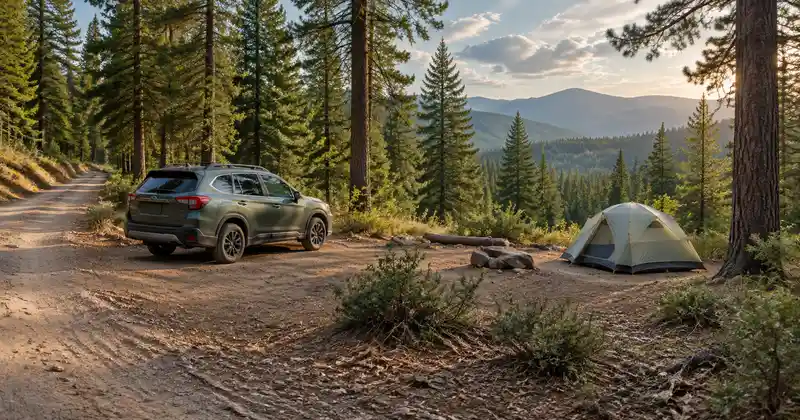
Dispersed Camping Oregon: Free Sites, Rules and Planning
Planning dispersed camping Oregon starts with identifying who manages the land, not with choosing a campsite pin from an app. Oregon has free dispersed camping on BLM land, National Forests, and Oregon State Forests, but each system has different stay limits, vehicle rules, closures, fire restrictions, and camping boundaries.
For a legal trip, identify the land manager, confirm that overnight camping is allowed, check current access and fire restrictions, and choose an existing impacted campsite where local rules permit it. Keep a second legal camping area ready because free sites generally cannot be reserved.
Table of Contents
Dispersed Camping Oregon at a Glance
| Planning question | What to know |
|---|---|
| Is dispersed camping often free? | Yes, but not every public-land camping area is free |
| Main federal land managers | U.S. Forest Service and Bureau of Land Management |
| Oregon State Forest camping | Dispersed camping is free and permit-free where open |
| Reservations | Usually not required for ordinary dispersed camping |
| Potable water | Usually unavailable |
| Toilets | Usually unavailable |
| Trash service | Usually unavailable |
| RV hookups | No |
| Stay limit | Depends on the land manager and local order |
| Campfires | Depend on current restrictions |
| Coast camping | Separate beach and habitat restrictions apply |
| Vehicle access | Check current agency maps and road conditions |
Oregon Department of Forestry currently allows dispersed camping year-round on Oregon State Forests with no fee or permit requirement, although local closures, stay limits, sanitation rules, and fire restrictions still apply. BLM likewise allows dispersed camping across much of its public land unless an area is closed or specifically restricted.
What Counts as Legal Dispersed Camping in Oregon?
Dispersed camping generally means camping outside a developed campground.
You may find primitive sites on:
- BLM land
- National Forest land
- Oregon State Forest land
- Other public lands where the responsible agency specifically allows overnight camping
That does not mean every public-looking clearing is legal.
Oregon landscapes often contain a mixture of federal land, state land, private property, developed recreation areas, wilderness, wildlife habitat, and locations subject to temporary closures.
Before camping, verify:
- Who manages the parcel?
- Is overnight camping allowed?
- Are you required to use an existing or designated site?
- Can your vehicle legally reach it?
- Is the area currently open?
- Are there fire, wildlife, or seasonal restrictions?
An abandoned fire ring or old campsite pin is not legal authorization.
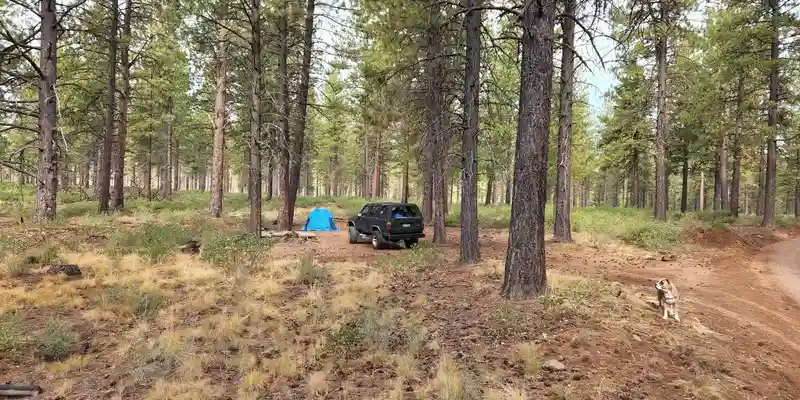
Dispersed Camping Oregon Rules by Land Manager
The biggest planning mistake is assuming Oregon has one statewide dispersed-camping rule.
It does not.
BLM Camping in Oregon
BLM states that most public lands are generally open to dispersed camping unless camping conflicts with other authorized uses, harms resources, or the area is posted closed.
A 14-day limit is common, but the exact period and relocation requirements must be checked for the specific BLM area.
For example, BLM’s current Steens Mountain guidance allows dispersed camping for no more than 14 days within a 28-consecutive-day period and recommends using previously disturbed campsites instead of creating new ones. Three Forks also currently lists a 14-day limit.
Do not assume a rule published for Steens Mountain automatically applies unchanged to every BLM parcel in Oregon.
National Forest Camping in Oregon
National Forest rules can differ by forest, ranger district, wilderness area, and active Forest Order.
The Deschutes National Forest, for example, currently lists an active 14-Day Camping Order, effective November 14, 2024, that prohibits occupying a single location for longer than 14 consecutive days. The forest also maintains separate camping, fire, wilderness, and area-closure orders.
Another Oregon National Forest may have different site restrictions or motorized-access rules.
Always check the exact forest.
Oregon State Forest Dispersed Camping
Oregon State Forests provide one of the clearest options for free camping in Oregon.
ODF currently states:
- Dispersed camping is allowed year-round where forestland is open.
- No dispersed-camping fee is required.
- No permit is required.
- Do not establish a campsite within 25 feet of a river or stream.
- Do not deposit human waste within 100 feet of a campsite, trail, or body of water.
- Maximum campsite occupancy is generally eight people and two vehicles.
- Pets must remain on a leash no longer than six feet.
- You must pack out garbage where no receptacle is provided.
- Campfires and charcoal barbecues are prohibited in dispersed campsites during the Regulated Use portion of fire season.
ODF also says parts of the Santiam State Forest remain closed because of damage from the 2020 wildfires, while the Clatsop and Tillamook state forests are currently open for recreation subject to specific site and fire restrictions.
Two Free Oregon Camping Areas to Start Your Research
These examples are not a ranking of Oregon’s “best” dispersed campsites. They show how different legal free-camping options can be.
Oregon State Forests
Tillamook and Clatsop State Forests are useful starting regions for campers researching free forest camping.
True dispersed camping on Oregon State Forest land currently has no fee or permit requirement. However, ODF notes that it does not publish a map of individual dispersed campsites, so you still need to use state-forest maps, current recreation information, signs, and existing-site principles to plan your stay.
Do not confuse free dispersed camping with ODF’s improved camping options. Developed drive-in sites, walk-in sites, and designated campsites can charge fees even when nearby dispersed camping is free.
Three Forks on BLM Land
Three Forks is a primitive BLM recreation site in southeastern Oregon managed by the Vale District.
BLM currently lists:
- Dispersed camping
- No camping fee
- 14-day stay limit
- Primitive conditions
- High-clearance four-wheel drive highly recommended for access
This is an important example because “free camping” does not necessarily mean “easy camping.”
The site requires a long dirt-road approach, and BLM specifically warns that getting there is challenging. A camper with a low-clearance sedan or large trailer should not treat its legal camping status as proof that the road suits the vehicle.
How to Find Dispersed Camping in Oregon Legally
Use a repeatable process instead of collecting random coordinates.
1. Choose a Region
Start broadly:
- Central Oregon
- Eastern Oregon
- Coast Range
- Southern Oregon
- Cascades
- Northwest state forests
2. Identify the Land Manager
Determine whether the candidate area is:
- BLM
- U.S. Forest Service
- Oregon Department of Forestry
- Oregon State Parks
- Another state or local agency
- Private property
3. Confirm Overnight Camping
Open the agency’s current recreation, alerts, orders, or camping page.
Look specifically for words such as:
- Dispersed camping
- Camping prohibited
- Designated camping only
- Closure
- Stay limit
4. Confirm Whether It Is Free
Do not assume BLM or Forest Service ownership automatically means no fee.
Some developed BLM and Forest Service campgrounds charge nightly rates even though nearby primitive camping may be free.
5. Check Legal Motorized Access
If you plan to drive to the campsite, confirm that the road is legally open to your vehicle.
6. Check Seasonal Closures
Forest roads can close because of:
- Snow
- Mud
- Wildlife protection
- Wildfire
- Storm damage
- Timber operations
- Restoration work
7. Check Fire Restrictions
Do this shortly before departure.
8. Check Weather and Smoke
A site that looks perfect on a map may be a poor choice during extreme heat, wildfire smoke, snow, or heavy rain.
9. Save Maps Offline
Cell service cannot be assumed on remote Oregon public lands.
10. Prepare a Second Legal Area
A first-come site may already be occupied.
Third-party camping apps can be useful for discovering possible areas, but the current land manager remains the authority on whether camping and vehicle access are legal.
Dispersed Camping Near Bend: Why Extra Research Matters
Central Oregon is extremely popular for camping, which makes current rules especially important.
The Deschutes National Forest currently maintains an active 14-day camping order along with separate area closures and camping restrictions. Its alerts page also lists specific closure orders rather than treating the entire forest as unrestricted camping land.
BLM has also closed about 40 acres of public land between Bend and Redmond to dispersed camping and other access because of long-term camping, sanitation, unauthorized routes, and resource damage. The closure began June 1, 2025 and was announced without a fixed reopening date.
That is exactly why an old “free camping near Bend” pin should be treated as a lead—not proof that the area is currently usable.
Camping on the Oregon Coast: What Is Different?
The Oregon Coast follows a different set of rules from ordinary BLM or National Forest roadside camping.
Oregon State Parks currently says camping is allowed on many ocean beaches, but you must camp above the high-tide line and know the local restrictions.
Beach camping is prohibited:
- Adjacent to an Oregon State Park
- From the south jetty of the Columbia River to Tillamook Head
- On beaches within Seaside
- Cannon Beach
- Manzanita
- Rockaway Beach
- Lincoln City
- Newport
- Bandon
- Gold Beach
- Within protected western snowy plover habitat areas
There is another current restriction to know: western snowy plover seasonal protections are active March 15 through September 15, 2026 at affected beaches. Some locations restrict recreation to wet sand during that period and may prohibit dogs.
Overnight parking is also prohibited at Oregon State Park day-use areas and waysides, which means legal beach camping does not automatically provide legal overnight vehicle parking.
Check tide conditions before sleeping on a beach. A campsite that is above the water at sunset may not remain safe through the next high tide.
How to Use Forest Service MVUMs in Oregon
A Motor Vehicle Use Map, or MVUM, answers one important question:
Where is your motor vehicle legally allowed to travel on National Forest System roads and trails?
The Ochoco National Forest explains that its MVUM is the official legal reference for roads and trails open to public motorized travel and republishes its maps regularly. The current map page includes 2026 MVUMs.
An MVUM can show:
- Legal motorized roads
- Vehicle classes
- Seasonal restrictions
- Routes where motorized access is allowed
But it does not guarantee that the road is physically suitable.
Forest Service MVUM data specifically distinguishes legal motorized use from actual conditions. A road can legally be open while snow, washouts, mud, rocks, or fallen trees make travel impractical.
Use an MVUM to answer “May I drive there?” Then separately answer “Can my vehicle safely handle the current road?”
RV Dispersed Camping Oregon: Check the Road Before the Campsite
Oregon boondocking can work well for camper vans, truck campers, small trailers, and some RVs, but road access becomes the limiting factor quickly.
Before taking an RV onto a primitive road, consider:
- Ground clearance
- Road width
- Low branches
- Steep grades
- Washouts
- Deep potholes
- Mud
- Sand
- Snow
- Turning radius
- Trailer length
- Places to turn around
Never drive farther down a questionable road assuming there will be enough space to turn your trailer around.
Also remember that primitive dispersed camping normally provides no:
- Electrical hookups
- Water connection
- Sewer hookup
- Dump station
- Trash pickup
Carry enough freshwater and have a legal plan for wastewater and sewage.
Three Forks is a good reminder of the distinction between legal and RV-friendly access. BLM allows camping there, but it recommends high-clearance four-wheel drive for the approach.
Water, Toilets and Waste
Plan as if a dispersed site will provide no services unless the official listing states otherwise.
Bring enough water for:
- Drinking
- Cooking
- Cleaning
- Pets
- An emergency reserve
Do not assume an Oregon stream or spring is safe to drink untreated.
Sanitation rules depend on the agency. On Oregon State Forest land, ODF prohibits depositing human waste within 100 feet of any campsite, trail, or body of water. Garbage must be packed out where no receptacle exists.
In especially sensitive, high-use, rocky, sandy, or coastal areas, packing out human waste may be more appropriate or specifically required.
Follow the exact local order rather than applying one universal digging rule to every Oregon landscape.
Campfires and Oregon Fire Restrictions
An old fire ring does not mean a fire is legal today.
Oregon’s fire restrictions can vary simultaneously by:
- BLM district
- National Forest
- Oregon Department of Forestry protection district
- County
- Specific recreation area
ODF instructs visitors to use its current interactive fire-restriction map because fire season and restrictions vary geographically.
On Oregon State Forests, ODF specifically prohibits campfires and charcoal barbecues in dispersed campsites during the Regulated Use portion of fire season.
BLM Oregon/Washington likewise maintains district-specific restrictions and emergency closures. As of September 5, 2026, its current fire page lists active restrictions and recent wildfire closure changes in multiple Oregon districts.
A new Medford District BLM fire-prevention order took effect at 12:01 a.m. on September 5, 2026 and remains effective until further notice. That is a good example of why fire rules must be checked close to departure rather than copied from an old camping guide.
Wildfires, Smoke and Temporary Closures
Wildfire conditions can change both camping legality and access.
A fire may lead to:
- Emergency public-land closures
- Road closures
- Campfire restrictions
- Poor air quality
- Burned-area hazards
- Hazard trees
- Damaged recreation infrastructure
On September 3, 2026, for example, BLM partially rescinded its Fox Fire closure near Baker, Oregon. Some areas reopened on September 4 while another campground remained closed for suppression repairs.
That type of partial reopening is why “the fire is over” is not enough information.
Before traveling, check the responsible BLM, Forest Service, or ODF closure page plus current wildfire and smoke information.
Food Storage and Wildlife
Oregon public lands support black bears and many smaller animals that can become attracted to campsites.
Keep food, garbage, pet food, and scented items secured.
The exact food-storage requirement may differ by National Forest or recreation area. Some areas have formal orders requiring specific storage methods.
Do not assume that the same cooler setup is compliant everywhere.
If an official food-storage order applies, follow it even if a more casual method worked on a previous trip.
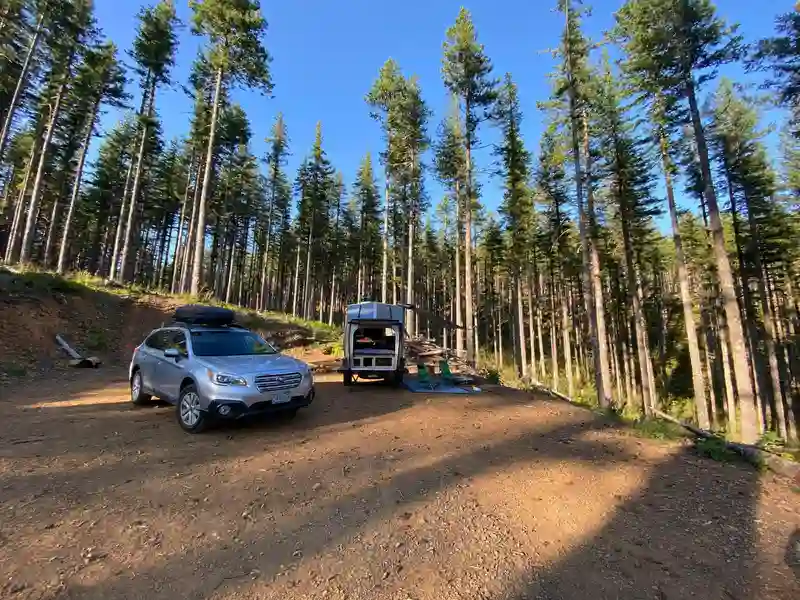
What to Do When Your First Site Is Full or Closed
Free dispersed campsites generally cannot be reserved.
If your first location is occupied:
- Stay on legal roads.
- Continue to another existing legal campsite.
- Do not drive onto vegetation to create space.
- Do not squeeze into someone else’s occupied site.
- Move to your backup area if necessary.
- Use a developed campground as a final fallback.
This is where it helps to build a legal backup camping option before leaving home.
Try to arrive while there is still daylight. It is much easier to assess road surfaces, dead trees, slopes, site boundaries, and trailer turnaround space before dark.
Another useful example is Shadow Mountain in Wyoming, where “dispersed” camping is restricted to numbered sites. You can see how designated dispersed camping can work before planning similar high-use public-land areas.
Oregon Dispersed Camping Checklist
Before leaving, confirm:
- Land manager identified
- Public/private boundary checked
- Overnight camping allowed
- Free versus fee status checked
- Stay limit verified
- Designated-site requirement checked
- Current road map or MVUM saved
- Seasonal road status checked
- Vehicle suitability evaluated
- Oregon Coast restrictions checked if applicable
- Fire restrictions checked
- Wildfire closures checked
- Weather and smoke checked
- Water packed
- Toilet/waste plan prepared
- Trash storage prepared
- Food-storage rules checked
- Maps downloaded offline
- Backup legal camping area chosen
Frequently Asked Questions
Is dispersed camping free in Oregon?
A large amount of dispersed camping Oregon is free, especially on eligible BLM, National Forest, and Oregon State Forest land. However, public ownership does not guarantee free camping. Developed campgrounds, designated improved campsites, special recreation areas, and some managed camping zones charge fees. Check the exact official location before assuming it costs nothing.
Can you dispersed camp anywhere in Oregon National Forests?
No. National Forests can contain camping closures, designated-site areas, wilderness restrictions, seasonal roads, motor-vehicle limits, and special Forest Orders. Check the specific Oregon National Forest and ranger district, then review current alerts and the appropriate MVUM if you will access the site by vehicle.
How long can you stay on BLM land in Oregon?
A 14-day limit is common on Oregon BLM land, but the exact measurement period and relocation rules can vary by area. Steens Mountain currently allows dispersed camping for up to 14 days within a 28-day period, while Three Forks lists a 14-day stay limit. Always verify the local BLM office’s current rule.
Where can you dispersed camp near Bend, Oregon?
Deschutes National Forest and BLM lands around Central Oregon provide dispersed-camping opportunities, but the Bend area also has active closures and a Deschutes National Forest 14-day camping order. Do not rely on an old campsite pin; check current Forest Service and BLM maps and alerts before selecting an area.
Can you dispersed camp on the Oregon Coast?
Yes, beach camping is allowed in some Oregon Coast areas, but major restrictions apply. Camping is prohibited next to Oregon State Parks, within several named coastal communities, and in protected western snowy plover habitat. Camp above the high-tide line where beach camping is legal, and verify overnight parking separately.
Conclusion
For dispersed camping Oregon, begin with the land manager rather than a campsite pin. Confirm that overnight camping is legal, check the current stay limit, verify motorized access and road conditions, and review fire, wildfire, and coastal restrictions that apply to the exact location.
Download the official maps before leaving cell service, bring the water and waste-management supplies you need, and keep one legal backup area ready in case the first site is full or conditions change.
References:
- Oregon Department of Forestry — Camping on Oregon’s State Forests
Official camping guidance - Oregon Department of Forestry — Restrictions & Closures
Current fire restriction information - Bureau of Land Management — Camping on Public Lands
BLM camping guidance - Bureau of Land Management — Steens Mountain Cooperative Management and Protection Area
Steens Mountain camping guidance - Bureau of Land Management — Three Forks
Three Forks recreation site - Bureau of Land Management — Oregon/Washington Fire Restrictions
Current BLM fire restrictions and closures - U.S. Forest Service — Deschutes National Forest Alerts
Current Deschutes alerts and Forest Orders - U.S. Forest Service — Ochoco National Forest Visitor Maps and Guides
Ochoco Motor Vehicle Use Maps - Oregon State Parks — Ocean Shore State Recreation Area
Official Oregon beach camping rules