
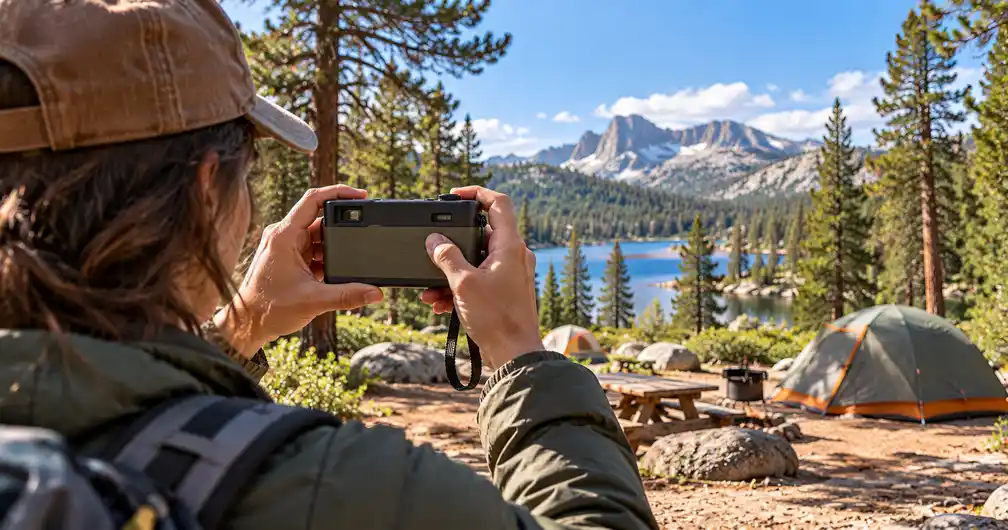
Camp Snap Camera Review: Is It Good for Camping Trips?
A Camp Snap camera review for campers needs to answer a different question from a normal camera review: does its screen-free simplicity make a trip better enough to justify the image-quality compromises? For casual daylight snapshots, family camping, and trips where you want to keep your phone packed away, the answer can be yes. For night photos, fast action, wildlife, or technically sharp landscapes, it is a much weaker fit.
This Camp Snap camera review focuses mainly on the original V105 platform because that is the version many current owners and used buyers still search for. It also explains how V105 relates to V103/V103B and where the newer Camp Snap 2, 110D, and CS-Pro fit in the 2026 buying picture.
Table of Contents
Camp Snap Camera Review: Quick Verdict for Camping Trips
The short version of this Camp Snap camera review is simple: Camp Snap works best as a memory camera, not as a replacement for a good smartphone or dedicated outdoor camera. Its strengths are the lack of a screen, light weight, rechargeable battery, large photo capacity, and uncomplicated controls. Its weaknesses are shutter delay, imprecise framing, soft 8MP files, and limited low-light performance.
| Camping use | Practical assessment |
|---|---|
| Screen-free family trips | Strong fit |
| Daylight campsite photos | Good for casual memories |
| Landscapes in good light | Fine for a retro look |
| Children using the camera | Very simple to learn |
| Evening campsite photos | Limited |
| Fast-moving kids or pets | Shutter delay can hurt |
| Wildlife photography | Poor fit |
| Multi-day charging | Manageable with USB-C |
| Rain and rough weather | Needs protection |
Buy it for the experience. You point, shoot, and move on without reviewing every frame. If that behavior sounds appealing, the technical limits may be acceptable. If dependable sharpness and low-light results matter more, use a phone or a more capable compact camera.
What Is the Camp Snap Camera?
The original Camp Snap is a screen-free digital point-and-shoot built around the simplicity of a disposable camera without film development. It stores images digitally, recharges over USB-C, and uses a small optical viewfinder instead of a rear photo-review screen.
That makes the product useful in screen-free situations. A child can carry it at summer camp without games, social apps, or messages. Adults can use it for the same reason: take the photo and return to the trip instead of stopping to inspect the result.
It is still a basic digital camera. The retro look comes from a small sensor, fixed-focus lens, simple processing, and optional filters rather than actual film.
Camp Snap V103 vs. V103B vs. V105
A useful Camp Snap camera review needs to separate the versions. Camp Snap says V105 uses the same internal hardware and produces the same image quality as V103B. The main V105 changes are the revised power control and built-in support for custom filters.
On V105, the side selector handles OFF, ON, and FLASH functions rather than requiring the older long-press power method. V105 also ships with current filter support installed.
For someone comparing V103B with V105, do not expect a major image-quality upgrade. For owners installing filters or following support instructions, the exact version does matter.
Camp Snap Camera Review: Design, Battery and Storage
Size and Portability
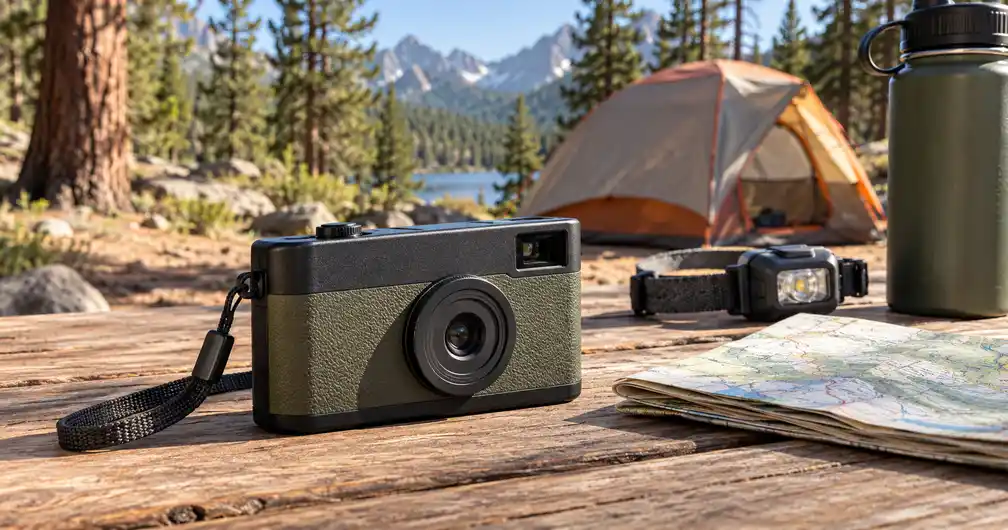
The V105 body measures about 4.5 x 2.5 x 1 inch. That makes it easy to carry in a jacket pocket, small daypack, or family camp tote without the bulk of a conventional camera kit.
This portability is one of the clearest camping advantages in our Camp Snap camera review. The camera can stay nearby for breakfast, short walks, campground games, and scenic stops instead of being left in the vehicle.
Small does not mean rugged. A dry pouch or padded case is sensible around rain, sand, dust, and crowded camp tables.
Camp Snap Battery Life
Camp Snap rates the V105-era camera for about 500 photos per charge. Tom’s Guide recorded 459 photos in independent testing, which puts the manufacturer claim in a realistic range without guaranteeing identical results.
For camping, shot count is more useful than promising a number of days. Charge the camera before departure and bring its USB-C cable plus a power bank on longer trips. Flash use and battery condition can change practical endurance.
If you plan to take a camera on a multi-stop camping road trip, include charging in the same routine as headlamps and navigation devices.
Storage
The V105 specification lists a preinstalled 4GB memory card with capacity for about 2,000 photos. That is enough for most camping trips unless the card already contains many older images.
The large capacity also suits a screen-free camera because you do not need to delete imperfect shots while traveling.
Camp Snap Camera Review: Photo Quality and Real-World Limitations
Daylight Photos
Daylight is where this Camp Snap camera review finds the original model most convincing. The 8MP sensor can produce pleasant casual images of campsites, friends, trail breaks, cabins, and landscapes when there is enough light.
The files are not technically competitive with current smartphones. Fine detail is softer, dynamic range is narrower, and highlights can be less forgiving. That imperfect look is part of the appeal, but it should not be confused with superior image quality.
Camp Snap Sample Photos: What Should You Expect?
Independent Camp Snap sample photos show a consistent pattern: bright scenes give the camera its best chance, while results become less dependable as light falls or subjects move.
Expect retro-looking color, moderate detail, some grain, limited highlight recovery, imperfect viewfinder framing, and a higher risk of blur with movement. View full sample galleries from independent reviewers before buying; small social-media images can hide softness.
Low-Light and Evening Campsite Photos
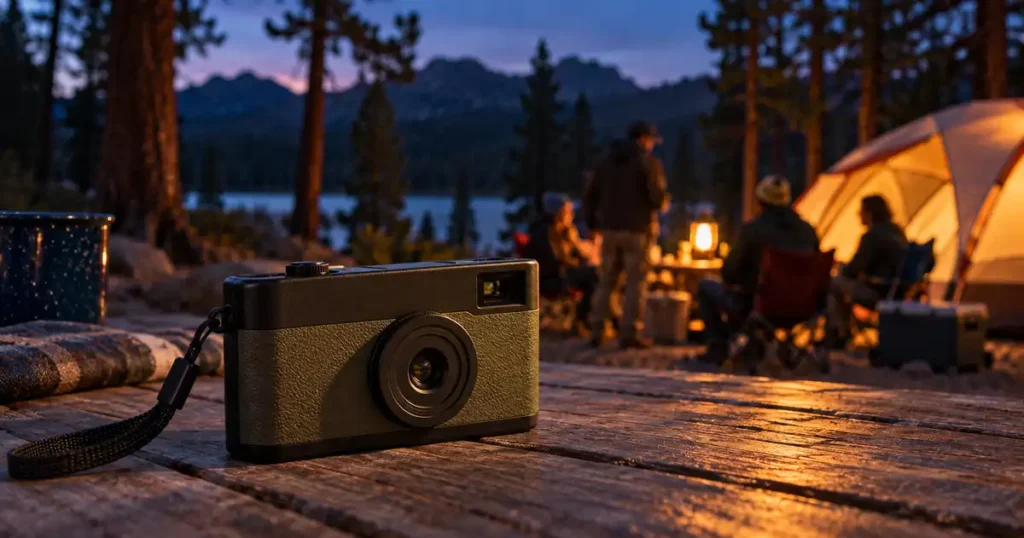
Low light is a major limitation. Lantern-lit tables, moving children after sunset, people near a campfire, and dim tents are much harder than a sunny campsite.
The built-in LED flash can help at short distances, but it does not turn Camp Snap into a strong night camera. A modern smartphone generally does better because of computational night processing.
If evening photography matters, this Camp Snap camera review suggests keeping another camera or phone available.
Shutter Response and Moving Subjects
Several independent reviewers report a noticeable delay between pressing the shutter and image capture. That matters for children running, dogs moving, games, or quick candid expressions.
Compose, press deliberately, and hold the camera steady briefly instead of dropping it immediately after the shutter press. When a moment matters, take a second frame.
Is a Screen-Free Digital Camera Useful While Camping?
This is the strongest argument in favor of Camp Snap. You cannot check every smile, zoom into the frame, delete it, and shoot five nearly identical versions. You take the picture and return to what you were doing.
For families, that can mean giving children a camera without handing them a phone. For adults, it can reduce the chance that taking one photo turns into checking messages or social media.
The trade-off is uncertainty. You cannot confirm that an important group photo worked or that the framing is correct. Our Camp Snap camera review therefore treats screen-free shooting as a deliberate compromise, not an automatic advantage.
Using Camp Snap With Kids at Camp
The original product was closely associated with summer-camp use, and the idea is practical. The controls are simple, the camera stores many photos, and there is no large display for reviewing images or running unrelated apps.
For a family camping trip with kids, a simple camera can become a creative activity. Children can photograph campsite setup, meals, leaves, friends, and favorite moments from their own perspective.
Do not assume every organized camp permits it. Electronics policies vary, so parents should check current camp rules before packing any digital camera.
Is Camp Snap Waterproof or Rugged Enough for Camping?
This Camp Snap camera review does not treat the original V105 as a waterproof action camera. The manufacturer has offered a separate waterproof case, while the camera itself is not presented with a formal waterproof rating that justifies exposing it freely to rain.
The product has also been marketed as durable and drop-resistant, but that is not the same as a published waterproof, dustproof, or shockproof certification.
Store it in a dry pouch or case when rain is possible. Keep it away from wet tent floors, drinks, sand, and fine dust. If your trip involves regular rain, paddling, or beach spray, compare cameras with a documented ruggedness rating instead.
How to Transfer Camp Snap Photos After a Trip
Camp Snap uses USB-C for charging and data transfer. The supplied cable supports both, and another USB-C cable can work if it carries data rather than charging only.
A computer is the simplest transfer method. Compatible phones and tablets with a native USB-C port can also recognize the camera. Camp Snap says that for iPhones this means iPhone 15 or newer. USB-C-to-Lightning is not supported for direct transfer to older Lightning iPhones; an SD-card-reader workflow is needed instead.
Test your transfer method before a long trip if you plan to back up photos while traveling.
Camp Snap Filters: Useful or Gimmicky for Camping Photos?
V105 supports downloadable custom filter files, including Camp Snap presets and user-created options. It loads one custom filter at a time.
For camping, that deliberate approach can be useful: choose a look before leaving and stop thinking about settings during the trip. Test the filter first, because no filter can repair motion blur, poor framing, or weak exposure.
Our Camp Snap camera review favors using filters sparingly. If simplicity is the reason you bought the camera, spending hours tuning filters defeats part of the purpose.
Camp Snap vs. a Smartphone for Camping
| Feature | Original Camp Snap V105 | Modern smartphone |
|---|---|---|
| Screen-free shooting | Yes | No |
| Controls | Very simple | More options |
| Daylight quality | Casual/retro | Usually stronger |
| Low-light quality | Limited | Usually much stronger |
| Photo review | Later | Immediate |
| Apps/distractions | None | Many |
| Charging | USB-C | Device-dependent |
| Zoom flexibility | Very limited | Usually better |
A smartphone is the more capable imaging tool. Camp Snap is the more intentionally limited experience.
That distinction is central to this Camp Snap camera review: buy Camp Snap because you want the limitation, not because you expect it to outperform the phone already in your pocket.
Camp Snap vs. a Disposable Camera
Both experiences delay photo review, but the logistics differ.
Camp Snap is reusable, rechargeable, and digital. It can hold roughly 2,000 images on its included card and does not require film development.
A disposable camera uses real film, offers a limited number of exposures, and requires development. If you want actual film character, Camp Snap is not a substitute. If you want a similar wait-to-see-the-photo experience while taking many images, the digital approach is easier.
Is the Camp Snap V105 Still the Current Model?
V105 is no longer the newest generation. As of September 27, 2026, Camp Snap’s U.S. storefront lists Camp Snap 2 at $69.99, CS-Pro at $99, and the new 110D at $74.99. The 110D page says the first batch is scheduled to ship at the end of October 2026.
The Camp Snap 2 page showed the camera sold out when checked for this Camp Snap camera review, so a listed price does not guarantee immediate availability.
Newer models matter if you are buying today. Camp Snap 2 adds six on-camera filters and other updates, while CS-Pro is positioned as a higher-resolution option. The 110D uses a different retro-inspired body.
V105 remains relevant for existing owners, used-camera buyers, and readers comparing older reviews.
Who Should Buy a Camp Snap for Camping?
This Camp Snap camera review sees the strongest fit for campers who:
- Want to keep a phone packed away more often.
- Want a simple camera for children or family trips.
- Mostly photograph in daylight.
- Like intentionally imperfect retro images.
- Want a tiny camera that is easy to carry.
- Prefer digital storage to film development.
- Are comfortable seeing the results later.
Consider something else if you photograph wildlife or fast action, need strong night results, want precise framing, expect smartphone-level detail, require documented waterproofing, or must confirm important photos immediately.
The useful question is not whether the retro look is objectively “good.” It is whether Camp Snap’s restrictions match the kind of camping trip you want.
Frequently Asked Questions
Is Camp Snap good for camping trips?
Yes, for the right camper. This Camp Snap camera review finds its strongest use in casual daylight photography, family trips, and screen-free situations. It is less suitable for night scenes, wildlife, fast action, or trips where you need consistently sharp, technically strong images.
How long does the Camp Snap battery last?
The original V105-era specification is about 500 photos per charge. Tom’s Guide recorded 459 photos in its independent test. Actual endurance depends on use, battery condition, and flash use, so charge before departure and bring USB power on longer trips.
Is the Camp Snap V105 better than the V103?
V105 is a usability update, but not a major image-quality upgrade over V103B. Camp Snap states that V105 and V103B share the same internal hardware and image quality. V105 mainly changes the power/flash switch and ships with current custom-filter support.
Does Camp Snap take good photos at night?
Low-light photography is one of the original camera’s main weaknesses. The LED flash can help with nearby subjects, but moving people, dim campsites, and night scenes are more likely to blur or look harsh than photos from a modern smartphone.
Is Camp Snap waterproof?
The original V105 should not be treated as waterproof unless it is inside a compatible protective solution designed for that use. The manufacturer has offered a separate waterproof case, while the camera itself is not presented with a formal waterproof rating.
Conclusion
This Camp Snap camera review comes down to one trade-off: the camera gives up technical capability in exchange for simplicity and a genuinely screen-free shooting experience.
For daylight-heavy family trips, summer camps, road trips, and casual campsite memories, that can be exactly the point. For night photography, wildlife, fast-moving subjects, or campers who need dependable image quality, it is the wrong tool.
If you are buying new rather than using a V105 you already own, compare the current Camp Snap lineup, price, and availability before purchasing. The original model still explains the concept, but Camp Snap 2, CS-Pro, and 110D now give current buyers other screen-free options.
References:
- Camp Snap — Version 105 Update: What’s New + Why It Says 105 — Used to verify that V105 shares the same internal hardware and image quality as V103B, while changing the power switch and preinstalling custom-filter support. Camp Snap Screen Free Digital Camera
- Camp Snap — Original V105 Product Specifications — Used to verify the 8MP sensor, body dimensions, 4GB card, approximately 2,000-photo capacity, 500-shot battery claim, LED flash, and USB-C. Camp Snap Screen Free Digital Camera
- Camp Snap — V105 Support — Used to verify V105 power behavior, one-custom-filter-at-a-time support, and current V105 filter instructions. Camp Snap Screen Free Digital Camera
- Camp Snap — Camera FAQ and Support — Used to verify data-cable requirements, USB-C transfer behavior, and limitations with Lightning-equipped iPhones. Camp Snap Screen Free Digital Camera
- Camp Snap — Current Product Lineup — Used to verify the September 27, 2026 prices and current lineup for Camp Snap 2, 110D, and CS-Pro. Camp Snap Screen Free Digital Camera
- Camp Snap — Camp Snap 2 Product Page — Used to verify the $69.99 listed price, six on-camera filters, 500-shot claim, and sold-out status observed during the final fact-check. Camp Snap Screen Free Digital Camera
- Camp Snap — Camp Snap 110D — Used to verify the $74.99 price and first-batch shipping statement for the end of October 2026. Camp Snap Screen Free Digital Camera
- Tom’s Guide — Camp Snap Screen-Free Digital Camera Review — Used to verify the independent 459-photo battery result and reported shutter-delay limitation. Tom’s Guide
- Digital Camera World — Camp Snap Review — Used to cross-check V103B specifications, shutter lag, viewfinder limitations, blur risk, daylight image character, and waterproof-case availability. Digital Camera World
- DPReview — Camp Snap Camera Review — Used to cross-check the summer-camp use case, screen-free design, USB-C transfer, flash behavior, and independent observations about image quality and shutter response.