
Camping Activities for Kids: 25 Screen-Free Ideas for Day and Night
The best camping activities for kids do not need expensive toys, complicated preparation, or a phone. A few simple games and nature-based activities can fill quiet mornings, energetic afternoons, evenings around camp, and rainy stretches without turning the trip into a tightly scheduled program.
The 25 ideas below are organized by when they work best. Choose a few daytime activities, several quiet options, and a couple of nighttime games before leaving home. That gives you enough variety to adapt to your children’s ages, the campsite, weather, and energy level.
Table of Contents
Camping Activities for Kids: Quick Picks by Age and Situation
Use this table when you need a fast activity rather than reading the entire list.
| # | Activity | Best fit | When | Energy | Equipment |
|---|---|---|---|---|---|
| 1 | Observation Scavenger Hunt | Mixed ages | Day | Moderate | Paper, pencil |
| 2 | Nature Bingo | Younger/school-age | Day | Moderate | Bingo sheet |
| 3 | Nature Detective Walk | School-age/mixed | Day | Moderate | Optional notebook |
| 4 | Sound Map | Mixed ages | Day | Quiet | Paper, pencil |
| 5 | Nature Journal | Mixed ages | Day/rain | Quiet | Notebook, pencils |
| 6 | Cloud-Spotting Stories | Mixed ages | Day | Quiet | None |
| 7 | Animal-Track Detective | School-age/older | Day | Moderate | Optional field guide |
| 8 | Campsite Color Hunt | Younger/mixed | Day | Moderate | None |
| 9 | Soft-Marker Obstacle Course | School-age | Day | Active | Soft markers |
| 10 | Frisbee Target Toss | School-age/older | Day | Active | Soft flying disc |
| 11 | Sock Toss Challenge | Mixed ages | Day/rain | Moderate | Socks, container |
| 12 | Compass Direction Challenge | School-age/older | Day | Moderate | Compass |
| 13 | Screen-Free Stargazing | Mixed ages | Night | Quiet | Optional blanket |
| 14 | Constellation Stories | Mixed ages | Night | Quiet | None |
| 15 | Night Sound Listening | Mixed ages | Night | Quiet | None |
| 16 | Lantern Shadow Puppets | Younger/mixed | Night | Quiet | Lantern/flashlight |
| 17 | Flashlight I Spy | Mixed ages | Night | Low | Flashlight |
| 18 | Campsite Charades | Mixed ages | Night | Moderate | None |
| 19 | Story Circle | Mixed ages | Night | Quiet | None |
| 20 | Campfire Question Game | Mixed ages | Night | Quiet | Legal campfire optional |
| 21 | Twenty Questions | Mixed ages | Rain/quiet | Quiet | None |
| 22 | Camping Story Chain | Mixed ages | Rain/quiet | Quiet | None |
| 23 | Nature Pictionary | School-age/mixed | Rain | Quiet | Paper, pencils |
| 24 | Card or Dice Games | Mixed ages | Rain/night | Quiet | Cards/dice |
| 25 | Draw a Campsite Map | School-age/mixed | Rain/day | Quiet | Paper, pencils |
Age recommendations are flexible. A six-year-old and a ten-year-old may enjoy the same activity with different rules, boundaries, or difficulty levels.
Set Safe Activity Boundaries First
Before starting active camping activities for kids, identify where children can and cannot play.
Keep games away from:
- Campground roads and parking areas.
- Fire rings and cooking equipment.
- Tent stakes and guylines.
- Neighboring campsites.
- Cliffs, steep slopes, or unstable ground.
- Water unless an adult is providing appropriate direct supervision.
- Wildlife.
Weather can also change the plan. If you hear thunder, stop outdoor games and move to a substantial building or enclosed metal-topped vehicle. A tent or open picnic shelter is not appropriate lightning protection. Wait at least 30 minutes after the last thunder before returning to outdoor activities.
Daytime Camping Activities for Kids
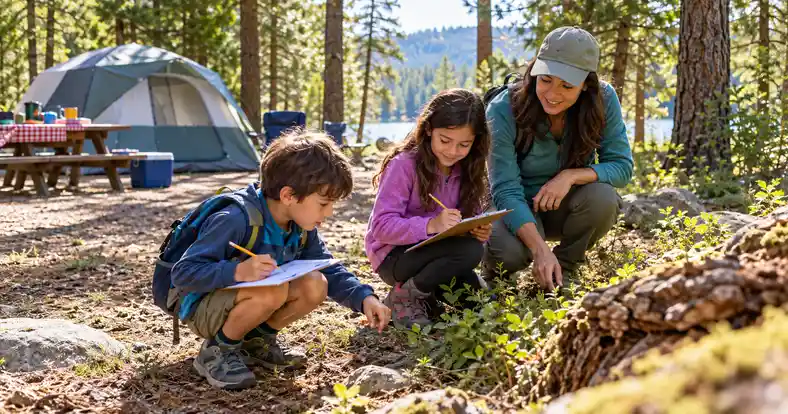
These camping activities for kids work particularly well during mornings and afternoons when there is enough light to move around the campsite safely.
1. Observation Scavenger Hunt
Create a list based on things children can find without collecting.
Examples include:
- Something rough.
- Something yellow.
- A pine cone.
- A bird.
- An animal track.
- A round rock.
- Three different leaf shapes.
- Something making a natural sound.
Children can point to, sketch, or describe each item.
Avoid making the game about bringing natural objects back to camp. Rocks, plants, feathers, flowers, and other natural items should generally remain where they are found.
2. Nature Bingo
Draw a simple bingo grid before the trip and fill it with things children might observe: a bird, flower, cloud, insect, fallen log, mountain, trail sign, squirrel, or interesting bark pattern.
Children mark a square when they spot the item.
For younger kids, use pictures instead of written clues. Older children can use more difficult categories such as animal signs or specific landscape features.
3. Nature Detective Walk
Turn a short campground walk into an investigation.
Ask questions such as:
- What animals might live here?
- Can you see tracks?
- Which direction is the wind coming from?
- Why is one area wetter than another?
- What sounds change as you walk?
The objective is observation rather than reaching a destination.
Stay on appropriate trails and keep the walk within the abilities of everyone in the group.
4. Sound Map
This is one of the easiest quiet camping activities for kids.
Give each child paper and ask them to place an X in the center representing where they are sitting. For several minutes, everyone listens without talking.
When they hear something, they draw a symbol showing the direction it came from.
A bird might become a small wing symbol. Wind could be wavy lines. A creek might be represented by water marks.
Compare maps afterward.
5. Nature Journal
A small notebook can provide several days of screen-free entertainment.
Children can:
- Sketch the campsite.
- Draw wildlife seen from a distance.
- Record the weather.
- Draw interesting leaves without picking them.
- Write about the day.
- Make a list of sounds.
- Describe the best part of the trip.
A journal works especially well because it can be used for five minutes or an entire quiet afternoon.
6. Cloud-Spotting Stories
Find a safe place to sit or lie down and look at the clouds.
One child chooses a cloud shape and explains what it resembles. Everyone else adds something to the story.
A cloud that looks like a dragon might become a dragon searching for a campground. Another cloud becomes its mountain.
No supplies are required, making this an easy activity when you want everyone to slow down.
7. Animal-Track Detective
Look for footprints, scat, feeding signs, or other evidence that animals have passed through an area.
Children can sketch what they see and compare shapes.
The goal is to observe signs—not follow an animal, approach wildlife, or disturb dens and nests.
If you cannot confidently identify a track, that can become part of the game: describe its size, shape, and direction without guessing.
8. Campsite Color Hunt
Choose five or ten colors and see whether children can find them around camp.
For example:
- Green.
- Brown.
- Yellow.
- White.
- Red.
- Gray.
The object only needs to be observed.
For older children, make it more difficult by looking for unusual combinations such as something both green and rough.
9. Soft-Marker Obstacle Course
Create a small obstacle course on a safe, already durable part of the campsite.
Use reusable items such as bandanas, soft markers, or empty containers to create tasks like:
- Walk around a marker.
- Step over a low object.
- Balance along an imaginary line.
- Toss something into a bucket.
- Finish with three jumping jacks.
Do not build obstacles from branches, move large rocks, dig holes, or damage vegetation.
10. Frisbee Target Toss
Instead of throwing a flying disc across a busy campground, turn it into a stationary accuracy game.
Pick a safe target such as a chair or soft marker and take turns throwing from different distances.
This keeps the activity contained and reduces the likelihood of children chasing a disc across a campsite road or through someone else’s camp.
11. Sock Toss Challenge
Roll clean socks into soft balls and use a bucket, box, or empty gear container as the target.
Move the target farther away after each successful round.
For mixed ages, give younger children a shorter throwing line and older children a longer one.
This is also one of the easiest camping activities for kids to move under shelter during ordinary light rain.
12. Compass Direction Challenge
A simple compass can turn the campsite into a basic navigation classroom.
Start by finding north, south, east, and west.
Then ask questions such as:
- Which direction is the tent?
- Which side of camp receives the morning sun?
- What direction is the campground entrance?
- Can you point west without looking at the compass again?
Keep the challenge inside established campsite boundaries. This is an introduction to direction finding, not an excuse for children to navigate alone through unfamiliar terrain.
Night Camping Activities for Kids
Nighttime camping activities for kids should generally be quieter, slower, and more contained than daytime games.
Darkness makes roads, roots, tent lines, uneven ground, and water more difficult to see. Skip running games, nighttime hide-and-seek, and anything that encourages children to wander away from camp.
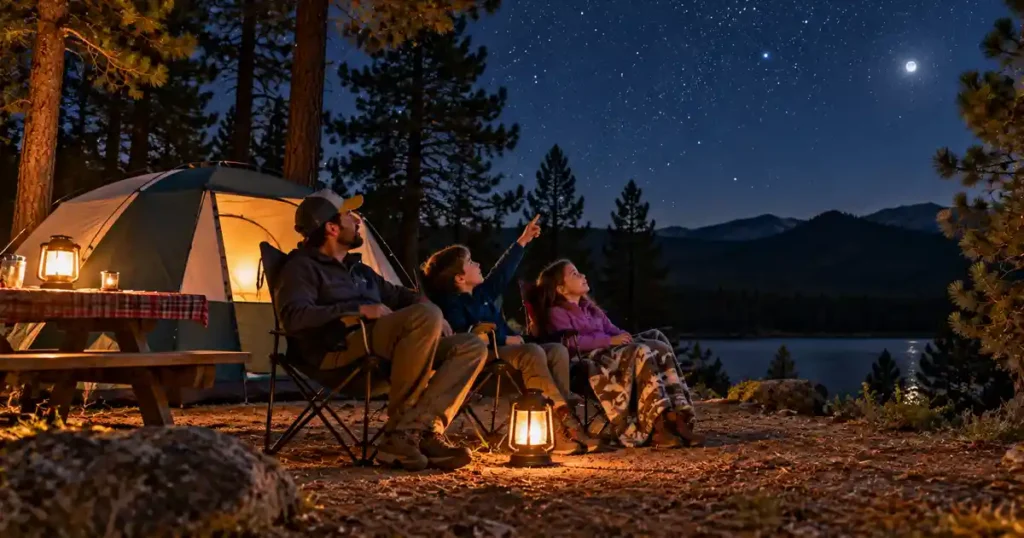
13. Screen-Free Stargazing
Find a safe open viewing spot and spend several minutes letting your eyes adjust to the darkness.
Children can look for:
- The brightest object in the sky.
- The moon.
- Different star patterns.
- A satellite moving steadily across the sky.
- Changes in how many stars become visible over time.
You do not need an app or telescope. The point is simply to look.
14. Make Your Own Constellation Stories
Instead of worrying about identifying official constellations, ask each child to choose several visible stars and imagine a shape.
They might see:
- A tent.
- An animal.
- A canoe.
- A giant spoon.
- A funny character.
Then invent a story explaining how that shape ended up in the sky.
This keeps stargazing accessible even when nobody in the family knows astronomy.
15. Night Sound Listening Game
Sit together quietly and listen.
Count how many different sounds you hear in five minutes.
Possible sounds might include insects, wind, water, birds, distant vehicles, or moving branches.
Children should stay beside the group rather than walking into the darkness to investigate a sound.
16. Lantern Shadow Puppets
Point a lantern or flashlight toward a suitable light-colored surface and make hand shadows.
Try animals, faces, or made-up creatures.
Turn it into a guessing game by having one person create a shape while everyone else tries to identify it.
Keep lanterns and children well away from hot cooking equipment or an active fire.
17. Flashlight I Spy
Everyone stays within a small established area.
One person chooses a nearby object visible from camp and gives clues such as:
“I spy something round.”
“I spy something beside the tent.”
Other players guess the object while using a flashlight only when necessary.
This provides the fun of nighttime exploration without sending children through the campground.
18. Campsite Charades
Use camping-themed prompts such as:
- Pitching a tent.
- Paddling a canoe.
- Seeing a bear from a safe distance.
- Hiking uphill.
- Cooking breakfast.
- Putting on a backpack.
Keep the game relatively quiet if other campers are nearby.
19. Story Circle
One person begins with a sentence:
“On the first night of our camping trip, we heard a strange noise…”
The next person adds one or two sentences, and the story continues around the circle.
You can make it funny, mysterious, or completely ridiculous.
This works with almost any age and requires no equipment.
20. Campfire Question Game
When campfires are legal and conditions allow one, use the time around the fire for a simple conversation game.
Ask questions such as:
- What was your favorite part of today?
- What animal would make the funniest camper?
- What food would you eat on every camping trip?
- Where should the family camp next?
- What new thing did you notice today?
Check local fire regulations before lighting a fire. Keep children supervised around flames and do not turn the area immediately around the fire into an active play zone.
A campfire is optional—the same game works around a lantern when fires are prohibited.
Rainy-Day Camping Activities for Kids
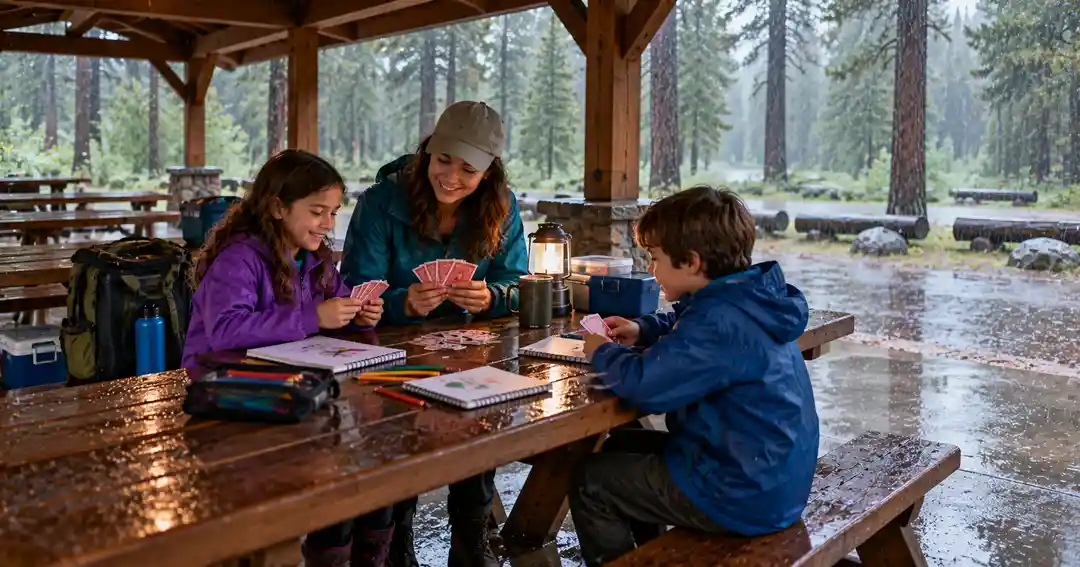
Rain does not automatically end a camping trip, but weather conditions matter.
Light rain without thunder may simply mean switching to quiet camping activities for kids under an appropriate dry area. A thunderstorm is different. If thunder is audible, move to a substantial building or enclosed metal-topped vehicle rather than remaining in a tent or open shelter.
21. Twenty Questions
One player silently chooses an animal, camping object, place, or other familiar subject.
Everyone else gets up to 20 yes-or-no questions to identify it.
For younger children, allow more clues and fewer restrictions.
No equipment is needed.
22. Camping Story Chain
One person starts a camping story with a single sentence.
Each player adds one sentence until the group has created a complete adventure.
Give the story a theme if children need help beginning:
- A squirrel steals something unusual.
- The tent begins talking.
- A mysterious map appears.
- Everyone wakes up tiny.
- A friendly animal needs help finding home.
23. Nature Pictionary
Write simple nature and camping subjects on small pieces of paper.
Ideas include:
- Tent.
- Tree.
- Owl.
- Mountain.
- Camp stove.
- Canoe.
- Backpack.
- Rain cloud.
- Fish.
- Flashlight.
One person draws while everyone else guesses.
For younger children, skip the written prompts and let an adult whisper the subject.
24. Card or Simple Dice Games
A deck of cards or a few dice takes almost no room in a camping box and works for many different ages.
Choose games your family already understands rather than spending a rainy afternoon explaining complicated rules.
Cards are particularly useful because the same deck can support several games during one trip.
Keep paper cards dry and use a stable surface when possible.
25. Draw a Campsite Map
Ask children to draw the campsite from above.
They can include:
- The tent.
- Vehicle.
- Picnic table.
- Cooking area.
- Nearby trail.
- Restroom if there is one.
- Safe play boundary.
- Campground road.
This works as a quiet drawing activity while also helping younger campers understand how the campsite is arranged.
How to Adapt Camping Activities for Kids by Age
The same camping activities for kids can often work for siblings several years apart. Change the challenge rather than creating a completely different activity for each child.
Younger Children
Keep activities:
- Short.
- Visual.
- Easy to explain.
- Close to the campsite.
- Cooperative rather than highly competitive.
A color hunt may last ten minutes instead of an hour. Nature bingo might use pictures. Scavenger hunts can focus on obvious objects.
School-Age Kids
Children in this range can usually handle:
- More detailed clues.
- Simple scores.
- Team challenges.
- Longer observation activities.
- Basic compass work.
- Nature journaling.
- More complicated storytelling.
Give them some decision-making freedom while keeping clear physical boundaries.
Older Kids and Tweens
Older children can make familiar camping activities for kids more challenging by:
- Designing scavenger hunts for younger siblings.
- Leading charades.
- Creating more complicated compass questions.
- Keeping a detailed nature journal.
- Running a family quiz.
- Inventing new rules for a campsite game.
Giving older children some responsibility can be more engaging than simply asking them to participate in an activity designed for younger siblings.
Build a Small Screen-Free Camping Activity Kit
You do not need a large toy box.
A compact family activity kit might contain:
- A deck of cards.
- Two or three dice.
- A small notebook.
- Pencils or crayons.
- A simple compass.
- A soft flying disc.
- Several bandanas or reusable markers.
- A small collapsible container.
- Flashlights or headlamps.
- Printed scavenger-hunt or bingo sheets.
Many of the camping activities for kids in this guide need nothing at all, so treat the kit as a backup rather than the centerpiece of the trip.
Leave room for children to invent their own games and spend time simply exploring the sights and sounds around camp.
Common Mistakes When Planning Camping Activities for Kids
One of the easiest mistakes is planning too much.
Children do not need entertainment scheduled from breakfast until bedtime. A camping trip should still leave room for eating slowly, talking, helping with simple camp tasks, resting, observing wildlife, and inventing games.
Other common mistakes include:
- Bringing an excessive number of toys.
- Choosing active games for a cramped campsite.
- Letting children run near campground roads.
- Playing close to tents, stakes, and guylines.
- Turning wildlife observation into wildlife chasing.
- Picking flowers or collecting natural objects when rules prohibit it.
- Treating rain and thunderstorms as the same situation.
- Running flashlight tag in unfamiliar terrain.
- Assuming a campfire will always be permitted.
- Choosing complicated activities after children are already tired.
The most useful camping activities for kids are often the ones you can start, stop, simplify, or change in a few minutes.
Frequently Asked Questions
What Are the Best Camping Activities for Kids With No Equipment?
Some of the easiest camping activities for kids with no equipment are cloud-spotting stories, campsite color hunts, Twenty Questions, story circles, charades, night sound listening, and make-your-own constellation stories. Choose activities that fit the available space and keep children within clearly established campsite boundaries.
What Camping Activities Work for Different Ages?
Observation scavenger hunts, charades, storytelling, nature journals, and target games adapt particularly well to mixed ages. Give younger children simpler clues, shorter distances, and more help. Older children can use harder prompts, keep score, take leadership roles, or design challenges for younger siblings.
What Can Kids Do at Night While Camping?
Good nighttime activities include stargazing, constellation stories, listening games, shadow puppets, Flashlight I Spy, charades, and story circles. Keep nighttime games slow and close to camp. Avoid activities that require running, hiding, approaching water, or wandering through unfamiliar terrain after dark.
What Can Kids Do While Camping When It Rains?
During ordinary light rain, children can play cards, Twenty Questions, Pictionary, story-chain games, draw campsite maps, or use nature journals in an appropriate dry space. If thunder is audible, stop treating the weather as normal rain and move everyone to proper lightning shelter.
How Do You Keep Kids Entertained While Camping Without Screens?
Prepare a small mix of active, quiet, daytime, nighttime, and poor-weather choices instead of scheduling the entire trip. A few camping activities for kids plus cards, paper, pencils, a compass, and a flashlight can provide plenty of options while still leaving room for free play and spontaneous exploration.
Conclusion
The best camping activities for kids are simple enough to fit naturally into the trip. You do not need to complete all 25 ideas or keep children occupied every minute.
If you are also looking for ideas on where to take the kids camping, our family camping trip in Santa Cruz guide compares practical campground options for families and helps you choose a setting that fits your children and camping style.
Pick several options for daylight, one or two nighttime games, and a few quiet weather backups. Pack a small reusable activity kit, establish safe campsite boundaries, check campground and fire rules, and watch the weather.
Then leave some unscheduled time. Often, the most memorable screen-free camping activities for kids begin when children have enough space to notice, imagine, and invent something for themselves.
References:
- National Weather Service — Lightning Safety Outdoors — Used to verify that tents and open picnic shelters are not safe lightning shelters, that campers should move to a substantial building or enclosed metal-topped vehicle when thunder is heard, and that outdoor activities should wait at least 30 minutes after the last thunder.
- U.S. National Park Service — Campfires — Used to verify campfire-rule checks, changing fire conditions, and the need for close supervision of children around campfires.
- U.S. National Park Service — Camping Safely: Before the Trip — Used to verify guidance on matching outdoor activities to the abilities of the group, keeping children together, and preparing for changing conditions.
- Leave No Trace — Principle 4: Leave What You Find — Used to verify that rocks, plants, and other natural objects should generally remain where they are found and that visitors should avoid constructing structures or altering natural areas.
- U.S. National Park Service — Leave What You Find — Used to support low-impact alternatives such as observing, sketching, journaling, and enjoying natural objects without removing them.