
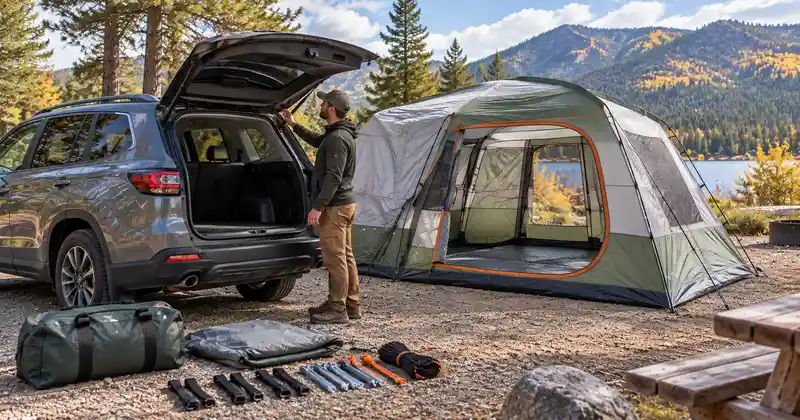
SUV Camping Tent: Compatibility, Types and Buying Guide
An SUV Camping Tent can turn an open rear hatch into part of your sleeping or living space, but compatibility matters more than capacity or price. A tent marketed as “universal” can still use a connection system that works better with certain hatch heights, rear-door styles, and vehicle shapes.
Start by deciding where you will sleep: inside the SUV, inside the ground tent, or in both spaces. Then verify the vehicle connection, calculate the combined SUV-and-tent campsite footprint, and compare capacity, drive-away flexibility, ventilation, weather protection, packed size, and price.
Table of Contents
SUV Camping Tent at a Glance
| Type | Best for | Main sleeping area | Vehicle connection | Drive-away flexibility | Main limitation |
|---|---|---|---|---|---|
| Tailgate shelter | Couples or solo SUV sleepers | Vehicle cargo area | Rear hatch sleeve | Depends on design | Limited ground-tent space |
| Full attached tent | Couples and families | Ground tent + vehicle | Full rear sleeve | Model-dependent | Large combined footprint |
| Tent with screen room | Longer family stays | Main tent + vehicle | Full rear sleeve | Model-dependent | More weight and campsite space |
| Hatchback tent | Smaller CUVs and hatchbacks | Ground tent + vehicle | Lower/smaller sleeve | Model-dependent | Fit range is more specific |
| Detachable hybrid | Family basecamp and road trips | Ground tent + vehicle | Removable connection | High | Larger, heavier, more expensive |
The first useful question is not “How many people does it sleep?” It is “How will this shelter connect to my exact vehicle?”
SUV Camping Tent Compatibility: Check the Vehicle First
Rear-mounted tents are unusual because part of the shelter is your vehicle.
That means tent fit depends on more than the fabric dimensions.
Identify Your Rear-Door Style
Start by identifying whether your vehicle has:
- Upward-opening liftgate
- Standard hatchback
- Split rear doors
- Barn doors
- Swing-out rear door
A tent designed around an upward liftgate may not work with another rear-door design.
For example, Napier currently says its compact Sportz Cove requires a standard hatch and does not work with barn doors. By contrast, the company recommends several of its larger SUV tent models for vehicles with barn doors.
Verify the Manufacturer’s Fit Guidance
“Universal SUV tent” should not be interpreted as “guaranteed to fit every vehicle.”
Napier currently describes the Backroadz SUV Tent as using a universal vehicle sleeve for CUVs, SUVs, and minivans. The sleeve uses an elastic end, adjustable wheel-well and trunk straps, and internal fabric flaps to reduce gaps around different vehicle shapes.
The same manufacturer uses a different design for its Dome-To-Go. That model is intended specifically for smaller CUVs and hatchbacks, and Napier says its sleeve sits lower than the sleeves on the larger Backroadz and Sportz SUV models.
The practical takeaway is simple: check fit for the actual vehicle category and model instead of relying only on the word universal.
Check What Is Attached to the Rear of the SUV
Rear accessories can interfere with the sleeve or prevent a tight connection.
Look for:
- Rear-mounted spare tire
- Bike rack
- Cargo carrier
- Ladder
- Recovery equipment
- Swing-away storage system
- Large hitch-mounted accessories
If the product manufacturer does not specifically confirm compatibility with an accessory, do not assume the tent will seal around it correctly.
Decide Where You Will Sleep
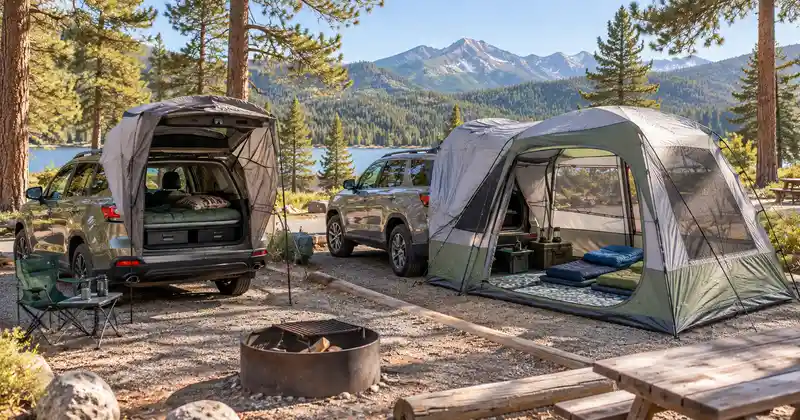
The best SUV tent depends heavily on whether the vehicle itself is part of the sleeping area.
Sleeping Mainly Inside the SUV
If you already have a sleeping platform or mattress in the cargo area, you may only need:
- Bug protection
- Privacy
- More ventilation
- Rain protection around the hatch
- A small sheltered entrance
A compact SUV tailgate tent can make more sense than carrying a large ground tent.
Napier’s current Sportz Cove is an example. It attaches over an open liftgate, extends shelter by a little more than 2 feet, weighs 8 pounds, includes a mesh screen door, and comes in two vehicle-fit sizes.
Sleeping Mainly in the Ground Tent
If the vehicle is mainly for gear storage, focus more heavily on:
- Ground floor dimensions
- Standing height
- Mattress arrangement
- Rainfly coverage
- Ventilation
- Vehicle sleeve
- Interior storage
A full attached model such as the Backroadz works more like a normal family tent that happens to provide direct access to the SUV’s cargo area.
Using Both the Tent and the SUV
Families may use the vehicle as an extra sleeping, changing, or storage area while others sleep in the ground tent.
That can make the setup very flexible, but do not automatically add vehicle sleeping positions to a tent manufacturer’s stated capacity.
Plan the sleeping layout yourself based on:
- Actual mattress dimensions
- Seat-folding configuration
- People
- Children
- Pets
- Gear
- Safe exits
Main Types of SUV Tents
Compact Tailgate Shelter
A tailgate shelter uses the SUV as most of the enclosure.
It is useful when you want to sleep in the vehicle but need more privacy and protection around the open hatch.
Advantages include:
- Lower weight
- Smaller packed size
- Quick setup
- Minimal additional campsite footprint
The trade-off is that you do not gain a large ground-level sleeping or living room.
Full Vehicle-Attached Ground Tent
This is the classic car tent attached to SUV design.
You pitch a normal ground tent behind the vehicle, then connect a fabric sleeve around the cargo opening.
This gives you:
- Tent sleeping space
- Standing room
- Direct cargo access
- Vehicle storage without walking outside
The trade-off is footprint.
A 10 × 10-foot tent behind an SUV requires far more campsite length than a freestanding 10 × 10 tent by itself.
SUV Tent With Screen Room
A screen room adds bug-protected living space outside the sleeping area.
Napier’s current Sportz SUV Tent with Screen Room combines a 10 × 10-foot main tent with a 7 × 6-foot floorless screen room. It weighs 52 pounds, provides more than 7 feet of headroom, and includes a full rainfly with taped seams.
That can be useful for:
- Chairs
- Shoes
- Gear
- Bug-protected lounging
But the extra room also increases:
- Weight
- Setup parts
- Stake count
- Campsite footprint
Hatchback Tent
Smaller hatchbacks and CUVs often sit lower than full-size SUVs.
Napier’s Dome-To-Go reflects this difference. Its vehicle sleeve is designed specifically for smaller hatchbacks and CUVs rather than using the company’s standard larger-SUV sleeve. The current tent measures about 8.5 × 8.5 feet, has a 6-foot-7-inch center height, weighs 31 pounds, and can become a standalone ground tent when the vehicle sleeve is disconnected.
This is why hatchback compatibility deserves its own check rather than being treated as a smaller version of every SUV.
Large Detachable SUV Basecamp
Larger hybrids can function as both vehicle-connected tents and independent basecamp shelters.
KingCamp’s BOUNDLESS X6 currently uses a detachable vehicle sleeve and can operate as a standalone cabin tent. It has a separate sleeping room and living area, with a deployed size of about 15.5 × 9.5 × 7.5 feet and a packed weight of 41.9 pounds.
This style is useful when campsite space is generous and you want the SUV available during the day.
Drive-Away Capability: Will the Tent Stay Up Without the SUV?
This feature matters more than many buyers expect.
Suppose you pitch camp Friday evening and want to use the SUV Saturday morning for:
- A trailhead
- Grocery run
- Sightseeing
- Fishing access
- Town visit
If your shelter depends completely on the vehicle for structural support, leaving camp can mean partially dismantling it.
A better fit for road-trip camping may be a model where you can:
- Disconnect the vehicle sleeve.
- Close the tent-side opening.
- Drive away.
- Return later and reconnect.
Napier’s Sportz SUV Tent with Screen Room can convert to a traditional ground tent after the vehicle sleeve is disconnected. KingCamp also states that the BOUNDLESS X6 can function independently after detaching the vehicle connection.
If you expect the SUV to remain parked for the whole trip, this feature may matter much less.
Measure the Campsite, Not Just the Tent
An SUV tent requires space for both the vehicle and the shelter.
Before booking a campsite, think about:
- Vehicle length
- Ground-tent length
- Open hatch
- Screen room
- Awning
- Stakes
- Guylines
- Door clearance
A campground can allow both tents and SUVs while still having a layout that makes an attached shelter impractical.
Some sites have:
- A parking spur beside the tent pad
- A raised or bordered tent pad
- Barriers between parking and camping space
- Narrow pull-ins
- Separate walk-in tent areas
A rear hatch tent works best when the vehicle can legally remain immediately beside the area where the tent is pitched.
Camping Trip Atlas has a separate guide to help you plan a campsite that fits your vehicle setup before committing to a large connected shelter. The existing article also covers campsite dimensions, vehicle suitability, reservations, and backup options.
Capacity and Interior Space
SUV tent capacity can be confusing because the vehicle adds usable space.
Treat the manufacturer’s capacity as a starting point rather than a guarantee of comfortable occupancy.
Measure:
- Sleeping pads
- Air mattresses
- Cots
- Pet beds
- Duffels
Then decide what can stay in the vehicle.
Also check standing height, not just floor size.
Napier’s Backroadz currently provides a 10 × 10-foot floor and 88-inch center height. The manufacturer rates it for up to five people.
That does not necessarily mean five adults plus large mattresses and gear will feel spacious.
Likewise, do not treat a screen room as sleeping capacity unless the manufacturer explicitly designs and rates it for that purpose.
Vehicle Sleeve and Weather Protection
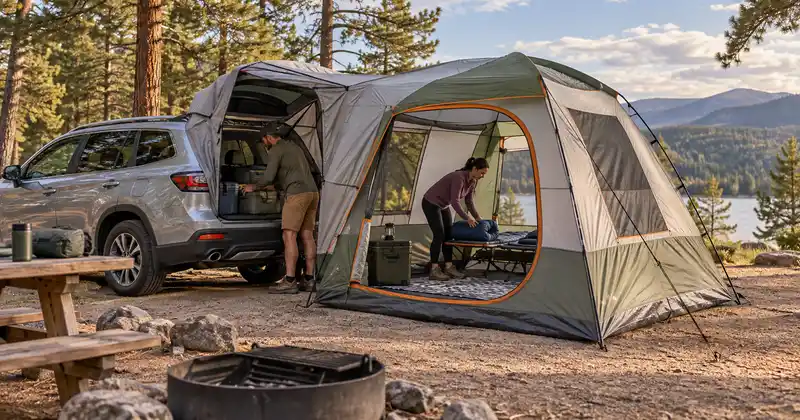
A rear hatch connection creates another potential weather entry point that normal ground tents do not have.
Evaluate:
- Sleeve tension
- Elastic edge
- Adjustment straps
- Wheel-well straps
- Internal flaps
- Rainfly coverage
- Door storm flaps
- Taped seams
The Backroadz currently uses a full rainfly with taped seams and a 1,500 mm PU coating. Napier also explains that its universal sleeve uses elastic, adjustable straps, and internal fabric flaps to reduce minor gaps around curved vehicle shapes.
A larger waterproof rating does not guarantee that every vehicle connection will be completely watertight.
Vehicle shape, sleeve tension, wind-driven rain, and correct setup all matter.
Ventilation and Condensation
Connecting a tent directly to a vehicle creates a large combined sleeping volume, but moisture can still build up overnight.
Look for:
- Mesh windows
- Roof vents
- Multiple doors
- Adjustable openings
- Rain-protected ventilation
The Backroadz currently has three mesh windows, while Napier’s screen-room model uses three side windows and two ceiling vents. KingCamp lists two doors and three windows plus the vehicle opening on the BOUNDLESS X6.
Do not seal every ventilation opening just because the temperature falls.
Breathing, wet clothing, and temperature differences can produce condensation even when the tent itself is not leaking.
Carbon Monoxide: Keep the Engine Off
Do not idle a gasoline-powered SUV while people are occupying a tent connected to its rear cargo area.
Carbon monoxide is colorless and odorless. Vehicle exhaust can become dangerous around enclosed or partially enclosed occupied spaces.
CDC specifically warns that when an SUV tailgate is open, exhaust can be pulled back into the vehicle if airflow is inadequate.
For an attached camping setup, the practical rule is:
- Shut the engine off before occupying the connected shelter.
- Do not use the vehicle engine as a heater for the tent.
- Keep gasoline-powered generators away from shelter doors, windows, and vents.
CDC advises operating portable generators more than 20 feet from windows, doors, and vents.
Electric-vehicle climate-control systems vary by manufacturer and model, so follow the vehicle manufacturer’s instructions rather than assuming guidance for one EV applies to another.
Setup, Stakes and Guying
SUV tents have an extra setup stage: attaching the shelter to the vehicle.
A typical process may involve:
- Pitching the ground tent.
- Positioning the SUV relative to the tent.
- Opening the rear hatch.
- Pulling the sleeve over the vehicle opening.
- Adjusting connection straps.
- Installing the rainfly.
- Staking the shelter.
- Tensioning the guylines.
Napier currently advertises about a 10-minute setup for the Backroadz and under five minutes for the much smaller Sportz Cove. Those are manufacturer claims under normal conditions and do not include selecting a campsite or arranging the rest of camp.
Large SUV shelters still need to be anchored correctly.
If you want a refresher on securing shelter lines, Camping Trip Atlas covers basic camping knots for tent guylines.
Weight and Packed Size
You are transporting an SUV tent by vehicle, but that does not make weight irrelevant.
Current designs range widely:
- Napier Sportz Cove: 8 lb
- Napier Backroadz: 25 lb
- KingCamp BOUNDLESS X6: 41.9 lb
- Napier Sportz SUV Tent with Screen Room: 52 lb
Packed dimensions matter too.
The Backroadz packs to about 30 × 11 × 11 inches, while KingCamp lists the X6 at about 30 × 14 × 12 inches.
Before buying, picture the complete cargo load:
- Tent
- Mattress
- Sleeping bags
- Coolers
- Chairs
- Water
- Cooking gear
- Clothing
- Activity equipment
A huge shelter is less useful if it consumes the space needed for the rest of the trip.
SUV Tent vs Rooftop Tent
Both systems connect camping shelter to a vehicle, but they solve different problems.
| Factor | SUV / tailgate tent | Rooftop tent |
|---|---|---|
| Main attachment | Rear hatch and ground | Roof rack |
| Ground footprint | Usually larger | Usually smaller |
| Roof-load check | No rooftop sleeping load | Essential |
| Sleeping position | Ground or vehicle | Elevated |
| Vehicle access | Direct cargo connection | Depends on tent layout |
| Drive-away | Model-dependent | Tent travels with vehicle |
| Main compatibility issue | Rear-hatch geometry | Roof and rack system |
| Large-family space | Often easier to obtain | Usually more limited |
A rooftop tent also requires more than simply having roof rails.
Thule advises verifying the vehicle manufacturer’s dynamic roof-load limit, a compatible rack system, the rack’s load rating, roof type, and proper crossbar support before mounting a rooftop tent.
An SUV tent may be the better option when:
- You want ground-level access.
- Your roof cannot support the desired rooftop system.
- You want a large family room.
- You do not want a permanent or heavy roof setup.
A rooftop tent may make more sense when a smaller ground footprint and elevated sleeping platform are priorities and the vehicle/rack system is compatible.
Current SUV Tent Examples
These are current specifications-based examples for different use cases. They are not personal testing claims or a universal ranking.
Napier Sportz Cove — For Sleeping Mainly Inside the SUV
Current manufacturer specifications include:
- Two vehicle-fit sizes
- CUV/SUV/minivan compatibility within those size options
- Standard hatch required
- More than 2 feet of rear awning
- 8 lb weight
- Mesh screen door
- Storm flap
- 2,000 mm PU coating
- Under-five-minute manufacturer setup claim
- Current price: $150, verified September 9, 2026
Best for: solo campers or couples who plan to sleep inside the SUV and mainly want bug protection, privacy, and more usable hatch space.
Main limitation: it does not provide a large independent ground-tent sleeping room.
Skip it if: you need a full family tent or your vehicle uses barn doors.
Napier Backroadz SUV Tent — For a Standard Family Setup
Current specifications include:
- 10 × 10-ft floor
- 88-in. center height
- Up to five-person manufacturer capacity
- 25 lb weight
- 30 × 11 × 11-in. packed size
- Broad CUV/SUV/minivan sleeve
- Full rainfly
- Taped seams
- 1,500 mm PU coating
- Three mesh windows
- Approximately 10-minute manufacturer setup claim
- One-year warranty
- Current price: $300, verified September 9, 2026
Best for: couples or families who want a normal standing-height ground tent plus direct access to SUV storage.
Main limitation: the 10 × 10-foot tent must sit directly behind the vehicle, so the complete setup needs a large, compatible campsite.
Skip it if: you routinely use compact campsites or the vehicle must leave camp frequently.
KingCamp BOUNDLESS X6 — For a Large Detachable Basecamp
Current manufacturer specifications include:
- 6–8-person stated capacity
- Approximately 15.5 × 9.5 × 7.5 ft deployed
- 41.9 lb
- 30 × 14 × 12-in. packed size
- Separate sleeping room and living area
- Detachable SUV connection
- Standalone cabin-tent use
- 210T polyester ripstop
- 3,000 mm PU specification
- Aluminum frame
- Stakes, ropes, poles, and carry bag included
- Current base price: $899.99, verified September 9, 2026
Best for: larger family basecamps where interior living space and the ability to disconnect the vehicle are priorities.
Main limitation: substantial footprint, weight, and price.
Skip it if: you want a compact shelter for occasional weekend use.
SUV Tent Comparison Table
| Model | Type | Vehicle fit | Main size | Capacity | Weight | Weather specification | Standalone use | Best use | Main limitation | Price verified Sept. 9, 2026 |
|---|---|---|---|---|---|---|---|---|---|---|
| Napier Sportz Cove | Tailgate shelter | Two CUV/SUV/minivan size ranges; standard hatch | 2+ ft awning extension | 2 | 8 lb | 2,000 mm PU | No traditional ground room | Sleeping inside SUV | Limited enclosed space | $150 |
| Napier Backroadz | Full attached ground tent | Broad CUV/SUV/minivan sleeve | 10 × 10 ft; 88-in. center | 5 | 25 lb | 1,500 mm PU | Not a primary standalone feature advertised on current page | Couples/families | Large rear footprint | $300 |
| KingCamp BOUNDLESS X6 | Detachable SUV basecamp | Vehicle-connected sleeve; verify exact fit | 15.5 × 9.5 × 7.5 ft | 6–8 | 41.9 lb | 3,000 mm PU | Yes | Large family basecamp | Footprint, weight, price | $899.99 |
Prices and availability may change. Verify the current manufacturer page and vehicle compatibility before purchasing.
Common SUV Tent Buying Mistakes
Avoid these mistakes:
- Buying because the word “universal” appears in the description.
- Ignoring rear-door style.
- Forgetting a spare tire, bike rack, or cargo carrier.
- Measuring the tent but not the SUV-plus-tent footprint.
- Treating maximum sleeping capacity as comfortable capacity.
- Assuming a screen room is designed for sleeping.
- Forgetting whether you need to drive away during the day.
- Ignoring the weather seal around the vehicle connection.
- Checking tent weight but not packed dimensions.
- Assuming an SUV tent and rooftop tent have the same compatibility requirements.
- Idling a gasoline vehicle while the attached shelter is occupied.
- Buying before checking replacement parts and warranty support.
SUV Tent Buying Checklist
Before purchasing, verify:
- Vehicle year, make, and model
- Rear-door style
- Manufacturer compatibility guidance
- Hatch height and opening shape
- Rear-mounted accessories
- Primary sleeping location
- Capacity
- Floor dimensions
- Standing height
- Screen room
- Drive-away capability
- Standalone use
- Vehicle sleeve design
- Attachment straps
- Rainfly
- Storm flaps
- Ventilation
- Floor construction
- Stakes
- Guylines
- Setup process
- Packed weight
- Packed dimensions
- Combined vehicle-and-tent campsite footprint
- Replacement parts
- Warranty
- Current price
- Current availability
Compatibility should be confirmed before price or capacity becomes the deciding factor.
Frequently Asked Questions
Will an SUV tent fit any SUV?
No. Some manufacturers use adjustable “universal” sleeves designed for a broad range of CUVs, SUVs, and minivans, but fit still depends on the vehicle’s rear opening and the specific tent. Hatchbacks, barn doors, rear-mounted spares, and accessories can require a different model or prevent proper attachment.
Can you drive away while an SUV tent stays set up?
Some models allow it. Look for a tent that can stand independently and has a vehicle sleeve that disconnects or closes when the SUV leaves. Other tailgate shelters rely more heavily on the vehicle and are less useful as standalone camps.
Can you sleep inside the SUV while using a tailgate tent?
Yes, that is one of the main uses for a compact tailgate shelter. The tent can add bug protection, privacy, ventilation, and covered hatch space while the mattress remains inside the cargo area. Make sure the sleeping platform, ventilation, vehicle position, and tent fit are appropriate for your setup.
Is an SUV tent better than a rooftop tent?
Neither is universally better. SUV tents generally provide easier ground-level access and more living space without requiring rooftop load capacity. Rooftop tents reduce ground footprint and provide an elevated sleeping platform, but require a compatible vehicle roof and properly rated rack system.
Can you run the SUV while an SUV Camping Tent is attached?
Do not idle a gasoline-powered SUV while people occupy an attached tent or open cargo sleeping area. CDC warns that exhaust can be drawn into vehicles through an open tailgate and that carbon monoxide can accumulate dangerously. Shut the engine off and keep gasoline-powered generators well away from tent openings.
Conclusion
The right SUV Camping Tent starts with compatibility—not with the biggest floor, highest capacity, or lowest price. Confirm how the sleeve fits your exact rear hatch, decide whether you will sleep in the vehicle or ground tent, and make sure the complete setup fits the campsites you actually use.
Once fit is confirmed, compare drive-away capability, standing room, weather construction, ventilation, weight, packed size, replacement support, and current pricing. Measuring the vehicle and campsite plan before buying is much easier than discovering a fit problem after arriving at camp.
References:
- Napier Outdoors — Backroadz SUV Tent
https://napieroutdoors.com/products/backroadz-suv-tent - Napier Outdoors — Sportz Cove
https://napieroutdoors.com/collections/ford-explorer-tents/products/sportz-cove - Napier Outdoors — Sportz Dome-To-Go
https://napieroutdoors.com/products/sportz-dome-to-go-model-86000 - Napier Outdoors — Sportz SUV Tent with Screen Room
https://napieroutdoors.com/products/sportz-suv-tent-with-screen-room - KingCamp — BOUNDLESS X6 SUV Tent
https://www.kingcamp.com/products/boundless-x6-suv-tent - Centers for Disease Control and Prevention — Carbon Monoxide Poisoning Basics
https://www.cdc.gov/carbon-monoxide/about/index.html - Thule — Will a Rooftop Tent Fit My Car?
https://www.thule.com/en-gb/articles/guides/how-do-rooftop-tents-work-a-complete-guide/how-do-you-know-if-a-rooftop-tent-fits-your-vehicle - Thule — What Roof Racks Do I Need for a Rooftop Tent?
https://www.thule.com/en-be/articles/guides/how-do-rooftop-tents-work-a-complete-guide/what-roof-racks-do-i-need-for-a-rooftop-tent