
Camping Shower Tent: Types, Features and Buying Guide
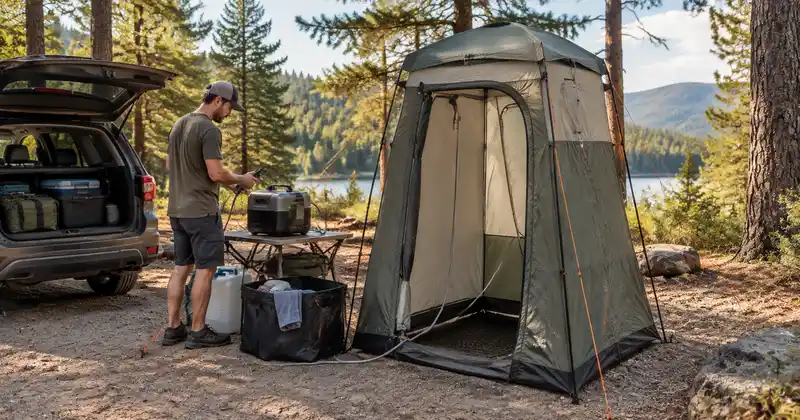
A Camping Shower Tent gives you a private place to shower, change clothes, or use a portable toilet, but the enclosure is only one part of the setup. Before buying one, decide how your water will be supplied, where the shower hose or bag will go, and how wastewater will drain.
For most car campers, a compact pop-up shelter works well for changing and toilet privacy, a structured single-room model is better for regular showering, and a two-room tent makes sense when you want a separate dry area for clothing and towels.
Table of Contents
Camping Shower Tent at a Glance
| Type | Best for | Setup | Typical floor | Shower setup | Main trade-off |
|---|---|---|---|---|---|
| Pop-up privacy shelter | Changing, toilet privacy, occasional showering | Very fast | Removable mat or floorless | External hose or lightweight system | Folding technique and wind stability |
| Framed single-room tent | Dedicated campsite showering | Moderate | Integrated, removable, or draining floor | Gravity bag or pressure shower | More packed bulk |
| Two-room shower tent | Families and longer stays | Moderate | Shower-side floor plus dry changing space | Integrated or separate shower system | Heavier and larger |
The right choice depends less on how quickly the tent opens and more on what you plan to do inside it.
What Does a Camping Shower Tent Actually Do?
A shower tent is primarily a privacy enclosure.
Depending on the model, it can provide:
- Private shower space
- Changing space
- Portable-toilet privacy
- Protection from light wind
- A place to hang towels or clothing
- Storage pockets for toiletries
- Hose or nozzle access
It does not automatically provide warm water, water pressure, or a showerhead.
Some models include a gravity-fed shower bag. Others are designed to work with a separate pressure shower. Basic privacy shelters may include no shower equipment at all.
NEMO’s Heliopolis, for example, is designed around a separate Helio pressure shower. It includes a hose pass-through and overhead nozzle mount rather than supporting a large gravity bag from the roof.
That distinction is important because the water system should influence which enclosure you buy.
Types of Camping Shower Tents
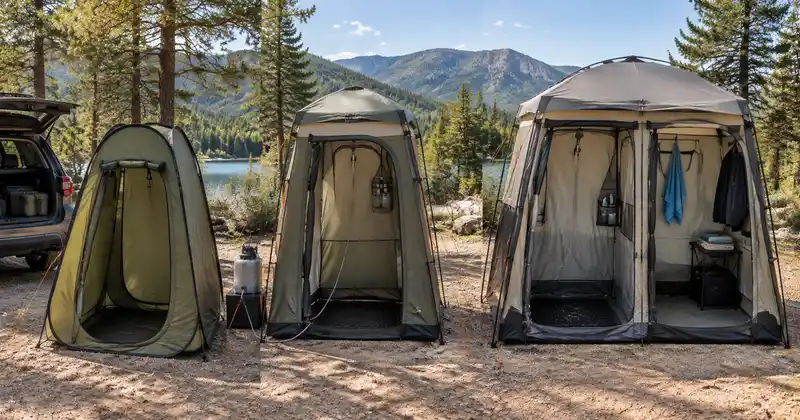
Pop-Up Shower and Privacy Tents
A pop-up shower tent uses a spring-steel frame that expands when removed from its carry bag.
Its main advantages are:
- Very fast deployment
- Low weight
- Small equipment list
- Good privacy for changing
- Easy portable-toilet use
- Useful for short car-camping trips
The trade-off is the packed shape. Many models fold into a wide circular or oval disc instead of a narrow tent bag.
Folding the shelter back down can also require practice. Deployment may take seconds, but takedown is not always as intuitive.
WolfWise’s current Blazers A20 is a good example. It opens to about 47.2 × 47.2 × 74.8 inches and includes a removable bottom mat and removable rain cover. The current manufacturer page also emphasizes staking because the shelter is lightweight.
A pop-up shelter works especially well when your main needs are changing clothes, toilet privacy, or showering with an external hose.
Framed Single-Room Shower Tents
A framed shower tent uses fiberglass, steel, or a combination of poles.
These models usually take longer to assemble than a spring-frame pop-up, but they can provide:
- More interior width
- Better structural support
- More storage
- Better shower-bag integration
- Taller standing height
- More controlled drainage
KingCamp’s current MARASUSA single-room shelter measures 66 × 66 × 85 inches, weighs 12.5 pounds, and includes a 20-liter solar shower bag. Its frame uses fiberglass and steel poles, and the manufacturer specifies a top hook with a 16 kg load rating.
That type of model is better suited to campers who expect to use the shelter regularly as an actual shower rather than mainly as a changing booth.
Two-Room Shower and Changing Tents
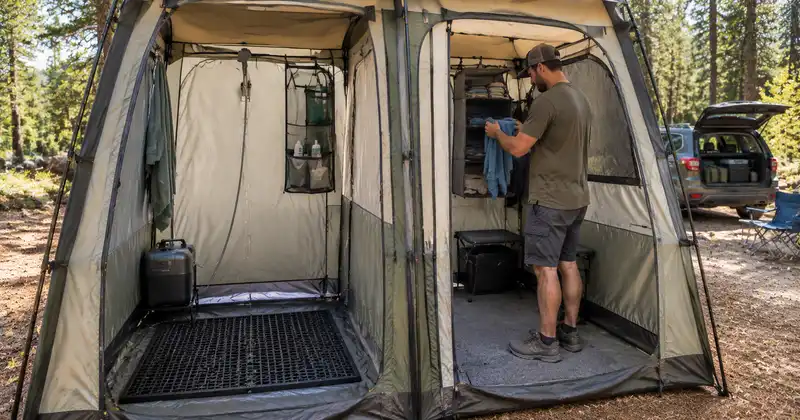
A two-room design separates the wet shower area from the dry changing area.
That solves one of the biggest practical problems with a single-room tent: keeping clean clothing and towels dry while you shower.
CORE’s current Two Room Instant Shower Tent uses a zippered divider to create separate shower and changing rooms. It measures 7 × 3.5 feet, stands 84 inches high, weighs 22 pounds, and packs to 44 × 9 × 9 inches.
Two-room shelters are particularly useful for:
- Families
- Longer campground stays
- Campers changing children
- Couples sharing the shelter
- Anyone who wants toiletries and clothing separated from shower spray
Their downside is obvious: more weight and more cargo space.
Choose the Shower System Before the Enclosure
The easiest buying mistake is choosing the tent first and figuring out the shower later.
Reverse that process.
Gravity Shower Bags
A gravity shower uses a water bag positioned above your head.
Water is heavy. A full 5-gallon bag holds roughly 40 pounds of water before the bag itself is counted.
Never assume that a lightweight privacy shelter can support that load.
If you want to hang a gravity bag from the tent, verify a manufacturer-approved hanging point and load rating.
KingCamp specifically lists a 16 kg load-bearing top hook for the MARASUSA and includes a 20-liter shower bag.
If the manufacturer does not specify that the tent can support a water bag, use another setup.
Ground-Based Pressure Showers
A pressure shower keeps the water reservoir on the ground.
A hose runs from the tank into the enclosure, which means the privacy tent does not need to support the weight of the water.
NEMO’s Heliopolis uses this approach with the Helio and Helio LX pressure showers. The shelter has a hose pass-through and overhead nozzle holder for hands-free use.
This can be a better approach for lighter shelters.
Battery-Pump Showers
Battery-powered pumps commonly draw water from a bucket or other container and send it through a shower hose.
For this setup, look for:
- Convenient hose access
- Enough floor space for movement
- A stable place for the water container outside
- Good drainage
- Safe placement of battery-powered components according to their manufacturer instructions
The shower tent itself does not need to carry the water load.
Shower Tent With Floor or Floorless?
There is no universally better floor design.
Floorless Shower Tent
A floorless shelter allows water to drain directly onto the ground.
Advantages:
- Simple drainage
- Less water pooling inside
- Easy portable-toilet placement
Disadvantages:
- Bare feet can be on dirt, gravel, or mud
- Splashing can create a muddy interior
- Campsite rules may not allow shower water to drain directly where you set up
Removable Floor
A removable floor gives you flexibility.
You can use it while changing clothes or using a portable toilet, then remove it for showering when site rules and ground conditions make that appropriate.
WolfWise’s A20 includes a removable bottom mat rather than a permanently attached shower floor.
Drained or Mesh Floor
A purpose-built shower floor can keep your feet off the ground while still allowing water to escape.
KingCamp’s MARASUSA uses a PE floor with drainage-oriented construction, while NEMO’s Heliopolis incorporates what the manufacturer calls French drainage into its floor design.
Remember: a draining floor does not make wastewater disposal automatically legal.
Drainage and Greywater: Where Does the Water Go?
A camp shower can create several gallons of wastewater in a few minutes.
Before setting up, know where that water is supposed to go.
Leave No Trace recommends carrying water at least 200 feet from streams and lakes for washing yourself or dishes and using only small amounts of biodegradable soap.
That is general low-impact guidance, not a universal campground regulation.
A campground, state park, national park, BLM area, or other land manager may have stricter rules requiring greywater to be:
- Collected
- Disposed of at a designated drain
- Placed in a utility sink
- Stored for later disposal
Always follow the local rule when it is stricter.
Also avoid placing the shower where runoff can flow:
- Into a lake or stream
- Across a road
- Into another campsite
- Under your sleeping tent
- Into a food-preparation area
Even biodegradable soap should not be treated as harmless when dumped directly into natural water.
Privacy, Ventilation and Interior Lighting
A privacy shelter needs to prevent unwanted visibility without becoming a humid box.
Look for:
- Opaque or coated wall fabric
- Secure door closures
- Closable windows
- Mesh roof ventilation
- High and low airflow
- Interior zipper or privacy lock
- Strategic towel and clothing storage
CORE states that its current two-room tent uses specially coated fabric intended to reduce visibility from outside, plus an interior zipper lock. It also uses a mesh ceiling and closable windows for ventilation.
Be careful with bright lights at night. Even reasonably opaque fabric can show a silhouette when a strong lantern is positioned directly behind the person inside.
Place lighting lower or off to one side when practical instead of shining it directly toward the wall.
Height and Width Matter More Than You Think
Standing height gets most of the attention, but width is just as important.
You need room to:
- Raise your arms
- Wash your hair
- Turn around
- Dry off
- Change pants
- Help a child
- Use a portable toilet
- Keep clean items away from wet walls
Compare three current designs:
- WolfWise A20: about 47.2 × 47.2 × 74.8 in.
- KingCamp MARASUSA: 66 × 66 × 85 in.
- CORE Two Room: 84 × 42 × 84 in. overall floor/height dimensions.
A compact shelter can be perfectly adequate for one adult changing clothes but feel restrictive when used for a shower and portable toilet.
Wind Stability and Anchoring
Privacy shelters are tall relative to their footprint, which means wind can push on a large amount of fabric.
Always use the supplied anchoring system when conditions require it.
Check for:
- Stakes
- Guyline attachment points
- Rainfly guylines
- Strong lower corners
- Stable pole hubs or joints
CORE includes a rainfly with attached guylines and stakes with its two-room model.
WolfWise also emphasizes staking its lightweight pop-up tents to keep them secure.
If you need help tensioning lines, Camping Trip Atlas has a guide to basic camping knots for securing guylines.
Do not treat a privacy tent as shelter during severe weather. Its job is privacy and light environmental protection, not storm survival.
Setup Speed vs. Takedown Convenience
“Pop-up” and “instant” describe different systems.
Spring Pop-Up
A spring-frame tent can open in seconds.
Its weakness is folding. You normally need to twist the flexible frame into a specific pattern before it fits back into the carry case.
Instant Frame
An instant-frame shelter uses pre-attached poles that telescope or lock into position.
CORE currently advertises its two-room model as setting up in as little as 60 seconds with two people.
That is a manufacturer setup claim, not a guarantee that your entire shower station will be operational in one minute.
You still need to:
- Select a site
- Stake the shelter
- Add guylines
- Fill the shower bag
- Position water
- Organize clothing
- Prepare drainage
Compare complete campsite effort, not only the headline setup time.
Current Camping Shower Tent Options
These recommendations are based on current manufacturer specifications and use cases, not personal testing.
WolfWise Blazers A20 — For Compact Pop-Up Privacy
Current specifications include:
- Pop-up construction
- 47.2 × 47.2 × 74.8 in. open size
- 22.8 × 22.8 in. folded footprint
- 190T polyester construction
- Removable rain cover
- Removable bottom mat
- Multiple ventilation openings
- Current price of $43.99–$44.99, depending on color, verified September 5, 2026
Best for: changing clothes, toilet privacy, beach use, and shower setups using an external hose or lightweight water system.
Main limitation: it is a compact, lightweight privacy shelter rather than a heavy-duty integrated shower system.
Skip it if: you need separate wet/dry areas or want to support a heavy overhead water reservoir.
KingCamp MARASUSA — For a Complete Single-Room Shower Kit
Current specifications include:
- 66 × 66 × 85 in. open dimensions
- 23.6 × 6.5 × 6.5 in. packed size
- 12.5 lb weight
- Fiberglass and steel frame
- 150D Oxford fly fabric
- 1,500 mm published water-resistance rating
- 20-liter solar shower bag included
- 16 kg rated top hook
- Mesh roof and side ventilation
- PE floor
- Current U.S. price of $139.99, verified September 5, 2026
Best for: car campers who want one purchase to provide both the privacy shelter and gravity shower.
Main limitation: more parts, weight, and setup than a basic spring pop-up shelter.
Skip it if: your priority is the smallest possible packed privacy enclosure.
CORE Two Room Instant Shower Tent — For Families and Wet/Dry Separation
Current specifications include:
- 7 × 3.5 ft overall floor size
- 84 in. center height
- 22 lb weight
- 44 × 9 × 9 in. packed size
- 68D polyester with 1,200 mm water-resistant specification
- Steel frame
- Zippered room divider
- 5-gallon shower bag included
- Shower-side PE floor
- Towel bars
- Storage pockets
- Mesh ceiling and closable windows
- One-year warranty
- Current price of $199.99, verified September 5, 2026
CORE also currently sells replacement shower-tent components including poles, joints, the water bag, stakes, carry bag, rainfly, and patch kit.
Best for: families and longer car-camping trips where separating the wet shower from clean clothing is valuable.
Main limitation: it is the heaviest and bulkiest recommendation in this shortlist.
Skip it if: vehicle storage is limited or you only want a quick changing booth.
Camping Shower Tent Comparison
| Model | Type | Open size | Weight | Floor | Shower included | Rooms | Best use | Main limitation |
|---|---|---|---|---|---|---|---|---|
| WolfWise Blazers A20 | Spring pop-up | 47.2 × 47.2 × 74.8 in. | Not used as comparison criterion because current page does not clearly publish it | Removable mat | No | 1 | Compact privacy | Limited integrated shower support |
| KingCamp MARASUSA | Framed single-room | 66 × 66 × 85 in. | 12.5 lb | PE/drainage-oriented floor | 20L solar bag | 1 | Complete single-room kit | More setup and bulk |
| CORE Two Room | Instant frame | 84 × 42 × 84 in. | 22 lb | Shower-side PE floor | 5-gallon bag | 2 | Families/wet-dry separation | Largest packed system |
Prices and availability can change, so verify the manufacturer listing before purchasing.
Using a Shower Tent as a Toilet or Changing Tent
Many camping shower tents work just as well as portable toilet or changing shelters.
For toilet use, prioritize:
- Enough floor space
- Stable ground
- Easy-clean or removable floor
- Ventilation
- Toilet-paper storage
- Interior privacy lock
- Room to enter and exit comfortably
NEMO’s Heliopolis even incorporates a toilet-paper holder with a dry bag into the shelter.
For changing clothes, a dry floor and towel storage can matter more than shower-bag compatibility.
If you expect to use one enclosure for both showering and toilet privacy, a removable floor or two-room arrangement can make the transition easier.
Common Shower Tent Buying Mistakes
Avoid these common errors:
- Buying the shelter before choosing the water system.
- Hanging a heavy shower bag from an unsupported frame.
- Ignoring where wastewater will drain.
- Choosing by height while ignoring width.
- Assuming every floor is designed for shower drainage.
- Failing to stake a tall privacy shelter.
- Ignoring the packed shape of a pop-up tent.
- Assuming fast deployment means easy takedown.
- Expecting the shelter to handle severe weather.
- Allowing soap water to drain toward natural water.
- Buying one small room when your family needs separate dry changing space.
How to Choose a Shower Tent: Buying Checklist
Before purchasing, verify:
- Primary use: shower, changing, toilet, or all three
- Single-room or two-room layout
- Standing height
- Interior width
- Packed dimensions
- Weight
- Pop-up, instant, or pole setup
- Floor type
- Drainage design
- Shower-water source
- Approved hanging load
- Hose pass-through
- Ventilation
- Fabric privacy
- Door closure
- Stakes
- Guylines
- Storage pockets
- Towel storage
- Replacement parts
- Warranty
- Current price and availability
If you are choosing a large two-room model, plan campsite space and vehicle storage before the trip. A privacy shelter still needs to fit alongside your sleeping tent, vehicle, cooking area, and other campsite equipment.
Frequently Asked Questions
Do you need a floor in a camping shower tent?
No. A floorless design can drain easily, while a removable or drained floor can keep your feet cleaner. The best choice depends on ground conditions and local greywater rules. A floor does not give you permission to let shower water drain anywhere, so plan wastewater disposal separately.
Can a pop-up shower tent hold a 5-gallon shower bag?
Not automatically. Five gallons of water weighs about 42 pounds before accounting for the bag. Only hang a filled shower bag from a shelter if the manufacturer provides a suitable support point and load rating. Otherwise, use an external support or a ground-based pressure shower.
What is the difference between a shower tent and a privacy tent?
A privacy tent mainly creates an enclosed place for changing or toilet use. A purpose-built shower tent may add drainage, hose openings, a shower-bag support, towel storage, or a shower system. Some products can serve both purposes, but their shower compatibility varies.
Is a two-room shower tent worth the extra space?
It can be for families or multi-night trips. One compartment can remain wet while the other holds dry clothing, towels, and toiletries. A two-room shelter is less attractive when packed space, vehicle storage, or setup simplicity matters more than having a separate changing area.
Where should you set up a Camping Shower Tent?
Choose stable ground where the shelter can be staked securely and shower runoff can be managed legally. Keep washing water away from lakes and streams; Leave No Trace recommends at least 200 feet as general guidance. Also avoid drainage paths, neighboring campsites, food-preparation areas, and locations exposed to strong wind.
Conclusion
A Camping Shower Tent should be chosen around your water system, drainage plan, privacy needs, and available campsite space—not simply how quickly it opens.
Choose a compact pop-up for basic privacy, a structured single-room model for a more complete shower setup, or a two-room shelter when keeping clothing dry matters. Before buying, verify dimensions, floor design, shower support, anchoring, packed size, and how wastewater must be handled where you camp.
References:
- WolfWise — Blazers A20 Pop Up Privacy Tent
Direct working URL - KingCamp — Single Room Shower Tent with Solar Shower Set / MARASUSA
Direct working URL - CORE Equipment — Two Room Instant Shower Tent
Direct working URL - CORE Equipment — Instant Shower Tent Replacement Parts
Direct working URL - NEMO Equipment — Heliopolis Privacy Shelter & Shower Tent
Direct working URL - NEMO Equipment — Helio Portable Pressure Shower
Direct working URL - Leave No Trace Center for Outdoor Ethics — Dispose of Waste Properly
Direct working URL