
Portable AC for Camping: What to Buy for Tents and RVs
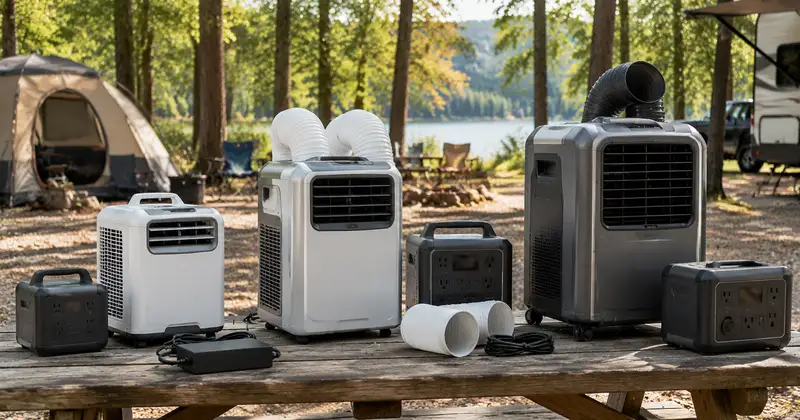
A Portable AC for Camping makes sense when you need real refrigerated cooling rather than just moving air around. For tents, prioritize low power draw, manageable weight, and a practical way to vent hot air outside. For vans and small RVs, higher cooling capacity can be useful. If you will camp off-grid, calculate the battery requirement before choosing the air conditioner.
The three current compressor units compared here—the EcoFlow WAVE 3, ZERO BREEZE Mark 3, and BougeRV PC35 PRO—serve different needs. None is automatically the right choice for every camper.
Table of Contents
Portable AC for Camping: Quick Buying Guide
| Camping setup | What matters most | Good direction |
|---|---|---|
| Small tent with shore power | Low power draw, weight, easy exhaust routing | 3,500-BTU class |
| Tent without shore power | Battery efficiency, total system weight | Dedicated battery portable AC |
| Van or small trailer | More cooling capacity and good venting | 5,000–6,100-BTU class |
| Large RV | Whole-space cooling ability | Consider an installed RV AC |
| Dry-climate personal cooling | Low power use | Evaporative cooler may be enough |
Do not use residential square-foot ratings as a guarantee for tents. A tent can be physically small but still difficult to cool because fabric walls offer little insulation and allow much more heat and air leakage than a house.
Real Air Conditioner or Portable Air Cooler?
This is the first decision to make.
Compressor Air Conditioner
A true portable air conditioner uses a refrigeration system to remove heat from the air. The U.S. Department of Energy defines portable ACs as units that contain a refrigeration source and deliver cooled, conditioned air to an enclosed space.
That is the category you want when your goal is to actually lower air temperature inside a tent, van, or camper.
Compressor ACs also use substantially more electricity than ordinary fans or small evaporative coolers.
Evaporative Air Cooler
An evaporative cooler passes air through water-wetted material. DOE notes that these systems cool through evaporation and work best in arid climates. They also add moisture to the air.
That can make an air cooler useful for personal comfort in a dry western campground, but it is not the same as refrigerated air conditioning.
If you camp somewhere hot and humid, buying a small “portable air cooler” because it is inexpensive can be disappointing if you expected true AC performance.
Why Cooling a Tent Is Different From Cooling an RV
Tent size alone does not tell you how difficult it will be to cool.
A tent has several disadvantages:
- Thin fabric walls
- Strong solar heat gain
- Air leakage around doors, vents, and seams
- Little insulation
- Frequent door opening
- Limited options for sealing AC ducts
A shaded tent at night may be much easier to cool than the same tent in direct afternoon sun.
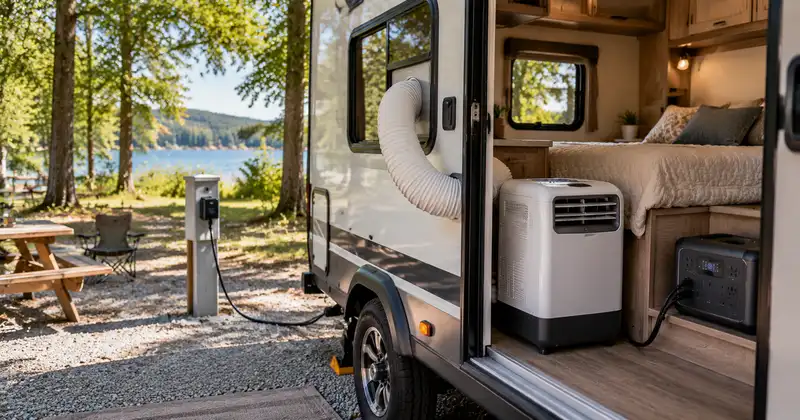
An RV or van usually has harder walls, insulation, and windows that can accept a temporary duct panel. That makes exhaust management easier.
But RVs have their own problem: more interior mass and often much more space. A 5,000- or 6,000-BTU portable unit may work well for a van sleeping area while struggling to cool an entire large travel trailer in full sun.
Think in terms of spot cooling and sleeping comfort, not just a target thermostat temperature.
How Much Cooling Capacity Do You Need?
BTU measures cooling capacity. More BTUs mean more heat-removal potential, but BTU alone is not enough to choose a camping AC.
Among the current models reviewed:
- BougeRV PC35 PRO: 3,500 BTU
- ZERO BREEZE Mark 3: 5,280 BTU
- EcoFlow WAVE 3: 6,100 BTU
A 3,500-BTU model is easier to pair with a modest power source but gives you less cooling capacity.
A roughly 5,000-BTU model creates a useful middle ground for tents, vans, and compact sleeping spaces.
A 6,100-BTU unit gives you more cooling potential but also asks more from the power system and is heavier.
Outside temperature, shade, humidity, ventilation, shelter insulation, and AC placement can matter as much as the BTU number.
Power Comes Before the Air Conditioner
This is the easiest part of the purchase to get backward.
Before deciding which AC you want, decide how you will power it.
Shore Power
A powered campsite is the simplest setup. You avoid carrying a large battery solely for air conditioning.
Even then, verify:
- Campsite electrical service
- Outlet type
- Campground electrical rules
- Whether generators are needed as backup
- What else will share the circuit
Before building a trip around AC power, it helps to check campsite hookups and generator rules before the trip.
Do not assume every campsite labeled “electric” provides unlimited power for an AC, cooking appliances, battery chargers, and everything else simultaneously.
Dedicated AC Battery
EcoFlow and ZERO BREEZE both offer batteries designed specifically for their systems.
EcoFlow’s WAVE 3 add-on battery is 1,024Wh and uses LFP chemistry. EcoFlow states a WAVE 3 runtime of 2–8 hours with its add-on battery, depending on operation and conditions.
ZERO BREEZE’s Mark 3 battery has 1,022Wh capacity. The manufacturer currently lists approximately 2–7 hours with one battery, depending on mode, temperature, and humidity. Its more detailed figures range from about 2–3 hours in Rocket mode to 5–7 hours in Sleep mode.
Those are manufacturer estimates, not independently tested Camping Trip Atlas runtimes.
General-Purpose Power Station
The basic planning equation is:
Battery capacity in watt-hours ÷ AC power draw in watts = theoretical runtime
For example, at continuous rated draw:
- 1,000Wh ÷ 690W ≈ 1.45 hours
- 1,000Wh ÷ 500W = 2 hours
- 1,000Wh ÷ 400W = 2.5 hours
Those numbers are theoretical. AC inverter losses reduce usable runtime, while a variable-speed compressor cycling down after the space cools can increase it.
That is why a simple watt-hour calculation is a planning baseline rather than a promise.
You must also check continuous inverter output, not just battery capacity.
BougeRV, for example, rates the PC35 PRO at 400W input but currently instructs off-grid users to pair it with a battery system or inverter rated for at least 2kW continuous output. Follow that manufacturer requirement rather than assuming a 500W inverter is sufficient.
What “Battery Powered” and “Cordless” Really Mean
A cordless camping air conditioner is not power-free.
It may run from:
- A detachable proprietary battery
- A separate portable power station
- DC power
- Shore AC
- A combination of those sources
EcoFlow’s WAVE 3 does not contain its main camping battery inside the AC. EcoFlow specifies an optional detachable WAVE 3 battery or compatible external power source.
ZERO BREEZE uses a 48V system and can run from its dedicated Mark 3 battery, AC adapter, or compatible external DC/AC arrangements.
Always compare the weight and cost of the complete cooling system, not just the AC box.
What About a 12V Air Conditioner for Camping?
Searching for a 12V air conditioner can lead you into a different product category.
True 12V compressor AC systems exist, but many are permanent or semi-permanent vehicle installations. Dometic, for example, currently offers 12V CoolAir rooftop units for campervans, trucks, and special vehicles.
An installed 12V system can make more sense if:
- You use a van or RV frequently
- You have a large dedicated battery bank
- Permanent installation is acceptable
- You want a cleaner long-term system
For occasional tent camping, a rooftop unit obviously is not portable enough to solve the same problem.
Venting and Condensation Matter More Than They Look
A compressor air conditioner moves heat—it does not make heat disappear.
The hot side of the AC must send its exhaust outside the space you are trying to cool.
BougeRV specifically instructs PC35 PRO users to route hot exhaust outside a tent, van, or truck. It warns that failing to vent that heat reduces cooling efficiency and can cause overheating.
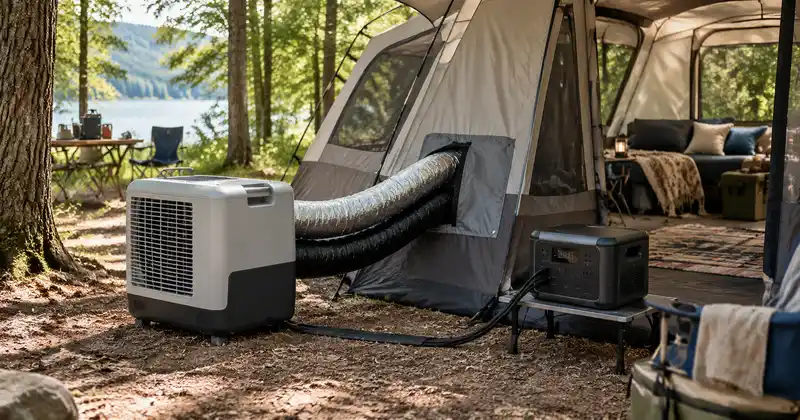
ZERO BREEZE uses a dual-hose configuration and recommends installing its rear ducts for enclosed spaces such as tents and vans.
For any model:
- Keep required air inlets clear.
- Vent hot air fully outside.
- Avoid sharply crushing or kinking ducts.
- Follow the manufacturer’s allowed duct length.
- Seal the shelter opening reasonably well without blocking required ventilation.
- Follow the manual for condensate drainage.
Do not place electrical connections in standing water just because the AC itself has some weather resistance.
Current Portable Camping AC Picks
These recommendations are based on current manufacturer specifications and camping use cases. They are not hands-on product-testing claims.
EcoFlow WAVE 3 — Best When Cooling Capacity Comes First
EcoFlow currently rates the WAVE 3 at:
- 6,100 BTU cooling
- 6,800 BTU heating
- 33.7 lb
- 690W rated cooling draw on AC
- 640W on DC
- 44–58 dB
- IPX4
- Optional 1,024Wh LFP battery
- Manufacturer battery runtime of 2–8 hours
Best fit: camper vans, compact trailers, larger tents where weight is less important, and campers already using the EcoFlow power ecosystem.
Main limitation: weight. Add the 21.4-lb WAVE 3 battery and the cooling system is roughly 55 lb before ducts or other equipment.
The current U.S. EcoFlow store also showed changing sold-out/preorder status among WAVE 3 packages when checked on September 4, 2026, so verify actual stock before building a trip around it.
Skip it if: carrying weight is a major concern or you only need modest spot cooling in a small tent.
ZERO BREEZE Mark 3 — Best for Lighter Off-Grid Use
ZERO BREEZE currently specifies:
- 5,280 BTU cooling
- 22 lb
- 500W rated cooling input
- 48V DC
- Dual-hose ventilation
- IPX4
- 1,022Wh optional battery
- 46 dB listed noise
- Heating and dehumidification functions
The manufacturer currently estimates 2–7 hours of operation from one battery depending on mode and conditions.
Best fit: tent camping, rooftop tents, vans, and small enclosed areas where a 22-lb main unit is easier to move.
Main limitation: getting all-night cooling can require additional dedicated battery capacity, adding cost and weight.
Skip it if: you want to cool a large RV interior or do not want to buy into a 48V/dedicated-battery setup.
BougeRV PC35 PRO — Best for a Small Tent With Reliable AC Power
BougeRV currently rates the PC35 PRO at:
- 3,500 BTU
- 400W rated input
- 22.05 lb
- 100–120V AC
- 50 dB
- IPX5
- 21.6 × 11.8 × 11.0 inches
- Two-year warranty
Its inverter compressor can reduce consumption under lighter load; BougeRV currently lists 274W consumption under its specified 86°F Sleep Mode test condition.
Best fit: smaller tents, truck campers, vans, or other compact sleeping areas where 3,500 BTU is sufficient and AC power is available.
Main limitation: it has materially less cooling capacity than the other two models.
For off-grid operation, BougeRV currently specifies a 2kW continuous-output battery system or inverter despite the AC’s 400W rated input, so power-station compatibility needs special attention.
Skip it if: you need maximum cooling output for a larger van or RV.
Portable Camping AC Comparison
| Model | Cooling | Rated cooling/input power | Main-unit weight | Battery option | Manufacturer runtime | Noise | Best fit | Main limitation |
|---|---|---|---|---|---|---|---|---|
| EcoFlow WAVE 3 | 6,100 BTU | 690W AC / 640W DC | 33.7 lb | 1,024Wh LFP | 2–8 hr | 44–58 dB | Van, small trailer, larger tent | Heaviest |
| ZERO BREEZE Mark 3 | 5,280 BTU | 500W | 22 lb | 1,022Wh | 2–7 hr | 46 dB | Tent, rooftop tent, van | Battery ecosystem cost |
| BougeRV PC35 PRO | 3,500 BTU | 400W | 22.05 lb | External power source | Depends on power source | 50 dB | Small tent, powered campsite | Lower cooling output |
Manufacturer runtime figures depend on operating mode and conditions and should not be read as guaranteed full-power runtime.
How to Get Better Tent AC Performance
A few setup choices can matter almost as much as the AC model.
Whenever practical:
- Pitch the tent in shade.
- Use legal, safely secured external shade to reduce direct sun.
- Keep the hot exhaust completely outside.
- Minimize unnecessary openings.
- Avoid blocking tent ventilation needed for occupants.
- Keep ducts short and correctly installed according to the manual.
- Start cooling before the tent becomes severely heat-soaked.
- Focus cool air on the sleeping area instead of expecting even residential-style cooling throughout a large tent.
A large tent in direct afternoon sun can overwhelm a small camping AC even if the manufacturer’s indoor-room rating looks adequate.
Portable AC for an RV: Know When It Is Too Small
Portable units can make good sense in:
- Camper vans
- Teardrop trailers
- Truck campers
- Small travel trailers
- Sleeping areas
- Supplemental cooling zones
But a 3,500–6,100-BTU portable AC is not automatically a substitute for a full-size RV rooftop system.
If your goal is to cool a large motorhome or travel trailer all day in direct sun, an installed RV air conditioner may be the more realistic solution.
A portable model works best when you can isolate a smaller sleeping or living area and route the exhaust cleanly outside.
Generator and Electrical Safety
If you plan to power the AC with a gasoline or propane generator, carbon monoxide safety is not optional.
CDC states that generators, grills, camp stoves, and other fuel-burning devices should never be used inside a camper or near openings where exhaust can enter.
CPSC recommends operating portable generators outdoors at least 20 feet from homes/buildings, with exhaust directed away from doors, windows, and vents. At a campsite, apply the same principle to occupied tents, vans, RVs, and AC air intakes: maximize separation and follow the generator manufacturer’s instructions.
Also:
- Never operate a generator inside a tent or vehicle.
- Never put it under an enclosed awning beside your sleeping space.
- Keep exhaust pointed away from people.
- Follow campground generator hours.
- Protect electrical equipment from rain according to its manufacturer instructions.
- Use outdoor-rated electrical cords sized for the load.
- Never defeat grounding or electrical safety devices.
An air conditioner is a comfort device, not a reason to create a CO or electrical hazard.
Common Camping AC Buying Mistakes
Avoid these mistakes:
- Buying an evaporative cooler and expecting compressor AC performance.
- Choosing BTU before determining the power source.
- Treating maximum manufacturer runtime as guaranteed runtime.
- Ignoring battery weight.
- Forgetting exhaust-duct space.
- Ignoring condensate drainage.
- Assuming “battery powered” means the battery is included.
- Buying a permanent 12V rooftop system when you need a portable tent AC.
- Expecting one small portable unit to cool a large RV.
- Assuming generators are allowed at every campsite.
Portable AC Buying Checklist
Before buying, answer these questions:
- Am I cooling a tent, van, or RV?
- Do I need spot cooling or whole-space cooling?
- Will I normally have shore power?
- How many hours of cooling do I need?
- How many watt-hours of battery capacity can I carry?
- Does my power station meet the AC manufacturer’s continuous-output requirement?
- How much BTU capacity is realistic for my shelter?
- How heavy is the AC?
- How heavy is the battery?
- Can I vent the hot exhaust outside?
- Can I manage condensate safely?
- Is the overnight noise acceptable?
- Are generators allowed where I camp?
- Is the current warranty and support acceptable?
If one of those answers is unknown, resolve it before purchasing.
Frequently Asked Questions
What size portable AC is best for a camping tent?
There is no single BTU size that works for every tent. A small shaded tent may work with a 3,500-BTU compressor unit, while a larger tent or hotter conditions may justify roughly 5,000–6,000 BTU. Tent fabric, sunlight, humidity, air leakage, and exhaust setup can matter as much as floor area.
How long will a portable AC run on a 1,000Wh power station?
For Portable AC for Camping, a 1,000Wh battery provides roughly 1.45 hours at a constant 690W draw, 2 hours at 500W, or 2.5 hours at 400W before conversion losses. Real runtime can be shorter because of inverter losses or longer when an inverter compressor cycles down instead of remaining at full rated draw.
Is a battery-powered air conditioner worth it for camping?
It can be worth it if you regularly camp without shore power and specifically need refrigerated cooling. The trade-off is battery weight, cost, and limited runtime. If you only need occasional cooling at powered campgrounds, buying a large dedicated AC battery may provide little benefit.
Is a portable air cooler the same as a camping air conditioner?
No. A compressor camping air conditioner actively refrigerates the air. An evaporative cooler uses water evaporation and works best in dry conditions. Evaporative coolers generally consume much less electricity, but they do not provide the same cooling or humidity control as a compressor AC.
Can you use a portable AC in an RV instead of the rooftop air conditioner?
Yes, in some small RVs or for spot cooling. A portable unit can work well in a van, truck camper, teardrop, or isolated sleeping area. For a large RV that needs whole-interior cooling, a properly sized installed rooftop or vehicle AC is usually the more appropriate category.
Conclusion
For Portable AC for Camping, choose the power system and shelter use case before comparing product features. A smaller tent may benefit most from a lighter, lower-draw unit; vans and compact RVs can justify higher cooling capacity; and large RVs may need a permanent system instead.
Before buying, calculate your battery needs, verify the AC’s required power output, make sure exhaust routing will work, and check campsite electrical and generator rules.
References:
- EcoFlow — WAVE 3 Specifications
EcoFlow WAVE 3 official specifications - ZERO BREEZE — Mark 3 Portable Air Conditioner
ZERO BREEZE Mark 3 official product and specifications - BougeRV — PC35 PRO 3500BTU Portable Air Conditioner
BougeRV PC35 PRO official product page - U.S. Department of Energy — Portable Air Conditioners
DOE portable air conditioner information - U.S. Department of Energy — Best Management Practice #13: Evaporative Coolers
DOE evaporative cooler information - Centers for Disease Control and Prevention — Carbon Monoxide Clinical Guidance
CDC carbon monoxide safety guidance - U.S. Consumer Product Safety Commission — Carbon Monoxide Safety
CPSC generator and carbon monoxide safety guidance - Dometic — Rooftop Air Conditioners
Dometic 12V rooftop AC product category