
Shadow Mountain Dispersed Camping: Sites, Access and Rules
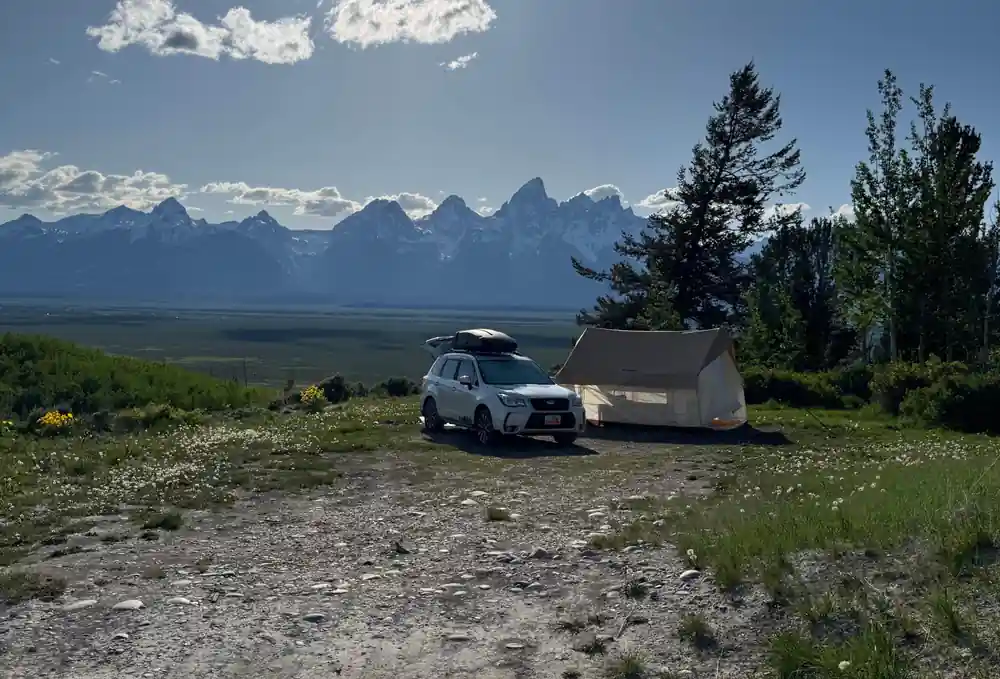
Shadow Mountain dispersed camping offers free, primitive camping on Bridger-Teton National Forest land just outside Grand Teton National Park. But “dispersed” does not mean you can camp anywhere along the road. Campers must use marked designated sites, availability is first-come, first-served, potable water is not available, and road conditions can change quickly.
Before driving in, check the current Forest Service alerts, motor-vehicle map, weather, food-storage rules, and fire restrictions. You should also have a legal backup campsite because arriving at Shadow Mountain does not guarantee that a designated site will be open.
Table of Contents
Shadow Mountain Dispersed Camping at a Glance
| Planning detail | What to know |
|---|---|
| Land manager | U.S. Forest Service, Bridger-Teton National Forest |
| Ranger district | Jackson Ranger District |
| Location | Outside Grand Teton National Park near the Kelly/Jackson Hole area |
| Camping style | Designated dispersed camping |
| Sites | Current Forest partner information reports 51 numbered sites |
| Reservations | None; first-come, first-served |
| Camping fee | Free |
| Potable water | Not available |
| Toilets | Vault toilets are reported at the base by the Forest’s nonprofit partner; verify before relying on them |
| Main Forest road | Shadow Mountain Road / Forest Road 30340 |
| Summer stay limit | Maximum five days within a 30-day period from May 1 through Labor Day |
| Bear precautions | Mandatory food-storage rules apply |
| Current fire status | Stage 1 Fire Restrictions were active August 30, 2026 |
Current operational information from Friends of Bridger-Teton National Forest reports 51 numbered sites and says campers must occupy one of those marked locations. The Forest Service’s main Shadow Mountain page confirms that the area has no potable water and that access roads are lightly maintained gravel and dirt roads.
Where Is Shadow Mountain Camping?
Shadow Mountain is in Bridger-Teton National Forest, within the Jackson Ranger District of Wyoming. It sits east of the main Teton Range and close to Grand Teton National Park, but the campsites are not inside the national park.
That distinction matters because Grand Teton National Park campground rules do not automatically apply to the Shadow Mountain designated camping area. The Forest Service manages the land, motorized access, dispersed camping restrictions, stay limits, food storage, and other Forest-specific rules.
One common approach reaches the base of Shadow Mountain from Antelope Flats Road. Forest Service destination information says this approach passes through Grand Teton National Park before reaching the National Forest boundary, where the road becomes gravel.
What Designated Dispersed Camping Means at Shadow Mountain
Ordinary dispersed camping often allows travelers to use suitable previously disturbed places along open Forest roads, subject to local restrictions.
Shadow Mountain is different.
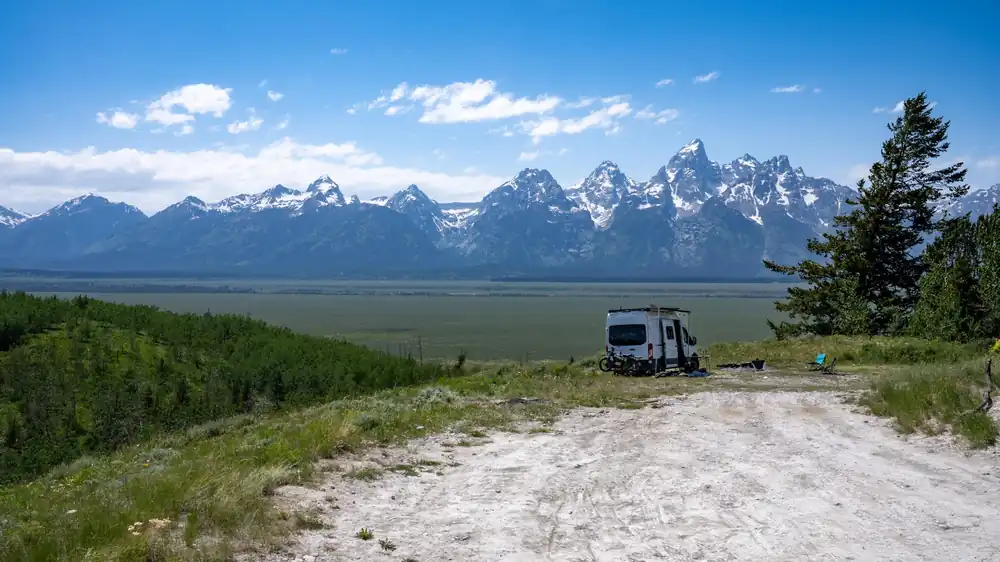
It is a designated dispersed camping area, meaning you must stay in an officially marked campsite. The current Forest order prohibits camping outside a designated site within mapped areas that include Shadow Mountain.
Friends of Bridger-Teton National Forest currently reports 51 marked and numbered campsites and specifically warns visitors not to pull onto an unmarked flat area and treat it as a campsite.
That gives Shadow Mountain a middle ground between a developed campground and unrestricted dispersed camping:
- There are designated places to camp.
- Sites are first-come, first-served.
- There is no standard campsite reservation.
- Camping is currently free.
- Services remain very limited.
- A site is not guaranteed just because you drove into the area.
The designated-site rule also means a campsite app or old GPS coordinate is not enough. On-site numbers, current Forest maps, and current restrictions take priority.
Shadow Mountain Campsites: What to Expect
How Many Designated Sites Are There?
Current July 2026 information from Friends of Bridger-Teton National Forest reports 51 numbered sites at Shadow Mountain.
Older mapping material has listed a slightly different total, so the safest approach is to treat the current numbered signs and latest Forest information as authoritative for finding legal sites rather than planning around a fixed historical count.
Most sites are primitive rather than developed campground pads. Do not expect electrical hookups, individual water connections, showers, or the predictable dimensions you might find on a reservable campground listing.
Lower Sites vs. Higher Sites
The road climbs farther onto Shadow Mountain, and conditions tend to become a bigger part of the decision as you travel beyond the lower camping area.
Friends of Bridger-Teton notes that lower sites generally lose winter snow before higher sites and that snow can remain at higher locations later into the season.
Do not interpret that as a fixed annual opening schedule. Snowpack, spring runoff, rain, road damage, and maintenance conditions change from year to year.
If you find a legal lower site that fits your vehicle and camping setup, there is little reason to continue climbing solely in pursuit of a more dramatic view when road conditions are questionable.
Tent, Van, and RV Considerations
Tent campers, vans, pickup campers, small trailers, and some RVs may all be able to use parts of the Shadow Mountain area, but vehicle type alone does not guarantee access.
Consider:
- Overall vehicle length
- Ground clearance
- Trailer length
- Turning radius
- Ability to reverse or turn around
- Road width
- Mud and rut depth
- Current precipitation
- Driver experience
- Space available within the exact numbered site
A primitive pull-in that works for a small SUV and tent can be unsuitable for a long travel trailer.
Large rigs should be especially conservative. If the road begins exceeding your clearance, traction, towing skill, or available turnaround space, stop before continuing farther uphill.
Shadow Mountain Dispersed Camping Map: Use Current Official Information
Planning should involve two different types of map.
First, use the current designated camping information to determine where camping is permitted.
Second, check the Forest Service Motor Vehicle Use Map (MVUM) to determine which roads are legally open to your type of motor vehicle and during what season. Forest Service MVUM data identifies designated motorized routes and seasons of use, with the national road dataset most recently refreshed on July 22, 2026.
Save the relevant information for offline use before leaving dependable service.
A useful planning sequence is:
- Identify the legal Shadow Mountain camping area.
- Check the current MVUM.
- Review active Forest closures and alerts.
- Follow road and campsite signs after arrival.
- Camp only in an available marked site.
Do not assume that an old map pin means the location is still a legal campsite.
How to Get to Shadow Mountain
Shadow Mountain Road is Forest Road 30340 within the Forest road network. The Forest Service lists it along with several connected roads in the Shadow Mountain/Ditch Creek area.
The North Shadow Mountain access from Antelope Flats Road passes through Grand Teton National Park before reaching Forest land. Forest Service information states that this access does not require a park pass simply to reach the trailhead and that the road turns to gravel at the Forest boundary.
Because the Forest Service’s current recreation page contains an apparent typo in its published seasonal closing date, do not rely on that page alone for the exact end of the motorized season. Use the current MVUM and Forest alerts for your trip dates.
Also avoid building your arrival plan around a normal map-app driving estimate. The final miles involve unpaved Forest roads where conditions may justify considerably slower travel.
Shadow Mountain Road Conditions and Vehicle Access
The Forest Service describes Shadow Mountain roads as lightly maintained gravel and dirt roads and cautions that they can become difficult during wet conditions.
That warning is more useful than a blanket statement that the road is “2WD accessible” or “4WD only.”
Legal Does Not Mean Passable
A road shown as legally open to motorized travel is not a guarantee that it is dry, recently graded, obstacle-free, or suitable for your vehicle.
Mud, deep ruts, erosion, snow, fallen trees, road work, and storm damage can change access without changing the basic road designation.
Check conditions immediately before leaving pavement. If heavy rain has occurred, be especially cautious about continuing simply because a navigation app shows the road as open.
Should You Take an RV or Trailer Up Shadow Mountain?
There is no reliable universal yes-or-no answer.
A short trailer behind a capable tow vehicle in dry conditions presents a very different situation from a long trailer after heavy rain. Site size and turnaround space also vary.
Before going farther uphill, ask:
- Can I turn around if the next section becomes worse?
- Can my entire setup stay on the established road?
- Does the vehicle have adequate clearance?
- Am I comfortable backing the trailer on an uneven road?
- Is the campsite itself large enough?
- Has rain or snow changed the road since the latest report?
If the answer becomes uncertain, choosing a lower site or another camping area is usually more practical than using the campsite hunt as an off-road challenge.
Is Shadow Mountain Free and Do You Need a Reservation?
Shadow Mountain designated dispersed camping is currently free and first-come, first-served. There is no campsite reservation that guarantees a numbered site before you arrive.
Demand can be high. Friends of Bridger-Teton reports that Shadow Mountain commonly fills early and uses a digital reader board near the turnoff to indicate when the area is full.
Do not interpret a reported arrival time as a guarantee. Occupancy changes by day, season, weather, and local events.
The better strategy is to have a legal backup identified before you arrive.
Water, Toilets, and Other Facilities
Potable Water
The Forest Service explicitly states that potable water is not available in the Shadow Mountain/Ditch Creek area.
Bring enough water for:
- Drinking
- Cooking
- Cleaning
- Personal hygiene
- Pets, if applicable
- A reasonable contingency
Do not plan around finding a reliable water source after reaching your site.
Toilets
Current information is less consistent.
Friends of Bridger-Teton says vault toilets have been installed at the base of Shadow Mountain. The main Forest Service recreation page, however, currently lists restroom information as unavailable.
Because of that discrepancy, confirm current toilet availability before depending on it. Campers farther from the base should also understand the applicable human-waste requirements before the trip.
Trash and Other Services
Treat Shadow Mountain as primitive camping.
Friends of Bridger-Teton continues to report problems with abandoned trash and human waste in the area.
Bring a way to pack out all garbage, food scraps, and other waste. Do not assume dumpsters, showers, hookups, electricity, or other developed-campground services will be available.
Shadow Mountain Camping Rules You Need to Know
The Five-Day Seasonal Stay Limit
Current Forest Order 04-03-24-204 limits camping throughout the Jackson Ranger District to no more than five days within a 30-day period from May 1 through Labor Day, except for stated exemptions such as developed campgrounds and the Gros Ventre Wilderness.
The same order identifies mapped designated camping areas—including Shadow Mountain—where camping outside designated sites is prohibited.
Friends of Bridger-Teton’s current Shadow Mountain guidance also describes the site-specific limit as five days within a 30-day period during that seasonal window.
Camp Only in Marked Sites
Do not create a new campsite beside the road.
Do not widen a pullout, drive onto undisturbed vegetation, or move camp outside the numbered designated sites simply because the legal sites are occupied.
If every site is full, Shadow Mountain is full.
Store Food Correctly in Bear Country
Both grizzly bears and black bears occur in Bridger-Teton National Forest, and mandatory food-storage regulations apply across relevant parts of the Forest.
The Forest Service says food and other attractants must be secured when unattended. Attractants include not only meals but also garbage, pet food, beverages, toiletries, and other scented items. Approved methods can include a locked hard-sided vehicle with the windows closed, approved bear-resistant storage, designated food boxes where provided, or other methods permitted by the applicable order.
Never keep food or scented items in your tent.
For most vehicle-based campers at Shadow Mountain, a closed hard-sided vehicle is one of the simplest storage options, but read the current Forest food-storage order before your trip.
Check Fire Restrictions Before Lighting Anything
As of August 30, 2026, Bridger-Teton National Forest is under Stage 1 Fire Restrictions, with Forest fire danger listed as High. The current order took effect July 22, 2026.
Under that Stage 1 order, wood and charcoal fires are allowed only in permanent Forest Service-maintained metal or concrete fire pits at specific listed developed recreation sites. Shadow Mountain’s dispersed sites are not among the listed developed-site exceptions.
Therefore, do not light a wood or charcoal fire in a Shadow Mountain campsite fire ring while this restriction remains in effect.
The current order does allow a device fueled only by liquid or gas that can be turned on and off when used in an area cleared of flammable material for at least three feet around the device.
Restrictions can be changed or rescinded, so recheck the Forest alert on the day you travel.
Weather, Wildlife, and Safety Planning
Shadow Mountain’s roads and primitive sites make weather part of the access decision, not merely a comfort issue.
Rain can turn dirt roads muddy or deeply rutted. Thunderstorms can bring lightning, strong wind, and heavy precipitation. Overnight temperatures can also be much colder than daytime conditions suggest.
Check the National Weather Service forecast for the Jackson Hole/Teton area immediately before leaving, then consider how the forecast affects both the campsite and the road.
Bear precautions are equally important. Keep a clean camp, secure attractants immediately when they are unattended, and do not leave coolers, garbage, pet food, or scented supplies around the campsite overnight.
Cell coverage should not be treated as guaranteed. Save maps and Forest contact information offline and make sure someone in your group understands how to return to the main road if navigation fails.
What to Do If Shadow Mountain Is Full
Do not solve a full designated camping area by creating an unofficial campsite.
Instead:
- Confirm that the reader board or actual numbered sites show the area is full.
- Do not occupy an undesignated pullout.
- Use the legal backup you identified before the trip.
- Confirm the alternative’s current rules and vehicle access.
- Avoid searching unfamiliar rough Forest roads after dark when you cannot adequately assess the surface or campsite.
This is a situation where it helps to build a legal backup camping option before departure rather than treating the backup as something to figure out after every site is occupied.
Friends of Bridger-Teton currently identifies Moran Vista as one possible fallback in the broader area, but availability and rules at any alternative should be rechecked before using it.
Shadow Mountain Camping Checklist
Before driving to Shadow Mountain, confirm:
- The current designated camping information is saved offline.
- The current Forest Service MVUM has been checked.
- Forest closures and alerts have been reviewed.
- Your vehicle and trailer are appropriate for current road conditions.
- You have a legal backup if all sites are occupied.
- Enough drinking and cooking water is packed.
- Your food-storage method complies with the current Forest order.
- Current fire restrictions have been checked.
- The latest weather forecast has been checked.
- Trash and waste supplies are packed.
- Navigation works offline.
- You have enough daylight to assess the road and campsite before settling in.
Frequently Asked Questions
Is Shadow Mountain dispersed camping free?
Yes. Current Forest-partner information describes Shadow Mountain as free designated dispersed camping. Sites are first-come, first-served rather than reservable, so the absence of a fee does not guarantee availability. Check current Forest alerts before departure because access or camping restrictions can change.
Do you need a reservation for Shadow Mountain camping?
No. Shadow Mountain’s numbered dispersed campsites are currently first-come, first-served. You cannot reserve a specific site in advance. Because the area is popular and can fill early, have a verified legal backup instead of assuming a particular arrival time will guarantee a site.
Can you camp anywhere along Shadow Mountain Road?
No. Within the regulated Shadow Mountain designated camping area, you must use a marked designated site. Current Forest Order 04-03-24-204 prohibits camping outside designated sites in mapped designated-camping areas. An empty roadside pullout is not automatically a legal campsite.
Can an RV or trailer reach Shadow Mountain campsites?
Some RVs and trailers may be able to use suitable sites, but access depends on the exact vehicle, road condition, weather, campsite dimensions, and driver’s experience. The Forest Service describes the roads as lightly maintained gravel and dirt that can become difficult when wet, so there is no universal RV-access guarantee.
How long can you stay at Shadow Mountain dispersed camping?
For shadow mountain dispersed camping, the current Forest order limits stays to no more than five days within a 30-day period from May 1 through Labor Day. Regulations can change, so confirm the active Forest order before your trip rather than relying on an old campsite listing.
Conclusion
Shadow Mountain dispersed camping works best for campers who understand what they are choosing: a free, primitive, first-come camping area with numbered designated sites, rougher road access than a developed campground, no potable water, and rules that can change with fire conditions and seasonal management.
Before driving up Shadow Mountain Road, check the current MVUM, Forest alerts, weather, food-storage order, and fire restrictions. Pack your own water, arrive prepared to turn around if road conditions exceed your vehicle or experience, and have a legal backup ready if every designated site is occupied.
References:
- U.S. Forest Service — Shadow Mountain/Ditch Creek Area
Direct working source - U.S. Forest Service — Order 04-03-24-204: Occupancy and Use — Camping
Direct working source - U.S. Forest Service — Stage 1 Fire Restrictions, Order 04-03-26-304
Direct working source - U.S. Forest Service — Be Bear Wise: Keep Bears Wild & People Safe
Direct working source - U.S. Forest Service — Food Storage and Sanitation Order
Direct working source - U.S. Forest Service FSGeodata Clearinghouse — Motor Vehicle Use Map Data
Direct working source - Friends of Bridger-Teton National Forest — Shadow Mountain Camping
Direct working source