
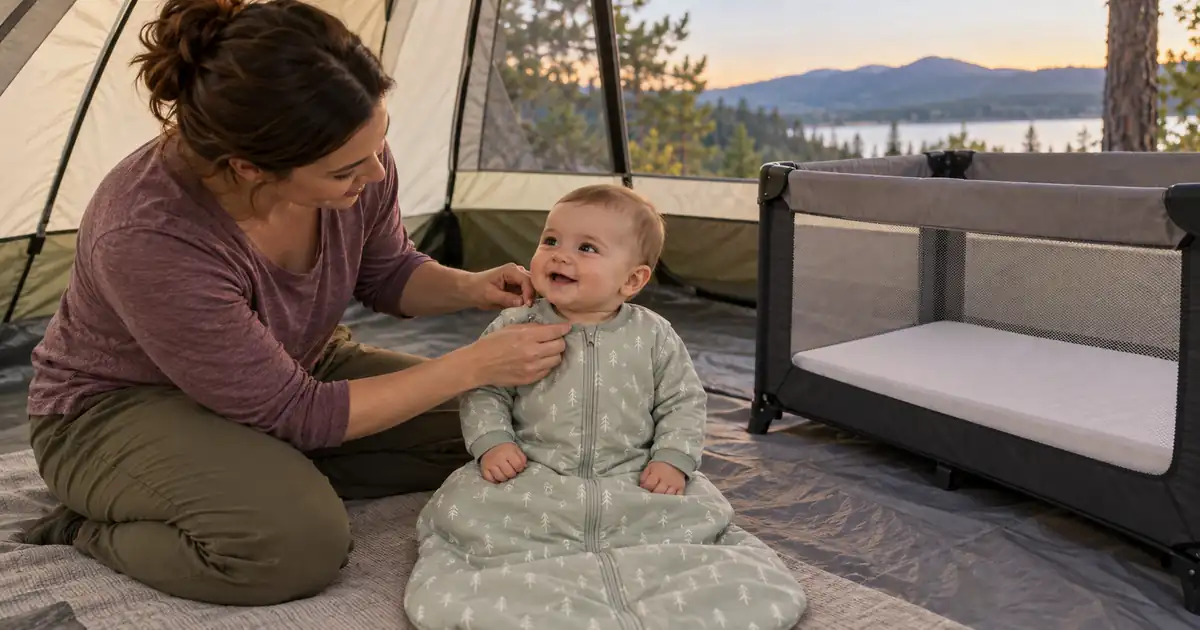
Infant Sleeping Bag Camping: How to Choose by Age, Fit and Conditions
Choosing sleepwear for a baby on a camping trip starts with the baby’s age and fit—not the lowest temperature printed on a sleeping bag. An infant sleeping bag camping setup should use appropriately sized, nonweighted wearable sleepwear and a separate, firm, flat infant sleep surface. This guide explains how to compare everyday sleep sacks with insulated outdoor options, interpret warmth claims, and decide whether the expected conditions suit your baby.
Table of Contents
Infant Sleeping Bag Camping: Start With Safe Sleep Basics
Before comparing insulation or packed weight, separate two things: the clothing your baby wears and the surface your baby sleeps on. One cannot compensate for problems with the other.
Wearable Sleep Sack vs. Ordinary Sleeping Bag
A standard adult or children’s camping sleeping bag is a loose bedding product. It may have a hood, a drawstring, or a wide opening that can shift over a baby’s face. It is not a substitute for infant sleepwear.
An infant-specific wearable sleeping bag or sleep sack is clothing that fits around the shoulders and neck while enclosing the legs. Designs vary. An ordinary nursery sleep sack may be relatively light, while an outdoor-specific product may use substantial synthetic or down insulation.
For infant sleeping bag camping, look for a nonweighted, hoodless garment expressly intended for your child’s age and measurements. Avoid loose coverings and never treat a manufacturer’s warmth claim as evidence that a product eliminates sleep-related risks.
The Separate Infant Sleep Surface
The American Academy of Pediatrics recommends putting babies on their backs for sleep on a firm, flat, noninclined surface in their own crib, bassinet, or play yard. Use the mattress and fitted sheet specified for that sleep product, without pillows, loose blankets, mattress toppers, stuffed animals, or extra padding.
Those principles still apply inside a camping tent. A shared adult sleeping bag, adult air mattress, soft camping pad, car seat, or improvised nest is not an appropriate overnight infant sleep surface. Place the approved portable sleep product on stable, level ground, follow its instructions and limits, and keep adult gear clear of it.
A camping tent is weather shelter, not a replacement for the baby’s separate sleep space. If you cannot fit and use that space as directed, change the setup or the trip.
Infant Sleeping Bag Camping: Choose by Age and Development
For infant sleeping bag camping, age labels are starting points, not permission to ignore the size chart. Weight, length, fit, mobility, and the manufacturer’s minimums all matter.
Babies Younger Than Six Months
Morrison Outdoors currently specifies its Little Mo for babies at least six months old. Do not size a younger baby into it, even if the baby already wears clothing labeled for six months.
For younger infants, consider only a conventional, nonweighted wearable sleep sack whose manufacturer explicitly permits your baby’s age and dimensions. For example, Woolino’s 4 Season Ultimate Baby Sleep Bag is marketed for approximately two months through two years, with adjustable underarm snaps. It is designed for a stated indoor room-temperature range—not as proof that it will keep an infant warm during a cold night outdoors.
For a newborn or a baby outside a product’s stated limits, seek appropriate age-specific guidance from the child’s clinician. If the anticipated camping conditions cannot support a safe, suitable sleep arrangement, postponing the overnight stay is preferable to improvising with extra bedding.
Six to Twelve Months
Some outdoor-specific options become eligible in this age range, but only after the child also meets the garment’s weight and height limits. Little Mo’s current page specifies ages 6–18 months, at least 15 lb (6.8 kg), and a body length of 24–34 inches (61–86 cm).
Babies develop at different rates. If your baby is showing signs of rolling, avoid any swaddle-style product that compresses the arms, chest, or body. Choose sleepwear that permits free movement, and always begin sleep with the baby placed on their back.
Twelve to Eighteen Months
Older infants may still fit the same outdoor wearable bag, but a product is no longer suitable once a size, height, weight, or movement limit is reached. Do not assume the age on the packaging guarantees fit until the stated upper limit.
For infant sleeping bag camping with an active older baby, check how easily the garment can be removed for nighttime care and whether its length and closure stay secure as the child moves. Keep the fabric clear of the face and follow instructions on carrying or walking while wearing the garment.
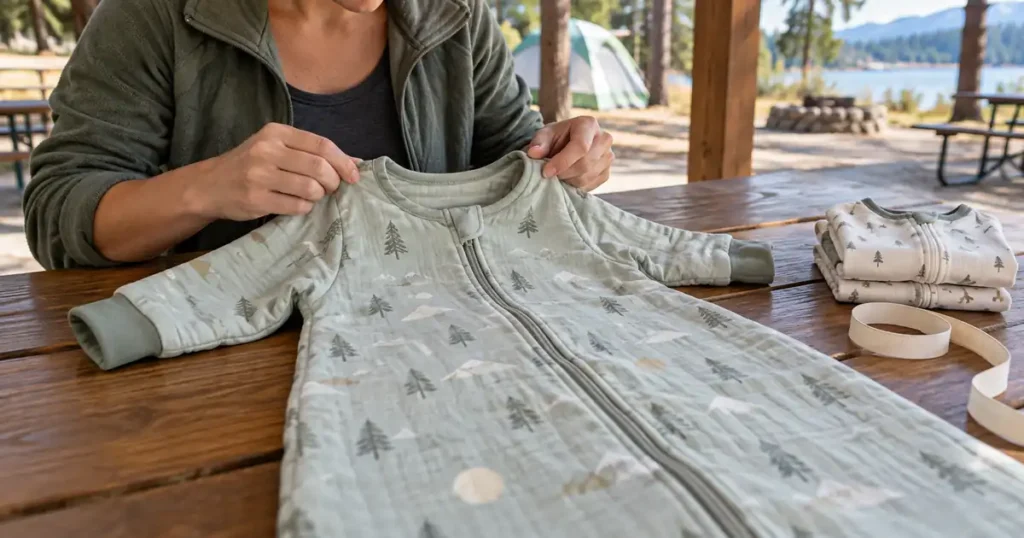
Infant Sleeping Bag Camping: How to Check Fit Before Buying
For infant sleeping bag camping, a close-fitting opening around the upper body matters more than leaving room to grow. The aim is a secure garment that does not restrict normal movement or slip over the head.
Neck and Shoulder Fit
Fasten the garment exactly as directed. The baby’s head should not be able to slip down inside the bag. The neckline should remain below the chin without riding upward or constricting the neck, while the shoulders should sit securely in place.
If the opening is too large, choose a smaller eligible size or a different product; don’t solve the problem by folding fabric around the neck, adding ties, or pinning material.
Length and Legroom
Check the brand’s height chart and the interior room available for comfortable leg movement. A spacious lower section can be useful, but surplus fabric is not automatically a sign of a better fit. The secure upper opening is especially important.
Remember that clothing sizes and sleeping-bag sizes do not necessarily correspond. Use the manufacturer’s garment measurements, not just the pajamas your baby wears.
Sleeves, Armholes, and Zippers
Make sure arms can move normally. If the design has adjustable arm openings or cuffs, follow the manufacturer’s developmental guidance rather than relying on a feature description alone. Do not use a swaddle that restricts arm movement once rolling begins.
Look for a zipper that closes smoothly, stays clear of skin, and allows practical diaper changes. Check that seams, closures, and fabric are undamaged. Follow the care instructions, because improper washing can affect the insulation or fit.
Why Sizing Up Can Be Unsafe
Buying a larger garment for an extra season is tempting. Morrison’s current Little Mo instructions explicitly warn not to size up and not to use the garment if the baby’s head can slip inside when it is fastened.
For infant sleeping bag camping, a poor fit is not a trade-off worth accepting to save money. If your baby is between sizes, compare another properly sized model instead of assuming the larger one is safe.
How to Compare Warmth, Insulation, and Temperature Claims
Infant sleeping bag camping insulation choices become harder when temperatures fall after sunset, because tents provide far less thermal protection than heated rooms. That makes warmth planning important—but no printed number can tell you whether a particular baby will be safely warm.
What TOG Means
TOG describes a textile’s thermal resistance. Brands often use it when describing ordinary wearable sleep sacks. Higher TOG values generally indicate more insulation, but the number does not account for the full sleeping environment or what a child wears underneath.
Use the brand’s garment-specific dressing guidance and intended room temperatures. Do not convert a TOG rating into a guaranteed outdoor camping temperature.
Outdoor Sleeping Bag Temperature Claims
Morrison Outdoors advertises a 20°F–60°F (-6°C to 15°C) range for Little Mo 20 and 40°F–60°F (4°C to 15°C) for Little Mo 40. The manufacturer describes its temperature figures as estimates based on its own experience and testing; these are not universal medical safety thresholds for infants.
For infant sleeping bag camping, a “20-degree” label must never be interpreted as a guarantee that a baby can safely sleep in a tent at 20°F. Conditions, layers, the sleeping environment, the baby’s individual needs, and the possibility of overheating all matter. If a forecast demands an improvised insulation strategy or makes the sleep environment difficult to manage, choose a milder night or a properly heated accommodation instead.
Down vs. Synthetic Insulation
Down usually provides excellent warmth relative to packed weight when kept dry, but requires careful protection from moisture. Synthetic insulation is typically bulkier at comparable warmth yet can be easier to manage when conditions are damp.
Morrison’s current specifications list Little Mo 20 with 650-fill-power duck down at approximately 8.7 oz (247 g); Little Mo 40 uses synthetic insulation and weighs approximately 14 oz (391 g). Those figures help with pack planning but do not establish which garment is suitable for a particular infant.
Avoiding Overheating
Too much insulation is also a problem. The AAP and NIH advise monitoring for sweating, a hot chest, flushed skin, or unusually hot skin. Adjust sleepwear according to the baby’s condition and the actual sleeping environment, and remove overly warm clothing when needed.
Avoid weighted sleepwear, loose layers, and covering the baby’s head during sleep. Do not assume that adding thick pajamas, a hat, or extra blankets is a safe solution for an unusually cold campsite. If your child has particular medical needs or temperature-regulation concerns, ask their clinician before the trip.
Comparing Infant Camping Sleep Options
These infant sleeping bag camping options are manufacturer-described examples, not independently field-tested recommendations. Specifications were checked on October 10, 2026. Availability, labeling, and sizing may change.
| Example | Manufacturer-stated fit | Insulation and intended conditions | Main limitation |
|---|---|---|---|
| Morrison Outdoors Little Mo 20 | 6–18 months; at least 15 lb; 24–34 in long | Down; advertised 20°–60°F range | Insulation rating is not a guarantee of safe sleeping temperature; strict minimum size |
| Morrison Outdoors Little Mo 40 | Same current Little Mo fit limits | Synthetic; advertised 40°–60°F range | Bulkier than down version; not a solution for infants below size minimums |
| Woolino 4 Season Ultimate Baby Sleep Bag | Manufacturer markets baby size for 2 months–2 years; fit must be checked | Merino wool lining and cotton exterior; stated indoor room range 63°–75°F (17°–24°C) | Not presented by Woolino as a cold-weather outdoor sleeping bag |
Morrison’s older general FAQ still calls Little Mo a 6–24-month product, whereas its current specific product page says 6–18 months and gives minimum and maximum measurements. Use the instructions accompanying the exact product you are buying and confirm any discrepancy with the manufacturer.
There is no one “best” product for every family. A correctly fitting everyday sack may be the sensible choice for a suitably controlled sleep environment. An insulated outdoor product is relevant only when the baby’s measurements qualify and the sleep arrangement and anticipated conditions can be managed appropriately.
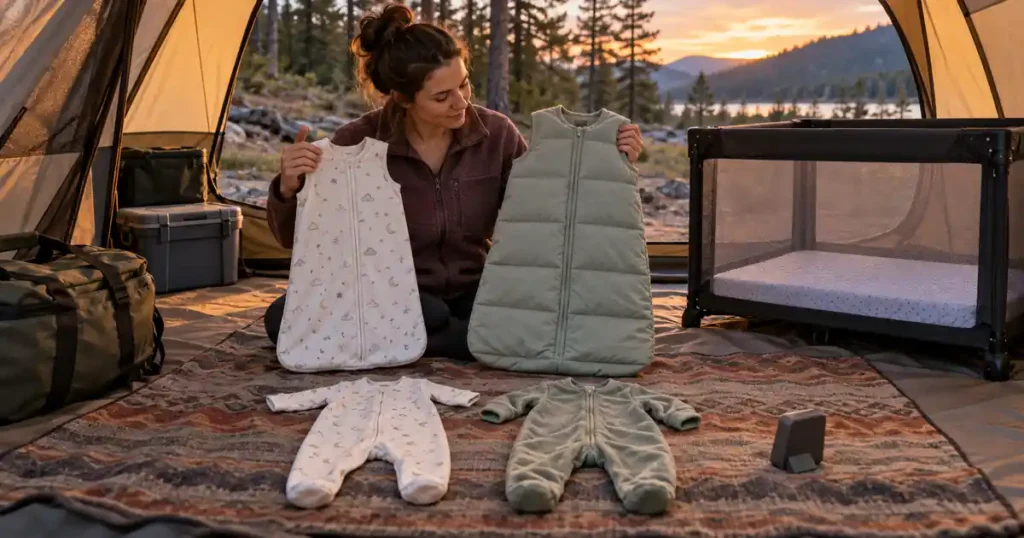
How to Plan a Baby Camping Sleep Setup
For infant sleeping bag camping, suitable clothing is only one part of planning. Before the trip, confirm that you can create an appropriate sleeping area and keep conditions manageable throughout the night.
Tent Space for a Portable Sleep Surface
Measure the actual footprint of the crib, bassinet, or play yard you intend to bring, then measure the tent’s usable floor space. Allow room for adults to reach the baby without stepping into the sleep space, and keep loose sleeping bags and other gear out of it.
Our guide to choosing a car camping tent with enough floor space explains why usable floor dimensions matter more than advertised capacity. You can also review understanding four-person tent capacity when planning a compact family setup.
Practice assembling the portable sleep product at home and follow the manufacturer’s mattress, fitted-sheet, age, and weight instructions. Do not add foam, a second mattress, a camping pad, or blankets to make the surface feel warmer.
Choosing Suitable Overnight Conditions
Start with a reliably mild forecast, a well-drained developed campsite, and a backup indoor accommodation option. Check nighttime lows, rain, wind, and the possibility of a sudden weather change—not just the daytime high.
If infant sleeping bag camping requires relying on the extreme end of a manufacturer’s estimated temperature range, the more practical choice may be a different date or an indoor stay. A product label cannot replace environmental judgment.
Nighttime Checks and Practical Supplies
Bring correctly sized sleepwear, a dry spare, simple changes of clothes, and the infant sleep product’s instructions. A suitable thermometer can help you understand conditions inside the sleeping area, but it does not replace checking the baby for overheating or distress.
Keep supplies for feeding and diaper changes accessible without crowding the baby’s sleep surface. Never put a baby to sleep in a car seat, carrier, or adult bed simply because those are convenient at camp. If the baby falls asleep in such a place, move them to the separate approved sleep surface.
Common Mistakes When Choosing Baby Camping Sleepwear
The most common infant sleeping bag camping mistakes are avoidable:
- Buying an ordinary adult or children’s sleeping bag instead of eligible infant wearables.
- Choosing an outdoor model based only on the age printed on the label.
- Sizing up when the neck or shoulders are too loose.
- Treating 20°F or 40°F manufacturer claims as medical guarantees.
- Relying on an indoor sleep sack for temperatures beyond its stated use.
- Adding loose blankets, pads, or a second mattress to an infant sleep space.
- Using weighted garments or restrictive swaddling once rolling begins.
- Ignoring the chance of overheating as temperatures change.
- Forgetting that a tent needs sufficient space for a separate crib, bassinet, or play yard.
- Planning a cold overnight trip without a practical change-of-plans option.
An Infant Camping Sleeping Bag Buying Checklist
Before purchasing infant sleeping bag camping gear, check:
- Eligibility: Does the exact product permit your baby’s current age, weight, and length?
- Upper-body fit: Can the head slip inside? Do the shoulders and arm openings stay secure?
- Movement: Can the baby move freely at their current developmental stage?
- Construction: Is the garment hoodless, nonweighted, in good condition, and free from dangerous loose details?
- Warmth claims: Are you using the manufacturer’s intended environment and layer guidance rather than relying on one temperature number?
- Sleep setup: Do you have a separate approved infant sleep surface that fits the tent?
- Care and cost: Can you clean, dry, and return or exchange the garment under the seller’s actual terms?
- Backup: Can you adjust the trip if the forecast or sleeping conditions are unsuitable?
For infant sleeping bag camping, answering these questions is more useful than buying the warmest-looking bag on a product page.
Frequently Asked Questions
Can newborns use an infant camping sleeping bag?
Do not assume they can. Morrison Little Mo currently has a six-month minimum age, and Woolino’s referenced baby size begins at two months. For a newborn, use only age-appropriate sleepwear and a separate approved sleep surface, and discuss unusual camping conditions with the child’s clinician. Avoid substituting a larger insulated bag or loose blankets.
Is Morrison Outdoors Little Mo suitable for a six-month-old?
Possibly—but age alone is not enough. The current Little Mo product page also requires at least 15 lb (6.8 kg), a body length of 24–34 inches (61–86 cm), and a secure fit that prevents the baby’s head from slipping into the garment. Check the exact product instructions and the baby’s current measurements before purchasing.
Does a 20-degree baby sleeping bag mean it is safe at 20°F?
No. A manufacturer’s 20°F claim does not establish a universal safe sleeping temperature for infants. Its estimate does not guarantee the baby’s comfort or safety, and it does not replace an appropriate sleep surface or careful temperature management. Do not plan extreme-cold infant camping around that number alone.
Can a baby sleep in a camping tent with a wearable sleep sack?
For infant sleeping bag camping, a tent can shelter an appropriate setup, but the baby still needs a separate, firm, flat, approved sleep surface with no loose bedding. The wearable sack must fit and suit the baby’s age and conditions. If the tent cannot accommodate that setup or the weather cannot be managed, change the sleeping arrangements.
How do you know if a baby’s camping sleep sack fits correctly?
With the garment fastened as directed, the neck and shoulders should stay securely positioned and the baby’s head should not slip inside. Arm movement must be appropriate for the baby’s development, and the body should not be squeezed or excessively loose. Check the manufacturer’s size chart and instructions rather than relying on age alone.
Conclusion
An infant sleeping bag camping purchase should begin with an appropriate separate sleep surface, then a garment that meets the baby’s age and measurement limits, fits securely, and suits manageable conditions. Outdoor insulation is useful only when those basics are already in place.
Before ordering, measure your baby, read the current manufacturer’s safety instructions, and choose overnight conditions that do not depend on a temperature-label promise. If the setup will not work safely, revise the trip rather than the rules of infant sleep.
References
The following authoritative and manufacturer sources were reviewed for this article. All links lead directly to the source pages.
- American Academy of Pediatrics — How to Keep Your Sleeping Baby Safe: AAP Policy Explained — Safe sleep surfaces, room sharing, loose bedding, and overheating.
HealthyChildren.org
- American Academy of Pediatrics — Swaddling: Is It Safe for Your Baby? — Swaddling, rolling, and wearable sleep sacks.
- U.S. Consumer Product Safety Commission — Safe Sleep: Cribs and Infant Products — Approved infant sleep spaces and unsafe bedding practices.
U.S. Consumer Product Safety Commission
- National Institutes of Health — Ways to Reduce Baby’s Risk — Safe sleep guidance and temperature-related precautions.
Safe to Sleep®
- Centers for Disease Control and Prevention — Helping Babies Sleep Safely — Wearable blankets and avoiding weighted infant sleep products.
CDC
- Morrison Outdoors — Little Mo Baby Sleeping Bag: Size, Specifications and Safety — Product sizing, insulation, weight, and manufacturer-estimated temperature ranges.
Morrison Outdoors
- Morrison Outdoors — Frequently Asked Questions — Manufacturer sizing statements and explanation of estimated temperature ratings.
- Woolino — 4 Season Ultimate Baby Sleep Bag — Baby-size eligibility, materials, adjustable fit, and stated room-temperature use.
Woolino