
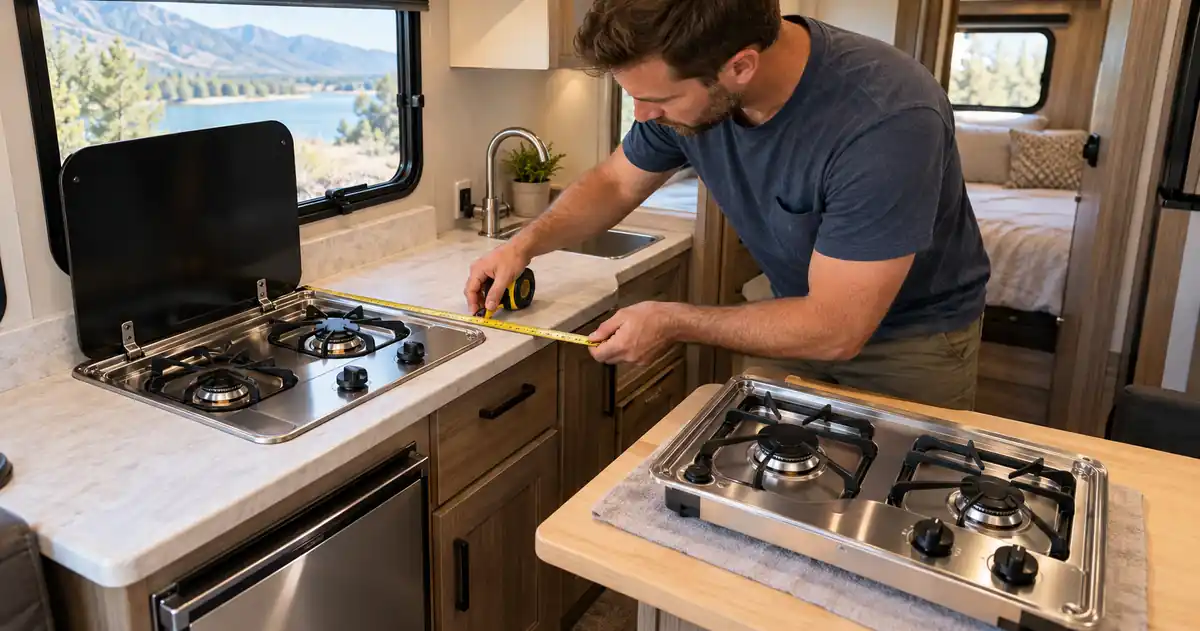
Camper Gas Stove: How to Choose a Compatible Replacement
A camper gas stove replacement should be chosen by installation compatibility first, not burner count or appearance. Before buying, identify the existing appliance, record the countertop opening and cabinet space, and compare those measurements with the replacement manufacturer’s instructions. You also need to confirm propane requirements, ignition, clearances, and whether a qualified RV technician can install and test the unit. This guide focuses on built-in RV cooktops, not portable camp stoves.
Table of Contents
Camper Gas Stove Replacement: Identify What You Have
A faulty camper gas stove does not always need complete replacement. Equally, a damaged or outdated unit may not be worth repairing if compatible parts are unavailable. Start by finding out exactly what is installed.
Find the Existing Model Number
Look for the model and serial information in the owner’s paperwork or at the rating-label location specified by the appliance manufacturer. Record the brand, model, fuel type, and installation documentation. If you cannot safely locate a label without moving the appliance or disturbing a gas connection, ask an RV service technician to identify it.
Cooktop Only or Full Range?
A drop-in RV cooktop provides burners without an oven. A full range combines a cooktop and oven and usually occupies a much larger cabinet opening. Some slide-in products also have different mounting and support arrangements from countertop-mounted models.
Is the Existing Unit Repairable?
A damaged knob, grate, or other manufacturer-supported component may be replaceable. Problems involving ignition, uneven flames, gas odor, repeated flameouts, or suspected leaks require qualified diagnosis, not experimental repairs.
Our guide to checking the RV’s propane and appliance systems explains where ordinary visual checks stop and professional evaluation becomes important. Do not attempt to repair or modify gas connections yourself.
Camper Gas Stove Cutout Dimensions and Cabinet Fit
The most common compatibility mistake is assuming that the advertised width of a camper gas stove matches the hole in the countertop. An appliance can look like the correct size and still require a different cutout, deeper cabinet, or larger clearance around combustible surfaces.
Measure the Existing Countertop Opening
The cutout is the opening into which the appliance fits. Record its side-to-side width and front-to-back depth, using inches to match many US product manuals. Also record the countertop thickness and the position of surrounding trim.
You may be able to find the original cutout specification in the existing appliance manual without removing anything. For concealed dimensions, arrange a qualified assessment rather than lifting a connected appliance to take measurements.
Check Overall Dimensions
The advertised product width and depth may include lips, trim, knobs, or a cover. They are not interchangeable with the installation opening.
For example, Suburban specifies a 16⅜ × 11⅝-inch cutout for its 3070ABK two-burner drop-in model. The 2938ABK three-burner model specifies 18¹⁵⁄₁₆ × 16⅛ inches. Those are materially different openings, despite the products sharing the same manufacturer and general design.
Confirm orientation from the installation diagram; do not assume that a published pair of dimensions corresponds to the direction you are measuring.
Check Available Space Below the Counter
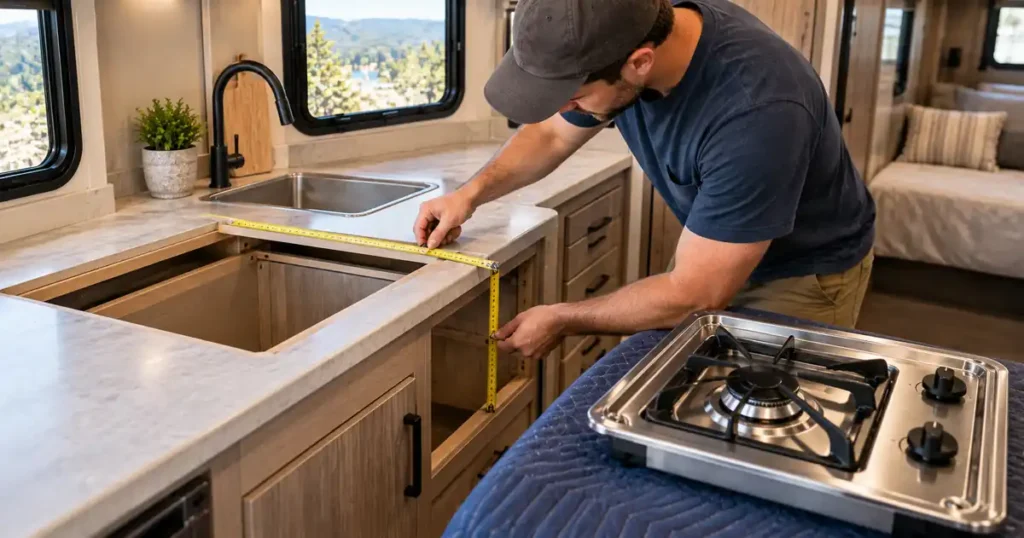
The burner box, controls, mounting hardware, and gas connection need room below and behind the visible cooking surface. Nearby drawers, plumbing, wiring, structural supports, or cabinet dividers may interfere even when the countertop opening looks suitable.
Ask the installer to assess both the cabinet and the appliance’s full installed footprint. Avoid ordering an oversized cooktop on the assumption that the opening can simply be enlarged.
Check Required Clearances and Mounting
A cooktop must have the clearances required by its exact installation instructions, including spacing from walls, cabinetry, overhead materials, and other combustible surfaces. Accessories such as a cover or splashguard may have their own instructions.
When shopping for a camper gas stove replacement, compare the manufacturer’s installation diagram with your actual kitchen—not with a different model’s manual or a retailer’s summary listing. Any cabinet alterations must be evaluated before purchase and performed safely by appropriate professionals.
Camper Gas Stove Compatibility: Propane, Ignition and Ventilation
Physical fit is only one part of camper gas stove compatibility. A replacement must also be approved for the intended RV installation and its fuel supply, electrical needs, mounting, and safety requirements.
Confirm the Approved Fuel and Gas System
Most US built-in RV gas cooktops in this comparison are intended for an appropriate low-pressure LP-gas system. That does not mean any propane appliance, fitting, regulator, or hose is interchangeable. Approved gas pressure, connection type, component placement, and system condition depend on the exact equipment and installation instructions.
Have a qualified RV gas technician confirm compatibility and perform installation and required testing. Never improvise adapters or use a portable stove’s cylinder-and-regulator arrangement as a substitute for a built-in appliance connection.
Manual, Piezo and Electronic Ignition
Suburban’s 3070ABK and 2938ABK specify match-light ignition. That is different from the push-button ignition used by some Furrion products. The Greystone by Furrion GGH12D2MA1B-BL also lists 12V DC, with illuminated controls and electronic features.
Before purchase, establish which functions need an electrical supply, where the controls will be accessible, and whether the camper already has an appropriate manufacturer-approved connection. Do not assume that replacing a match-light cooktop with an illuminated electronic model is a plug-and-play upgrade.
Flame-Failure Protection
Some models have a device intended to stop gas flow if the flame goes out. Furrion describes this as Flame Sense on its Greystone GGH12D2MA1B-BL. Its 20-inch FGH3Z25-BL three-burner cooktop also advertises a gas safety cut-off feature.
Other cooktops may not advertise the same protection. Verify the exact model, not just the brand, and do not treat a flame-sensing feature as a substitute for proper ventilation, safe operation, or functioning alarms.
Ventilation and Carbon Monoxide
Gas cooking produces combustion byproducts, and improper operation or ventilation can create dangerous carbon monoxide exposure. Follow the appliance instructions for ventilation and use the RV’s intended cooking ventilation system. Keep appropriate smoke, carbon monoxide, and LP-gas alarms functional and maintained as specified for the vehicle.
Never use a propane cooking appliance as a space heater. The CDC also warns against operating portable camping stoves inside a camper, tent, or other enclosed shelter. Opening a window does not convert an outdoor-only stove into an indoor-approved appliance.
Why Professional Installation Matters
Suburban expressly requires its gas appliances to be installed or serviced by a qualified technician. For other brands, follow the manufacturer’s installation requirements and applicable local rules. The professional should assess the mounting, cabinet, gas supply, electrical requirements if any, clearances, and required commissioning checks.
You can gather measurements, compare model documentation, and request estimates. Leave disconnection, gas-line work, connections, and leak or performance testing to qualified personnel. If you smell gas or suspect a leak, stop using the appliance, avoid ignition sources, follow your RV’s emergency instructions, and obtain professional help.
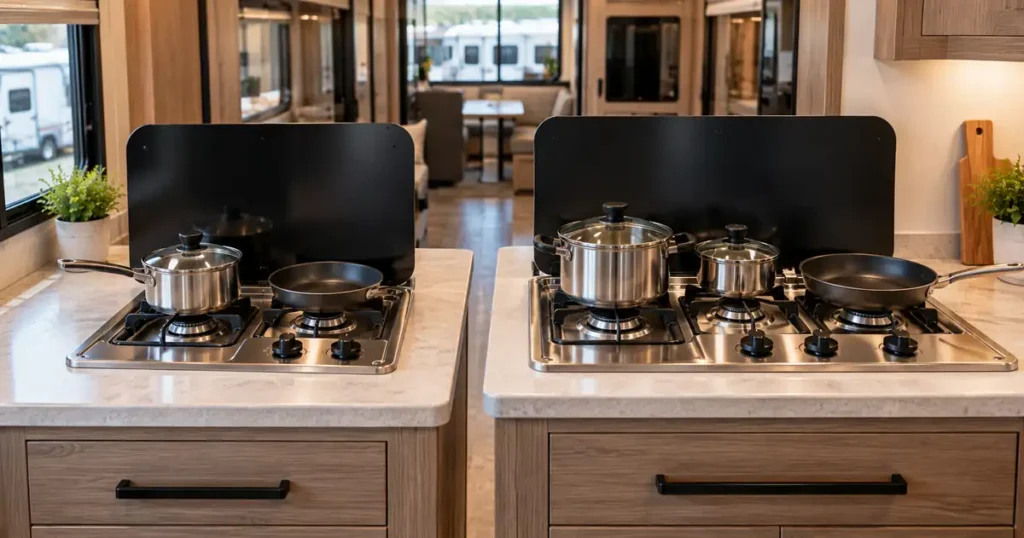
Two-Burner vs Three-Burner RV Cooktops
Once a replacement fits the kitchen and gas system, the number of burners becomes a practical cooking choice rather than the deciding factor.
When Two Burners Are Enough
A 2 burner RV cooktop often suits a small travel trailer or campervan where meals involve one saucepan and one skillet. It generally leaves more countertop or storage space and may simplify cleanup. For reheating, boiling water, and uncomplicated dinners, a third burner may offer little advantage.
Our guide to planning the rest of your camp kitchen helps match pans and utensils to real meals instead of buying equipment you rarely use.
When Three Burners Make Sense
A 3 burner RV cooktop may be useful when preparing separate dishes regularly or cooking for a larger group. Yet burner spacing is as important as burner count: three controls do not guarantee that three large pots fit comfortably at once.
A larger model may also require a different cutout, revised clearances, and more cabinet space. If those changes make installation costly or impractical, a compatible two-burner unit may be the better decision.
Burner Output and Pan Spacing
BTU/h describes burner heat-input rate, not a complete measure of cooking performance. Pan dimensions, burner spacing, grate stability, flame adjustment, and cookware affect everyday usefulness.
Compare the actual layout with your pots and pans. Check whether handles can stay clear of heat and whether burners can be adjusted comfortably. Do not let a high advertised total BTU figure override the appliance’s fit or required safety clearances.
Comparing Compatible Camper Propane Stove Options
The following camper gas stove examples are manufacturer-documented candidates, not universal drop-in replacements or products independently tested by Camping Trip Atlas. Dimensions and features were checked against manufacturer pages on October 11, 2026. A qualified installer must confirm suitability for the particular RV.
| Model | Burners and published input | Ignition and distinguishing feature | Published sizing information | Key limitation |
|---|---|---|---|---|
| Suburban 3070ABK | Two × 6,500 BTU/h | Match-light | Cutout: 16⅜ × 11⅝ in. | Verify clearances, burner box and gas connection |
| Suburban 2938ABK | One × 6,500 and two × 5,200 BTU/h | Match-light | Cutout: 18¹⁵⁄₁₆ × 16⅛ in. | Larger opening; not interchangeable with two-burner model |
| Greystone by Furrion GGH12D2MA1B-BL | Front 8,000, rear 6,500 BTU/h | Push-button ignition, Flame Sense, 12V DC specification | Overall: 11¾ W × 22¾ D × 4⅛ H in. | Get exact installation cutout and electrical details from manual |
| Furrion FGH3Z25-BL | Front 8,000 and two × 6,500 BTU/h | Push-button ignition, glass cover, advertised gas cut-off | Overall product dimensions listed separately from required cutout | Do not infer cutout from its “20-inch” marketing name |
Suburban Two-Burner Drop-In Cooktop
The 3070ABK makes sense as a candidate for an RV already designed for a small, similar Suburban drop-in cooktop. Its straightforward two-burner layout and match-light ignition avoid some electrical-feature complexity.
Its main disadvantage is limited cooking capacity, and the published cutout does not guarantee fit with another brand. Confirm the precise burner-box configuration, combustible clearances, and mounting requirements.
Suburban Three-Burner Drop-In Cooktop
The 2938ABK adds a third burner but requires a substantially larger published opening than the Suburban two-burner model. It is worth comparing when a larger compatible opening already exists or when an approved renovation is being professionally evaluated.
It is not an automatic upgrade simply because both appliances carry the Suburban name. Cabinet depth, clearances, connection configuration, and mounting still need verification.
Greystone by Furrion Two-Burner Cooktop
The GGH12D2MA1B-BL combines two differently rated burners with Flame Sense protection, a glass cover, cast-iron grates, and illuminated controls. This may appeal to RV owners who want more features in a two-burner format.
For a camper gas stove upgrade, the trade-off is installation complexity: its 12V specification and distinctive dimensions require careful review. The listed overall dimensions are not a verified countertop cutout. Obtain the exact manual and have the installer confirm the opening and required connections before ordering.
Furrion Three-Burner Alternatives
The FGH3Z25-BL is a standalone three-burner gas cooktop with a glass cover and the manufacturer’s stated safety cut-off feature. Although sold using a “20-inch” descriptor, its product page gives larger overall dimensions. A label such as “20-inch RV cooktop” is therefore insufficient for matching an existing kitchen.
Use the manufacturer’s model-specific installation drawing to determine the actual required opening. If that drawing or other critical dimensions are unavailable, treat the product as not yet confirmed compatible, rather than guessing.
RV Cooktop vs Range: Which Replacement Makes Sense?
For a camper gas stove, a cooktop-only replacement is the logical starting point when the existing cabinet has a shallow burner appliance and no oven. It preserves storage below the counter when the installation allows it and may reduce the scope of changes.
A full RV range combines stovetop burners with an oven. That can be attractive for travelers who bake regularly, but it introduces an oven cavity, additional heat-management considerations, cabinet alterations, and different installation specifications. Some ranges also need 12V DC power for features.
What Does a Camper Gas Stove Replacement Really Cost?
The purchase price is only part of a camper gas stove replacement budget. Current prices differ by model, seller, finish, and availability, and there is no reliable universal labor price for every RV kitchen.
Appliance Price
Compare the exact part or model number and what the price includes. A cover, trim kit, regulator-related component, or mounting accessory may be separate. Do not assume an unusually cheap listing includes everything needed for installation.
Qualified Installation
Ask an RV appliance service provider for a written quote based on your existing model, photos, cabinet opening, and the proposed replacement documentation. The price may change if cabinet work, electrical provisions, or other code-compliant modifications are necessary. Obtain that evaluation before purchasing a nonreturnable unit.
Returns, Warranty and Shipping
Check whether a seller accepts returns for incorrectly measured equipment, whether restocking or return-freight charges apply, and whether any installation or modification affects warranty coverage. Preserve the model documentation and order details until the replacement is commissioned successfully.
Common Camper Gas Stove Replacement Mistakes
Most expensive camper gas stove buying mistakes begin before installation. Avoid these assumptions:
- The outer width is the cutout. It may include trim, covers or controls.
- A three-burner model fits where a two-burner model did. Published cutouts can differ significantly.
- The cabinet is empty below the countertop. Drawers, supports and plumbing may obstruct the appliance.
- Any propane connection will work. Fuel pressure, fittings and installation requirements must match.
- Electronic ignition needs no extra planning. Some models also specify a 12V supply or illuminated controls.
- Every modern model has flame-failure protection. Confirm the actual product specification.
- A portable camp stove is an indoor RV replacement. The CDC warns against portable camping stove use inside campers.
- Gas installation is a routine DIY swap. Connection, verification and testing belong to qualified professionals.
If you are curious about comparing a portable outdoor propane stove, that separate category can serve an outdoor cooking setup. It should not be mounted into an RV countertop or used as a substitute for an approved indoor built-in unit.
Camper Gas Stove Buying Checklist
Use this camper gas stove checklist before placing an order:
- Record the existing appliance’s brand and exact model number.
- Confirm whether you need a cooktop or a full range.
- Find the existing and proposed manufacturer’s installation instructions.
- Compare the actual countertop cutout—not just overall width.
- Verify cabinet depth, support, mounting and combustible clearances.
- Ask a qualified installer to confirm fuel supply, gas connection and required testing.
- Verify ignition method, electrical needs and model-specific safety features.
- Check pan spacing, burner output and cooking capacity.
- Confirm included accessories, price, warranty, shipping and return terms.
- Obtain an installation quote and model approval before paying.
Frequently Asked Questions
Can you replace an RV gas stove with a different brand?
Potentially. A different brand may work when the exact appliance is approved for the RV installation and its cutout, cabinet support, clearances, propane requirements, and electrical needs are compatible. A matching nominal width is not enough. Have a qualified RV technician review the intended model and installation documentation before purchase.
How do you measure an RV stove cutout?
Measure the actual countertop opening side to side and front to back, and document countertop thickness and available cabinet space. Confirm these dimensions against the existing manufacturer’s manual. Do not disconnect or lift a gas-connected appliance solely to measure a hidden opening; arrange a qualified assessment where necessary.
Is a two-burner RV cooktop enough for a camper?
Often, yes. Two burners can handle many simple meals, particularly when you usually cook with one pot and one pan. A three-burner cooktop is useful only if you need another simultaneous cooking position, have enough pan space, and can accommodate the larger model without compromising safe installation.
Can you use a portable camping stove inside an RV?
No. Outdoor-only portable camping stoves must not be used inside RVs or other enclosed shelters. They are not interchangeable with appliances approved for permanent indoor RV installation. The CDC specifically warns that portable camp stoves can cause dangerous carbon monoxide buildup in enclosed spaces.
Should a professional install a replacement camper gas stove?
Yes. A camper gas stove connects to a fuel system and has model-specific mounting, clearance and possibly electrical requirements. Suburban explicitly directs qualified technicians to install and service its appliances. Have an appropriately qualified RV gas professional confirm compatibility, perform installation, and complete the required tests.
Conclusion
A camper gas stove is a good replacement only when it fits the actual countertop and cabinet, meets the RV’s approved fuel and installation requirements, and suits how you cook. Start with the existing model number and installation dimensions, then compare burner layouts and features. Before ordering, get confirmation from a qualified RV service professional and a clear quote for the complete job.
References
The technical specifications and installation requirements were verified using Suburban — Dual Burner Drop-In Cooktop, Suburban — Triple Burner Propane Drop-In Cooktop, and Suburban — Literature and Technical Documents.
Additional product specifications, burner configurations, ignition systems, and safety features were checked through Furrion — Greystone 12-Inch Two-Burner Gas RV Cooktop with Flame Sense and Furrion — Three-Burner Gas RV Cooktop with Glass Cover.
Carbon monoxide safety information was based on the Centers for Disease Control and Prevention — Carbon Monoxide Poisoning Basics and CDC — What to Do to Protect Yourself During a Power Outage.