
Custom Camper Mattress: Measure Corners, Choose Thickness and Check Order Terms
A custom camper mattress can solve a frustrating problem: your RV bed has unusual dimensions, angled corners, or a folding platform that standard mattresses cannot fit. But ordering the wrong shape or thickness can be expensive, especially when custom purchases cannot be returned.
Before buying, measure the actual bed platform, document every corner modification, check vertical clearance, and compare manufacturer return policies. This guide walks through the measurements and decisions that matter so you can order a replacement that fits your camper and sleeping needs.
Table of Contents
Custom Camper Mattress: Do You Actually Need One?
Not every worn RV mattress needs a made-to-measure replacement. Start by checking whether your sleeping platform matches an available standard size.
When a Standard RV Mattress May Fit
RV mattress labels are useful starting points, but they are not universally consistent.
For example, manufacturers may list RV queen dimensions of 60 × 74 inches (152 × 188 cm), while a residential queen is commonly 60 × 80 inches (152 × 203 cm). Some suppliers offer additional short-queen variations.
A mattress with the right label can still be too long, too wide, or the wrong shape.
If your platform is rectangular and matches a manufacturer’s published dimensions, a standard replacement may be easier to order and return. Measure before making that decision.
When Custom Sizing Makes Sense
A custom camper mattress becomes useful when the sleeping platform has features that standard products cannot accommodate.
Common examples include:
- Angled corners beside narrow walkways.
- Rounded corners near the foot of the bed.
- Notches around cabinetry or wheel wells.
- Unusual width or length.
- Tapered sides.
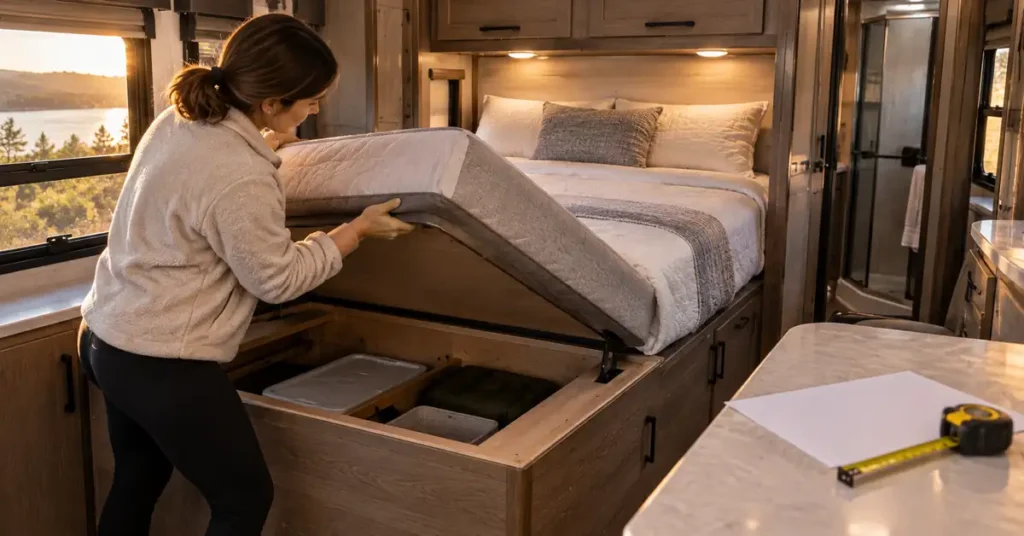
- Hinged sections for under-bed storage.
- Folding Murphy-bed platforms.
- Slide-out arrangements requiring special clearance.
Custom sizing allows you to specify the actual shape rather than forcing a standard rectangle into an unsuitable space.
Replacement Mattress vs. Topper
If your current mattress fits correctly, remains supportive, and simply feels somewhat firm, a topper may improve surface comfort.
However, a topper cannot reliably correct serious sagging, damaged foam, broken support components, or the wrong mattress shape.
When the underlying mattress is worn or physically incompatible with the camper, replacing it makes more sense than adding another layer.
Custom Camper Mattress Measurements: Start With the Platform
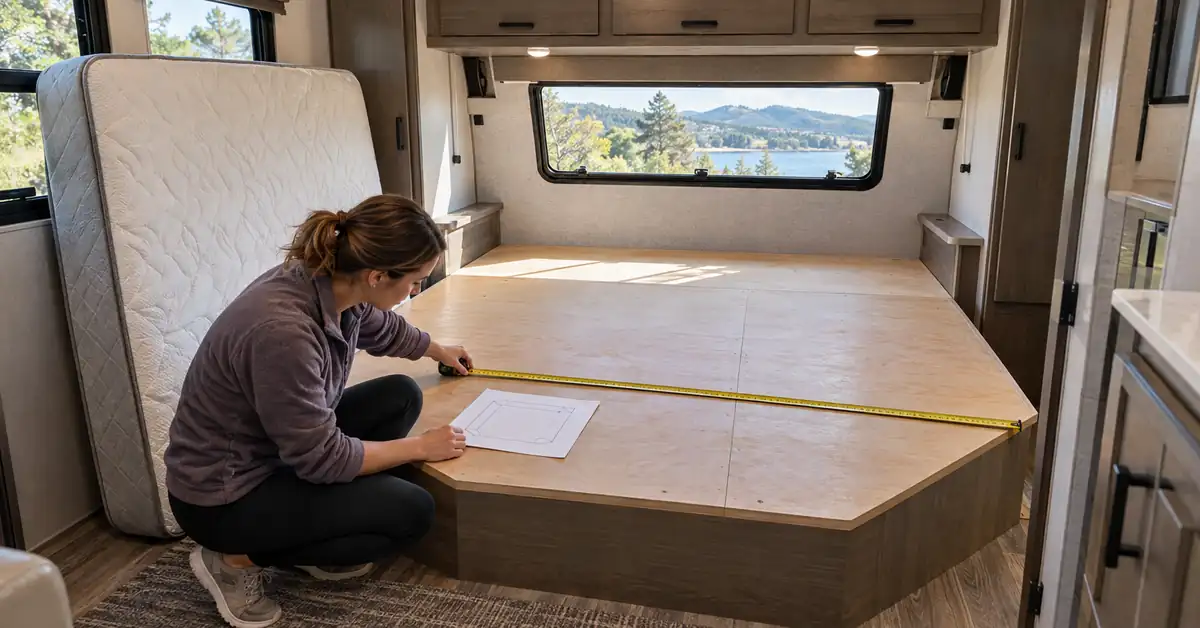
The most important step in ordering a custom camper mattress is measuring the bed platform rather than trusting the old mattress.
Foam can compress, covers can change shape, and an older mattress may no longer reflect its original dimensions.
Remove the mattress completely, inspect the platform, and record measurements before contacting a manufacturer.
Measure Width and Length
Measure the full sleeping platform from side to side and from the head to the foot.
Record:
- Maximum width.
- Minimum width, if the sides are uneven.
- Overall length.
- Any restricted sections near walls.
- Whether the platform is completely rectangular.
Use a rigid tape measure where practical, and record dimensions in inches. Measure twice before finalizing your notes.
Do not automatically subtract a fixed amount from the platform dimensions. Some manufacturers recommend a small allowance for tight wall-to-wall installations, but that allowance depends on the construction and manufacturer specifications.
Measure Tight Spaces and Wall-to-Wall Beds
If your mattress sits between two walls, measure the opening at several points.
A camper bedroom may appear square while its wall panels, trim, or cabinetry create slightly different widths.
Ask the mattress manufacturer what finished-size allowance it recommends.
A mattress that is too wide may be difficult to position, while a mattress that is unnecessarily narrow can create an uncomfortable gap.
Identify the Head and Foot
Before documenting corners, label the platform:
HEAD — FOOT — LEFT — RIGHT
Choose one viewing direction and use it consistently. For example, you can define left and right while standing at the foot of the bed facing the head.
Tell the manufacturer which direction you used, since some ordering diagrams use the opposite orientation.
Photographs and a simple overhead sketch can prevent confusion.
Check for Tapered or Uneven Sides
Not every camper bed maintains the same width from head to foot.
Measure the width at multiple positions if the platform narrows near the feet, follows a curved wall, or has irregular sides.
If the shape is complicated, ask whether the manufacturer requires a full-size template.
While the mattress is removed, inspect the platform for staining, dampness, or deterioration. Our guide to checking the camper for hidden water damage explains other places where moisture problems may appear.
Resolve significant moisture or structural problems before covering the platform with a new mattress.
How to Measure Cut Corners and Unusual RV Mattress Shapes
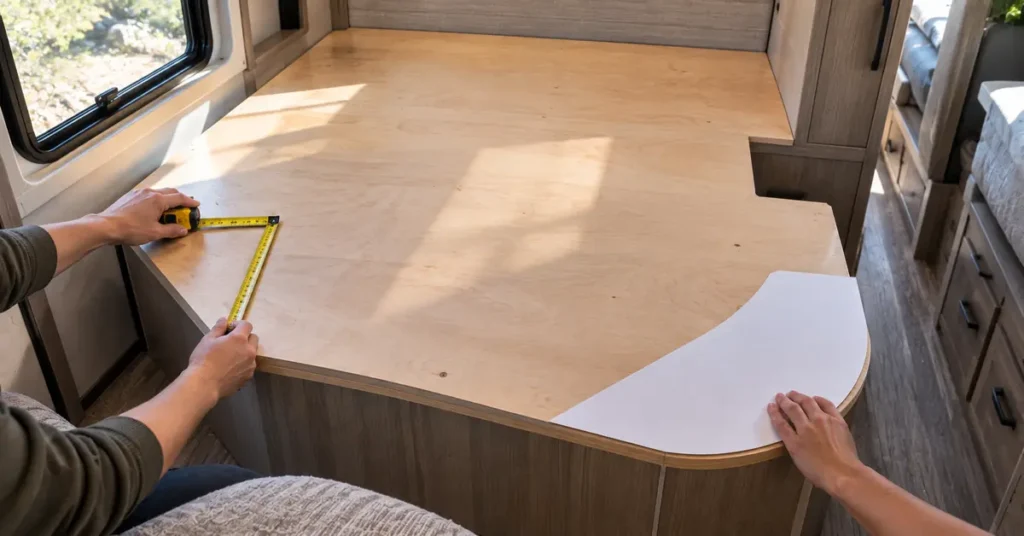
A made-to-measure camper mattress requires more than its maximum width and length when the platform has modified corners.
Manufacturers commonly distinguish angled corners, radius corners, and notches. Each requires different measurements.
Angled Corners
An angled corner has a straight diagonal cut replacing part of a square corner.
To document it:
- Identify the original square corner position.
- Measure how far the diagonal cut begins along the width.
- Measure how far it begins along the length.
- Record both distances.
- Label which corner is modified.
For example, a cut that extends 8 inches along one edge and 10 inches along the other is not necessarily interchangeable with a cut measuring 10 inches in both directions.
Never assume all diagonal cuts use a 45-degree angle.
Radius Corners
A radius corner has a smooth curve instead of a straight diagonal cut.
Some custom mattress builders ask for the radius, while others use horizontal and vertical measurements or a traced template.
Do not guess the radius by looking at the old mattress.
Use the manufacturer’s measurement method. For unusual curves, tracing the platform corner onto paper or cardboard may provide a more reliable record than estimating a single radius.
Notched Corners
A notch is a rectangular or otherwise defined cutout, often used to accommodate a cabinet, structural post, or other fixed obstruction.
Measure the notch’s width, depth, and position.
A notch that is correctly sized but placed on the wrong side can make the entire mattress unusable.
If the notch is not rectangular, send a detailed diagram instead of entering approximate values into a standard builder.
Avoid Left and Right Orientation Mistakes
Orientation errors are among the easiest ways to order the wrong custom camper mattress.
Your sketch should show the head, foot, left and right sides, and the position of every modified corner.
For example, a top-left angle in one manufacturer’s ordering tool might not correspond to what you call the left corner when standing at the foot of your camper bed.
Confirm the viewing direction used by the manufacturer’s software before submitting the order.
When to Send a Full-Size Template
A template is especially useful for:
- Irregular curves.
- Multiple angled corners.
- Complicated notches.
- Tapered platforms.
- Asymmetrical beds.
- Shapes that do not match the online customization options.
Ask the manufacturer whether it accepts a drawing, photographs, or a physical template.
Do not assume a sketch alone is sufficient for production.
Custom Camper Mattress Thickness: How Much Is Enough?
The ideal custom camper mattress thickness depends on available vertical space, sleeping preferences, mattress construction, and how the bed platform operates.
A thicker mattress is not automatically more comfortable or more suitable for an RV.
Measure Vertical Clearance
Before ordering, check the space above the platform.
Look for:
- Overhead cabinets.
- Windows.
- Reading lights.
- Wall fixtures.
- Low ceilings.
- Shelves.
- Nearby doors or access panels.
A mattress that is several inches thicker than the original can reduce sitting headroom or interfere with nearby fixtures.
Match Thickness to the Bed Platform
A custom RV mattress may be available in different thicknesses depending on the manufacturer.
For example, Tochta currently advertises custom thicknesses generally ranging from 4 to 10 inches. Wilderness RV Mattress offers designs including a 6-inch bunk mattress, an 8-inch foam mattress, and thicker foam or hybrid models.
These are product options, not universal recommendations.
Choose thickness based on the actual construction, manufacturer support requirements, clearance, and your comfort preferences.
A suitable 6-inch mattress may be more practical for a low-clearance bunk than a thick hybrid mattress, while a larger RV bedroom may accommodate a deeper construction.
Check Murphy Beds and Folding Platforms
For a Murphy bed or folding platform, mattress thickness affects whether the mechanism closes properly.
Measure the available space in both the sleeping and stored positions.
A mattress that fits when flat may interfere with cabinets or hinges when folded.
If the platform requires an integrated mattress hinge, confirm the exact fold location and whether the chosen construction supports it.
Mattress Weight and Storage Lifts
Weight also matters.
A heavier mattress may make under-bed storage harder to access or exceed the intended capacity of a lifting mechanism.
Ask the manufacturer for the approximate finished weight of your specific size and construction.
For campers used regularly, choosing a mattress that balances comfort with manageable weight can make daily use easier.
Foam, Memory Foam, Latex and Hybrid Custom Mattresses
Once dimensions are confirmed, compare mattress construction.
A custom camper mattress should provide the support and feel you prefer without compromising the space or operation of your RV bed.
High-Density Foam
All-foam constructions can provide a relatively straightforward option for unusual shapes.
Density, firmness, thickness, and layer design affect the overall feel.
Do not assume that the words high density automatically establish comfort or durability. Review the actual construction and support requirements.
Memory Foam
Memory foam responds to body weight and heat, often creating a more contouring surface.
Some people appreciate this feel, particularly when sleeping on their side. Others prefer a faster-responding mattress.
Different memory foam formulations also vary in warmth and firmness.
Latex
Latex generally has a more responsive feel than traditional memory foam.
It may appeal to sleepers who prefer less of a sinking sensation.
However, latex constructions can be relatively heavy, and not every custom RV manufacturer offers the same latex options.
Check available materials, weight, and care instructions for the actual model.
Hybrid Mattresses
Hybrid designs combine foam comfort layers with a coil support system.
They can provide a different balance of support and cushioning, but may be thicker and heavier than some all-foam alternatives.
Not every hybrid can accommodate every hinge, shape, or extreme thickness restriction.
Confirm those modifications with the manufacturer before ordering.
Firmness and Sleep Preferences
There is no single correct firmness for all RV travelers.
Consider your usual sleeping position, how the existing mattress feels, whether you share the bed, and how often you use the camper.
If you are preparing your RV for longer stays, a suitable sleeping setup becomes particularly important because you will use it every night rather than occasionally.
Avoid choosing a mattress based entirely on promotional comfort claims.
Split Camper Mattress and Hinged Mattress Options
A split camper mattress and a hinged mattress solve different problems.
One-Piece Mattresses
A one-piece mattress is the simplest option when the platform is fixed and accessible.
It avoids the separation between sections but may be difficult to maneuver through narrow camper interiors.
Two-Piece Mattresses
A two-piece design can help when the bed uses separate platforms or when access is restricted.
However, the sections may move independently and create a noticeable joint.
Ask how the sections are secured and whether each piece can be used with the intended platform.
Hinged Mattresses
A hinged design allows part of the mattress to fold while remaining connected.
This can help with under-bed storage, Murphy beds, and certain slide-out arrangements.
Manufacturers use different hinge constructions. Tochta describes an integrated design with padding extending across the fold, while Wilderness RV Mattress offers horizontal and vertical hinge choices in its custom builder.
These designs should not be assumed to work identically.
Measuring the Hinge Position
Identify the exact line where the mattress must fold.
Measure from the reference edge specified by the manufacturer—often the foot for a horizontal hinge.
For a vertical hinge, the manufacturer may require a measurement from one side.
If the platform changes height across the fold, document that difference.
Before ordering a custom camper mattress with a hinge, request confirmation that its thickness and fold arrangement work with the actual mechanism.
Will Your Custom Camper Mattress Fit Through the Door?
A mattress can fit the bed perfectly and still be difficult to get inside the camper.
Doorway and Interior Clearance
Measure the RV entry door and any narrow hallways or turns leading to the bedroom.
Check whether the mattress must pass around kitchen cabinets, through a sliding door, or up a raised sleeping platform.
Compressed vs. Full-Size Delivery
Some manufacturers ship foam mattresses compressed and rolled inside boxes.
Tochta and Mattress Insider describe compressed shipping for relevant foam products. Wilderness RV Mattress also describes boxed delivery for its custom models.
This can simplify entry, but confirm the packaging dimensions and whether the specific mattress can be safely unpacked in place.
Not every mattress construction is shipped the same way.
Expansion and Manufacturing Tolerances
Foam products may not measure exactly the same at every stage of expansion or use.
Wilderness RV Mattress currently advises that finished mattresses can vary by approximately plus or minus 1 inch because of material expansion and contraction.
That is important when the bed is tightly surrounded by walls or cabinetry.
Ask each manufacturer about its own measurement tolerance rather than assuming every custom mattress will fit with zero variation.
Bedding, Protection and Moisture
An unusual mattress shape may also require custom fitted sheets or protectors.
Consider moisture beneath the mattress, especially on solid platforms with limited airflow.
Inspect and dry the space regularly, improve ventilation where appropriate, and consider compatible under-mattress ventilation products.
No accessory can guarantee that condensation or mold will never occur.
Comparing Custom Camper Mattress Manufacturers
The following comparison is based on published manufacturer information, not independent product testing.
Policies and options were reviewed on October 11, 2026.
| Manufacturer | Customization | Construction options | Important order-policy detail |
|---|---|---|---|
| Tochta | Custom dimensions, unusual corners, hinge options | Multiple foam-based designs | 100-night trial covers custom sizes, but incorrect customer-ordered sizes or shapes are excluded |
| Mattress Insider | Custom dimensions, angled and radius corners, unusual shapes | Foam, memory foam and latex options | Custom orders cannot be returned, canceled or modified once production starts |
| Wilderness RV Mattress | Rounded, angled and notched corners; horizontal and vertical hinges | All-foam and hybrid options | Custom products are excluded from the 100-night trial; custom orders are not eligible for cancellation or return once production begins |
Tochta
Tochta offers extensive customization through its sizing tools and customer support.
Its most distinctive purchasing consideration is the return policy. The published 100-night sleep trial includes custom-sized mattresses, but it does not cover orders placed with incorrect dimensions or shapes.
A customer must also follow the applicable trial procedures, including minimum-use and return authorization conditions.
For buyers who want a custom mattress but value an eligible comfort trial, Tochta may be worth comparing—provided the measurements are correct.
Mattress Insider
Mattress Insider supports cut corners, radius corners, unusual dimensions, and specialized shapes.
Its guidance recommends measuring the platform and notes that complex shapes may require a diagram or template.
The important limitation is financial: once production begins, a custom mattress is not eligible for ordinary returns, cancellation, or modification.
This makes written confirmation of dimensions particularly valuable.
Wilderness RV Mattress
Wilderness RV Mattress provides a custom builder with several corner styles, hinge arrangements, and mattress constructions.
Its published return policy excludes custom-built products from the general 100-night sleep trial.
The company also states that incorrect customer measurements are the buyer’s responsibility and warns about finished-size variation.
Buyers should confirm both the design and the applicable custom-order terms before payment.
Custom Camper Mattress Return Policy: What to Check
A custom camper mattress return policy can matter just as much as the mattress itself.
A sleep trial, a cancellation policy, and a manufacturing-defect warranty are different protections.
Sleep Trials vs. Custom-Order Returns
Some manufacturers advertise sleep trials prominently across their websites.
That does not mean the same trial applies to every customized product.
Tochta currently extends its sleep trial to eligible custom-sized mattresses, subject to exclusions.
Mattress Insider and Wilderness RV Mattress place stricter limits on customized purchases.
Always read the policy applying to your exact order.
What Happens if You Measure Incorrectly?
A manufacturer generally cannot be expected to know the measurements of your camper platform unless those details were supplied and confirmed.
If you order the wrong shape, the resulting mattress may be manufactured exactly as requested but still be unsuitable.
Tochta offers a process for discussing an incorrectly sized mattress, potentially involving additional costs and shipping.
That is not the same as a standard refund.
Can You Cancel After Production Begins?
Production status can change what options remain available.
Tochta’s current FAQ describes a short cancellation window before production.
Mattress Insider states that custom orders cannot be canceled or modified once manufacturing begins.
Wilderness RV Mattress also excludes custom orders from cancellation after production starts.
Do not assume you can change a hinge or corner measurement after submitting the order.
What Does the Warranty Actually Cover?
A warranty is not necessarily a comfort guarantee.
Ask which manufacturing defects are covered, whether specific materials or components have exclusions, what documentation is required, and who pays any shipping costs.
A mattress that feels too firm may not qualify as defective.
Likewise, an incorrect customer-supplied dimension may fall outside warranty coverage.
Shipping, Collection and Refund Costs
Before paying, check whether:
- Delivery is included.
- Remote areas have extra charges.
- A return requires authorization.
- The mattress must be donated or shipped.
- Return shipping is the customer’s responsibility.
- Restocking or modification fees apply.
- Original delivery charges are refundable.
Save the policy applicable at the time of your order and request written clarification when terms are unclear.
How to Order a Custom Camper Mattress Without Guesswork
Use this process before purchasing a made to measure camper mattress:
- Remove the existing mattress and inspect the platform.
- Measure full width and length.
- Record any taper or wall-to-wall restrictions.
- Sketch every angled, rounded, or notched corner.
- Label head, foot, left and right.
- Measure thickness clearance and any required fold.
- Confirm finished mattress weight and doorway access.
- Compare suitable mattress constructions.
- Check available customization options with the manufacturer.
- Read the exact return, cancellation, tolerance, and warranty terms.
- Send the manufacturer your measurements, photos, and drawing.
- Obtain written confirmation of the finished specification before paying.
Keep a copy of the final approved drawing and order confirmation.
For an unusual RV bed, a manufacturer-reviewed specification can be more valuable than choosing the cheapest available foam construction.
Common Custom Camper Mattress Ordering Mistakes
The most avoidable custom camper mattress mistakes include:
- Trusting the RV manufacturer’s original mattress-size label.
- Measuring only the worn mattress instead of the platform.
- Recording the maximum width but missing a tapered section.
- Reversing the left and right corner positions.
- Confusing an angled cut with a radius corner.
- Ordering a mattress that is too thick for overhead cabinets.
- Forgetting a Murphy-bed fold or under-bed storage lift.
- Ignoring the finished weight.
- Failing to measure the camper entry route.
- Assuming every online sleep trial covers custom products.
- Overlooking the manufacturer’s finished-size tolerance.
- Paying before the final dimensions are confirmed.
Each mistake can turn an otherwise suitable replacement into an expensive problem.
Custom Camper Mattress Buying Checklist
Before submitting a custom camper mattress order, confirm the following:
- Platform: Exact width, length, and irregularities.
- Corners: Shape, measurements, and orientation.
- Hinges: Type, location, and any platform-height difference.
- Thickness: Suitable for comfort and available clearance.
- Construction: Materials and support requirements.
- Weight: Suitable for the RV platform and lifting hardware.
- Access: Compatible with entry doors and interior turns.
- Delivery: Packaging method and expansion requirements.
- Tolerance: Acceptable finished-dimension variation.
- Returns: Custom-order eligibility and exclusions.
- Warranty: Coverage and claim procedures.
- Confirmation: Written specification reviewed before production.
Frequently Asked Questions
Can you order a custom camper mattress with cut corners?
Yes. Manufacturers such as Tochta, Mattress Insider, and Wilderness RV Mattress offer customization for certain angled, rounded, or notched corners. The available options and measurement methods differ. Provide an accurate diagram and follow the manufacturer’s instructions rather than assuming all custom mattress builders use identical measurements.
How do you measure rounded corners on an RV mattress?
Remove the old mattress and examine the platform corner. Use the measurement method requested by the manufacturer, which may involve a radius, horizontal and vertical distances, or a physical template. Clearly mark the corner’s position and the head and foot orientation before submitting the dimensions.
What thickness should a custom camper mattress be?
Choose a thickness that provides an appropriate construction while preserving headroom, cabinet clearance, access to storage, and any folding mechanism. Manufacturers offer different profiles, including thinner bunk mattresses and thicker foam or hybrid options. There is no universal thickness that suits every camper.
Can you order a split or hinged camper mattress?
Yes. Some manufacturers offer separate mattress sections or integrated hinges for Murphy beds, storage access, and folding platforms. These designs work differently. Confirm the hinge direction, exact fold location, thickness, and platform operation before ordering.
Are custom RV mattresses returnable?
It depends on the manufacturer and reason for return. Tochta currently includes eligible custom sizes in its 100-night trial but excludes incorrect customer-ordered dimensions or shapes. Mattress Insider and Wilderness RV Mattress restrict returns once custom production begins. Check the specific policy and obtain clarification before paying.
Conclusion
A custom camper mattress is worth considering when a standard replacement cannot match your RV’s sleeping platform, but successful ordering depends on more than choosing comfortable foam.
Measure the platform, document unusual corners, verify thickness and hinge requirements, and check delivery access. Most importantly, review the manufacturer’s custom-order return policy and obtain written confirmation of the finished dimensions before production begins.
References
The measurement methods, RV sizing details, and customization options were verified using Tochta — Frequently Asked Questions and Custom Mattress Measurements, Mattress Insider — Custom Foam Mattress and Measuring Guide, Wilderness RV Mattress — RV Mattress Size Guide, and Wilderness RV Mattress — Custom Mattress Builder.
Return policies, sleep-trial exclusions, cancellation conditions, and customer measurement responsibilities were checked directly through Tochta — 100 Night Trial Return Policy, Mattress Insider — Custom Mattress Ordering and Return Restrictions, and Wilderness RV Mattress — Return and Refund Policy.